


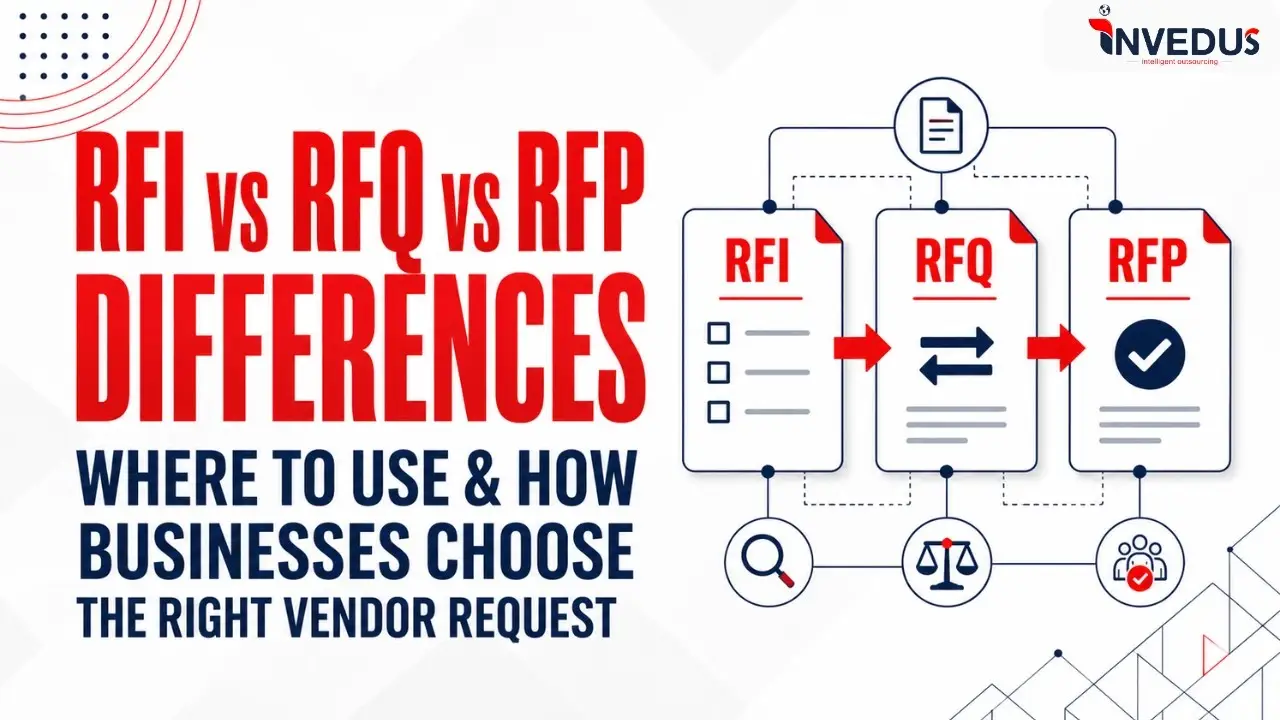
RFI vs RFP vs RFQ: Understand the Differences, Strategic Uses, & Sending the Right Vendor Request

Authored By: Juhi
Juhi is an experienced content creator with a deep understanding of audience engagement and brand...

Fact-checked By: Kush Saxena
Kush, a skilled professional in business development and relationship management at Invedus, has been helping...
Key Takeaways!
- Misunderstanding procurement requests like RFI, RFP, and RFQ leads to confusion, delays, and poor vendor decisions.
- RFI, RFP, and RFQ serve different stages, market discovery, solution evaluation, and pricing comparison, making their correct usage critical for effective procurement.
- A structured vendor selection using an RFP process enables businesses to evaluate capability, scalability, and long-term value beyond just cost considerations.
- Choosing the right document at the right stage improves procurement efficiency, reduces risk, and ensures scalable, well-informed vendor selection decisions.
- Invedus helps businesses streamline procurement by creating effective RFPs, RFIs, and RFQs, ensuring better vendor selection with clarity, accountability, and delivery confidence.
“Choosing the wrong procurement request often costs more than choosing the wrong vendor.”
Many businesses hear terms like RFI vs RFP vs RFQ but aren’t clear on when to use each, leading to confusion and poor vendor choices. The difference between RFI RFP and RFQ is strategic; RFI explores options, RFP evaluates solutions, and RFQ focuses on pricing.
- RFI (Request for Information)
- RFP ((Request for Proposal)
- RFQ (Request for Quotation)
Research shows companies shortlist 15–20 vendors but seriously assess only 5–7, while RFPs drive up to 39% of revenue with 40–45% win rates. This highlights the importance of a structured vendor selection process using RFP, where decisions go beyond cost to capability and long-term value. Using the right approach at the right stage ensures better, more scalable procurement outcomes.
In this guide, we will break down RFI vs RFP vs RFQ in a way that actually makes sense. When to use each, where most companies go wrong, and how to choose the right approach for better vendor decisions.
RFI, RFP, and RFQ Explained
RFI, RFQ, and RFP are key tools used at different stages of the procurement process. Each serves a distinct purpose in vendor selection. An RFI (Request for Information) is the starting point, used to gather general insights about suppliers, capabilities, and available solutions when requirements are still unclear. It helps businesses understand the market and filter potential vendors early.
An RFP (Request for Proposal) is more detailed and is used when requirements are defined, but solutions may vary. It invites vendors to submit comprehensive proposals, including methodology, timelines, and pricing, enabling organizations to evaluate overall value (not just cost).
An RFQ (Request for Quotation) is used when specifications are fixed, focusing mainly on pricing and delivery terms.
These documents are critical, as structured RFP processes show an average 45% win rate, highlighting their impact on successful vendor selection.
What is RFI (Request for Information)?
A Request for Information (RFI) is an early-stage procurement document used to collect broad insights about vendors, services, and available solutions. It is typically used when a business does not yet have clearly defined requirements and wants to understand the market before moving toward a detailed evaluation.
Instead of focusing on pricing or final selection, an RFI helps organizations explore capabilities, identify potential vendors, and build a strong foundation for the next steps, like RFP or RFQ.
Key Characteristics of an RFI
- Exploratory and Information-Focused
An RFI is designed to gather general information rather than make decisions. It allows businesses to understand what solutions exist, how vendors operate, and what approaches are available in the market. - Open-Ended and Flexible Structure
Unlike RFPs or RFQs, RFIs include open-ended questions that encourage vendors to share detailed insights about their capabilities, experience, and innovative approaches. - Wide Vendor Outreach
RFIs are usually sent to a large pool of vendors to capture diverse perspectives. This broad outreach ensures that companies do not limit themselves early and can explore multiple potential partners before shortlisting. - No Pricing or Detailed Proposals Required
Since the goal is information gathering, RFIs do not typically request pricing or detailed execution plans. This keeps the process simple and encourages more vendors to respond.
Benefits of Using an RFI
- Better Market Understanding
RFIs provide valuable insights into current trends, technologies, and vendor capabilities. - Efficient Vendor Shortlisting
By collecting and comparing responses, organizations can quickly identify the most relevant vendors and eliminate those that do not meet their needs. - Improved Requirement Clarity
The information gathered through RFIs helps businesses refine their needs and expectations, making future documents like RFPs more precise and effective. - Reduced Risk in Decision-Making
Early-stage insights minimize the chances of choosing the wrong vendor or solution, ensuring a more strategic and confident procurement approach.
Common Use Cases
RFIs are commonly used when businesses are entering a new market, adopting unfamiliar technology, or planning large-scale projects where requirements are still evolving.
They are especially useful for organizations that want to explore multiple solution approaches before committing to a specific direction.
Companies also use RFIs to shortlist vendors for upcoming RFPs, evaluate innovative service providers, or gain a deeper understanding of industry capabilities before making strategic procurement decisions.
What is RFP (Request for Proposal)?
A Request for Proposal (RFP) is a formal document used by organizations to invite vendors to submit detailed proposals for a specific project, product, or service. It clearly outlines business requirements, scope, timelines, and evaluation criteria, allowing vendors to present tailored solutions, not just pricing.
RFPs are typically used when the project is complex and requires expertise, innovation, or customized approaches. Instead of simply asking “how much it costs,” an RFP asks vendors how they will solve the problem. This makes it a critical step in strategic procurement and vendor selection.
Key Characteristics of an RFP
- Detailed and Structured Document
An RFP provides complete project information, including scope, objectives, timelines, and evaluation criteria. This ensures vendors clearly understand expectations and can respond accurately. - Focus on Solutions, Not Just Pricing
Vendors are required to submit comprehensive proposals covering methodology, approach, expertise, and value – allowing businesses to evaluate beyond cost. - Standardized Vendor Comparison
All vendors respond in a structured format, making it easier to compare proposals fairly and objectively based on defined criteria. - Used for Complex Projects
RFPs are commonly issued when projects require specialized skills, multiple stakeholders, or long-term partnerships.
Benefits of Using an RFP
- Better Vendor Selection
RFPs enable organizations to evaluate vendors on multiple factors such as capability, experience, and scalability, not just price, leading to more informed decisions. - Encourages Competitive Bidding
By inviting multiple vendors, RFPs create a competitive environment that often results in better quality solutions and pricing. - Improves Transparency and Fairness
A structured RFP process ensures all vendors are evaluated using the same criteria, reducing bias and improving accountability. - Saves Time in Evaluation
Since all responses follow a consistent format, businesses can quickly compare strengths, weaknesses, and overall value of each vendor.
Common Use Cases
RFPs are commonly used when businesses need complex solutions such as IT system implementation, outsourcing services, infrastructure projects, or long-term vendor partnerships. They are especially valuable when requirements are defined, but the approach may vary across vendors. Organizations also use RFPs after an RFI stage to shortlist qualified vendors and conduct a deeper evaluation before final selection.
Also Read: RFP Vendor Selection Process
What is RFQ (Request for Quotation)?
A Request for Quotation (RFQ) is a formal procurement document used by businesses to request price quotes and commercial terms from vendors for clearly defined products or services. It is typically used in the later stages of procurement when requirements, specifications, and quantities are already finalized. Here, the main goal is to compare pricing and select the most cost-effective supplier.
Key Characteristics of an RFQ
- Price-Focused Evaluation
The primary purpose of an RFQ is to collect and compare pricing from multiple vendors. Since requirements are already fixed, the decision is largely based on cost, delivery terms, and commercial conditions rather than creative solutions. - Clearly Defined Requirements
RFQs include detailed specifications such as product features, quantity, delivery timelines, and payment terms. This ensures all vendors quote for the same requirements, making comparisons accurate and fair. - Sent to Pre-Qualified Vendors
RFQs are usually shared with a selected group of trusted or shortlisted suppliers, which helps streamline the process and ensure relevant responses. - Standardized and Structured Format
The format of an RFQ is straightforward and structured, focusing on measurable factors like pricing, lead time, and compliance details, rather than open-ended responses.
Benefits of Using an RFQ
- Faster Procurement Process
Since RFQs focus on pricing for predefined needs, they reduce the time required to evaluate vendors and make decisions quickly. - Cost Transparency and Comparison
Businesses can easily compare multiple quotes side by side, ensuring they select the most competitive and cost-effective option. - Improved Decision Accuracy
With standardized requirements and comparable bids, organizations can make objective, data-driven decisions without ambiguity. - Efficient Vendor Selection for Standard Purchases
RFQs are ideal for recurring or standardized purchases where consistency and pricing matter more than innovation.
Common Use Cases
RFQs are commonly used when businesses already know exactly what they need and want to compare vendor pricing quickly. They are ideal for purchasing standardized goods such as office supplies, equipment, or raw materials, where specifications are fixed, and vendors are expected to deliver similar outputs.
RFQs are also widely used in bulk procurement, recurring purchases, and supply chain operations. Additionally, organizations use RFQs after completing an RFI or RFP process, when vendors have already been evaluated.
What is the Difference Between RFI RFP and RFQ?
RFP vs RFI vs RFQ differences in procurement (collectively known as RFx) represent different stages of the vendor selection process. These are also points that can help you choose the right proposal for the right vendor.
| Criteria | RFI (Request for Information) | RFQ (Request for Quotation) | RFP (Request for Proposal) |
| Primary purpose | Market discovery and capability mapping | Price comparison for defined needs | Full solution and vendor evaluation |
| Best used when | You don’t yet know what’s possible | You know exactly what you want | You know the outcome, not the method |
| Typical users | Founders, strategy, early procurement teams | Procurement, ops, finance | Leadership, cross-functional teams |
| Decision stage | Early research | Mid-stage selection | High-impact final selection |
| Pricing focus | None | Primary decision factor | Secondary to value and fit |
| Vendor response depth | High-level information | Structured pricing + terms | Detailed plans, methodology, pricing |
| Time investment (buyer) | Low | Medium | High |
| Typical sourcing cycle | ~7–10 days | ~5–7 days | ~20–30 days |
| Vendor effort required | Low | Medium | High (avg. ~24 hours per response) |
| Risk of misuse | Expecting quotes or commitments | Using for services or complex work | Overengineering simple purchases |
| Solution flexibility | High (exploratory) | Low (fixed scope) | High (multiple approaches proposed) |
| Evaluation complexity | Low | Medium | High |
| Common outcomes | Shortlist + clarity | Cost efficiency | Best-fit, lowest-risk partner |
| Adoption rate (usage) | ~83% of organizations use RFIs | ~88% use RFQs | ~88% use RFPs |
| Volume benchmark | Used selectively | Used frequently | Avg. ~153 RFPs per org/year |
| Success insight | — | — | Avg. RFP win rates ~44–45% |
5 Questions to Ask Before Choosing RFI, RFQ, or RFP
Even with clarity on what RFI, RFP, or RFQ are used for, you still can get more clarity. These are some of the questions our vendor managers found helpful for businesses to understand the necessity of each document with their use case.
1. Do we know exactly what we want?
If your requirements are unclear, you risk wasting time or selecting the wrong vendor. Asking this helps you decide whether you need market discovery (RFI) or a defined buying process.
2. Is cost the main decision factor?
When price is the dominant factor, an RFQ is ideal. If you prioritize value, service quality, or innovation, a price-only approach can mislead you.
3. How complex is delivery or implementation?
Complex projects require deeper evaluation, technical capabilities, timelines, and integration plans. This determines whether an RFP is necessary to evaluate vendor competence.
4. Will vendors propose different approaches?
If multiple solutions can meet your goal, you should invite vendors to present their strategies. An RFP encourages creativity and helps you compare approaches, not just quotes.
5. How risky is a wrong decision?
High-impact or costly decisions require more thorough evaluation. If the wrong vendor can disrupt operations, an RFP is the safer choice.
Examples of Which Request (RFP vs RFQ vs RFI) Should You Use
It might still be a bit hard for you to visualize in your position how RFI vs RFQ vs RFP will fit into your business structure and requirements. Here are some examples describing proposal matching needs.
Example 1: Hiring a Software Development Vendor → RFP (Why RFQs Fail Here)
Software development outcomes vary by architecture, team quality, delivery model, and risk management. RFQs fail because price alone doesn’t reveal scalability, security, or long-term support. An RFP allows vendors to propose technical approaches, timelines, and risk mitigation strategies, surfacing real capability, not just cost.
Example 2: Buying Office Equipment or Raw Materials → RFQ (When Price Truly Matters)
When specifications, quantities, and quality standards are fixed, differentiation is minimal. In these cases, speed, unit pricing, and delivery terms drive value. RFQs work best here because comparing standardized quotes delivers efficiency without overcomplicating the decision.
Example 3: Exploring Outsourcing or SaaS Tools → RFI → RFP Pipeline
Early-stage exploration benefits from an RFI to understand delivery models, security standards, and scalability. Once viable options emerge, an RFP helps evaluate implementation fit, support depth, and long-term cost, without locking decisions too early.
Example 4: Scaling Operations Across Multiple Locations → RFP with Phased Evaluation
Multi-location scaling introduces operational risk, compliance complexity, and coordination challenges. A phased RFP, capability screening first, solution design second, reduces risk and ensures vendors can scale consistently across regions.
What Does RFI, RFQ, or RFP Look Like?
As these documents for procurement have different purposes, their structures also differ. Please refer to the structure and our mock proposal to understand how it looks better.
Request For Information Template (Market Discovery)
- Document Title: Request for Information (RFI)
- RFI Number / Reference
- Issue Date & Response Deadline
- Company Overview
- Purpose & Scope
- Information Requested:
- Capability questions (e.g., services, technologies)
- Experience & case studies
- Certifications & compliance
- Submission Instructions & Contact
- Response Format / Attachments
Request for Proposal Template (Solution Evaluation)
- Document Title: Request for Proposal (RFP)
- Project Background & Objectives
- Scope of Work / Requirements
- Proposal Submission Instructions
- Evaluation Criteria & Weighting
- Timeline & Milestones
- Vendor Qualifications & References
- Pricing Breakdown
- Terms & Conditions
Request For Quotation Template (Price Comparison)
- Document Title: Request for Quotation (RFQ)
- Buyer Information & Issue Date
- Itemized List of Goods/Services
- Description, quantity, unit measure
- Specifications or SKU references
- Pricing Table: unit price, total price, taxes
- Delivery Terms & Timeline
- Payment Terms & Conditions
- Submission Deadline & Instructions
How Businesses Actually Combine RFI, RFQ, and RFP in Practice?
In real procurement cycles, businesses rarely use RFI, RFQ, and RFP in isolation. Instead, they combine or skip steps based on clarity, risk, and maturity. Consider a mid-sized company planning to outsource its customer support across regions.
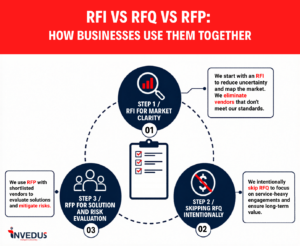
Step 1: RFI for Market Clarity (Sequential Use)
The company starts with an RFI to reduce uncertainty, not to select a vendor. At this stage, leadership is mapping the market and validating assumptions before committing time or budget.
The RFI helps answer:
- Which delivery models exist (onshore, offshore, hybrid)
- What pricing ranges are realistic at scale
- Whether vendors meet security, compliance, and data standards
- Which providers can support multi-region growth
The outcome isn’t a decision, it’s elimination. Vendors lacking operational maturity, compliance readiness, or geographic coverage are removed early, preventing costly evaluation later.
Step 2: Skipping RFQ Intentionally
In service-heavy engagements, the team deliberately avoids an RFQ. While pricing matters, it is not the primary risk driver.
An RFQ would:
- Reduce complex services to hourly rates
- Ignore onboarding time, training effort, and attrition risk
- Overlook SLA enforcement and escalation quality
Instead of forcing premature price comparisons, the business prioritizes delivery reliability and long-term cost stability, knowing poor execution is far more expensive than higher initial rates.
Step 3: RFP for Solution and Risk Evaluation
Only shortlisted vendors receive the RFP. At this point, the company knows what it needs but wants to evaluate how vendors will deliver.
The RFP evaluates:
- Staffing models and ramp-up timelines
- KPIs, reporting cadence, and governance
- Risk mitigation and continuity planning
- Pricing in the context of service quality
This step surfaces vendor execution maturity, making quality, accountability, and scalability visible alongside cost.
Choosing the Right Vendors After You Receive RFI, RFQ, or RFP
Once responses arrive, vendor selection should shift from reading to systematic evaluation. This is where many businesses fail by relying on intuition instead of structure.
How to shortlist vendors (first filter)
Shortlisting removes risk before comparison. Start by eliminating vendors that fail non-negotiables:
- Regulatory, security, or data-handling gaps
- Inability to meet required timelines or scale
- Incomplete or evasive responses
A strong shortlist usually includes 3–5 vendors. More than that increases noise without improving decision quality.
How to score vendors objectively
Use a weighted scoring model to prevent price bias. A simple structure:
- Delivery capability (30%)
- Solution fit & approach (25%)
- Cost & commercial terms (20%)
- Governance, SLAs, risk controls (15%)
- Proof of experience (10%)
Score each category on a 1–5 scale, then multiply by weight. This exposes trade-offs clearly.
Common red flags to watch for
- Generic answers reused across sections
- Pricing without assumptions or exclusions
- Overpromising speed, scale, or outcomes
These factors will help you settle for a vendor faster than unnecessary decision-making. Expect to finalize your vendor within 24 hours by using this method.
Closing Words
RFIs, RFQs, and RFPs are important documents that are non-negotiable. Businesses that have started or are thinking of starting their vendor search should understand these proposal types for procurement in more detail.
Our article has solved the problem that was being faced by many businesses, differentiating and understanding the use cases of each document (RFI, RFQ, and RFP). Our vendor managers used their 5+ years of experience in creating the contents of this article. The proposals shown in our article are close to what most vendors will provide you.
Hence, we would suggest that you hire a vendor manager from Invedus or just work with us to cut short your time and effort of finding the right partner.
We have helped 70+ businesses create custom RFPs, RFIs, and RFQs. We are a trusted vendor and a partner that can help you document the right proposals, choosing the vendor who can fulfil what’s been promised. Invedus helps businesses move from RFP discovery to fulfilment with clarity, accountability, and delivery confidence.
Connect with Invedus to understand vendor management and procurement better.
Frequently Asked Questions
What comes first, RFQ or PR?
In procurement workflows, PR (Purchase Requisition) comes before RFQ. After approval, businesses may follow RFI vs RFP vs RFQ stages, depending on clarity. RFQs are used later when requirements are finalized, and pricing comparison becomes the primary decision factor.
What role does an RFI play in the procurement process?
In RFI vs RFP vs RFQ, an RFI plays an early-stage role by gathering market insights and vendor capabilities. It helps businesses refine requirements, shortlist suppliers, and reduce risk before moving to RFP or RFQ stages for deeper evaluation.
How does an RFI differ from an RFP and an RFQ?
In RFI vs RFP vs RFQ, an RFI focuses on exploration, an RFP evaluates detailed solutions, and RFQ compares pricing. The key difference lies in timing; RFI is used early, while RFP and RFQ are used when requirements become clearer.
What are the main differences between RFI, RFP, and RFQ?
The main difference in RFI vs RFP vs RFQ is purpose—RFI gathers information, RFP evaluates vendor solutions, and RFQ compares pricing. Each is used at different stages, ensuring businesses move from discovery to decision-making in a structured procurement process.
How do RFPs help businesses evaluate potential vendors?
In RFI vs RFP vs RFQ, RFPs enable structured evaluation by comparing vendor capability, approach, scalability, and cost. They standardize responses, apply scoring models, assess risk, and ensure objective comparison, helping businesses select the most suitable vendor aligned with long-term goals.
How can Invedus streamline your RFP process?
Invedus streamlines your RFP process by defining clear requirements, structuring evaluation criteria, and managing vendor communication efficiently. Within the RFI vs RFP vs RFQ framework, it reduces delays, improves response quality, and ensures faster, more accurate procurement decisions.
Can Invedus improve vendor selection outcomes with better proposal structuring?
Yes, Invedus improves vendor selection outcomes by structuring proposals with clear scoring models, defined criteria, and comparable formats. In the RFI vs RFP vs RFQ process, this ensures objective evaluation, better vendor fit, and stronger alignment with business goals.


Last updated on: May 13, 2026