


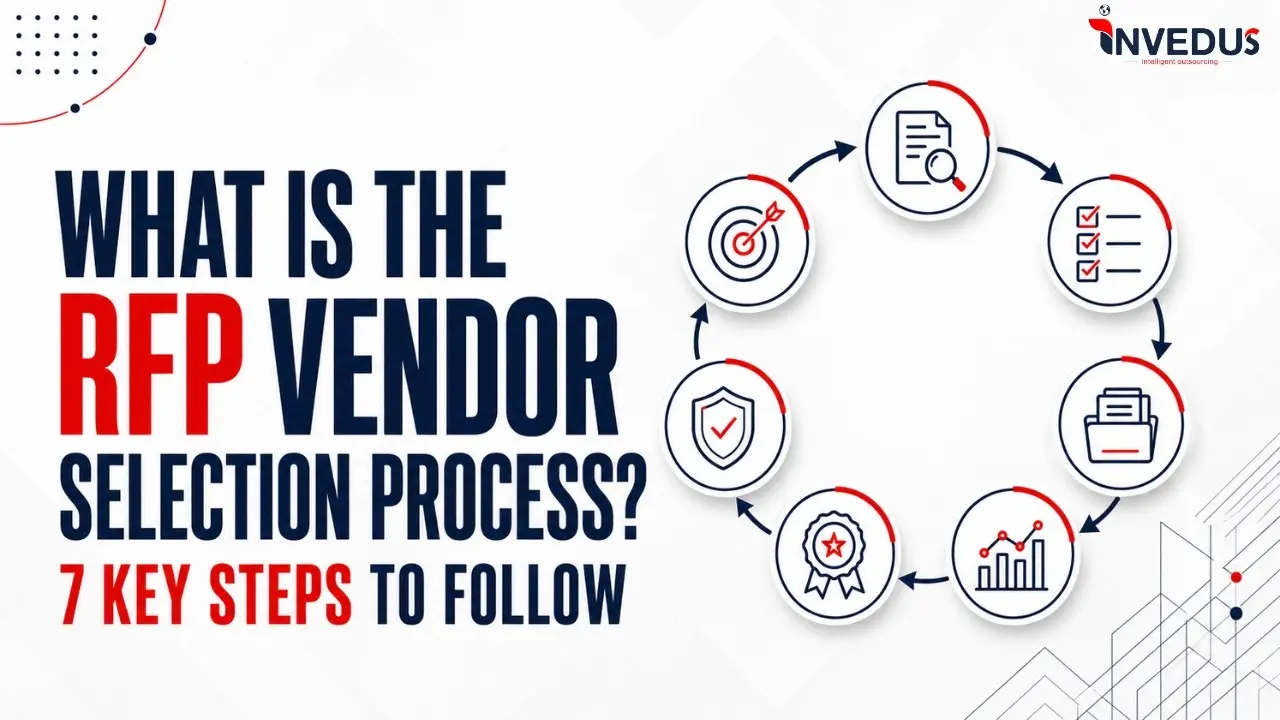
What Is the RFP Vendor Selection Process? 7 Key Steps to Follow

Authored By: Juhi
Juhi is an experienced content creator with a deep understanding of audience engagement and brand...

Fact-checked By: Kush Saxena
Kush, a skilled professional in business development and relationship management at Invedus, has been helping...
A Request for Proposal (RFP) is quite common in the procurement process. Think of it as a chance to become the vendor for a company’s requirement. However, this entire RFP vendor selection process is tough and can sometimes stretch over multiple steps.
If you want to find the best vendor for your business needs, you need to create an RFP, send it to your chosen vendors, scan every detail, and finalize the vendor that best suits you. Following this entire vendor selection process is very important to make sure you judge fairly and transparently in the future.
However, the process can look different based on your industry and requirements. We have done our research and outlined the vendor selection process and what are the steps involved. By the end of this blog, you will be able to onboard high-quality vendors in no time.
What Is the RFP Vendor Selection Process?
The RFP vendor selection process is the structured procedure people use to compare, vet, and choose vendors after issuing a request for proposal. This way, you can objectively reach a decision without being influenced by biases or other factors.
Vendor selection process through RFP is very common in scenarios, like:
- Government
- Large organizations
- Regulated industries
- High-value contracts
- Multi-year engagements
- Cross-department projects
- Audit-required purchases
- Policy-mandated bidding
Following this process will guarantee you a reduced risk of ending up with a fraudulent vendor, improve the accountability of quality of work, encourage healthy competition among potential vendors, and ensure the best fit in terms of cost and quality.
Examples of RFP Vendor Selection
Here are two detailed, realistic examples of the RFP process that you may have experienced or may observe in the market.
Example 1: IT Outsourcing (Help Desk + Infrastructure)
A 1,200-employee healthcare company needs 24/7 IT support across three locations. Their internal costs have reached $1.2M/year, so they issue an RFP to 8 IT outsourcing vendors with requirements like:
- 24/7 coverage with < 30-minute response time
- HIPAA-compliant security controls
- Onboarding timeline of 60–90 days
- Ability to support 2,500+ tickets/month
- Budget range: $700k–$950k/year
After scoring proposals, they shortlist 3 vendors. Final interviews focus on service quality, escalation processes, and disaster-recovery readiness. The winning vendor offers:
- 99.9% uptime SLA
- Local support team of 22 engineers
- Predictable $820k annual fixed-fee
- Quarterly performance reviews
This balances risk, compliance, and cost savings of ~32%.
Example 2: Accounting Services (Outsourced Finance Department)
A $10M-revenue ecommerce brand has outgrown its freelance bookkeeper. They issue an RFP for outsourced accounting + tax + payroll, expecting:
- Monthly bookkeeping for 6 entities
- Payroll for 95 staff
- Sales-tax filings in 14 states
- CFO-level reporting
- Budget of $6k–$10k/month
Five firms respond. Proposals are evaluated on industry experience, tech stack (Xero vs. QuickBooks), team qualifications, pricing model, and response time.
Two firms are shortlisted. The winning firm provides:
- Dedicated 3-person team
- $8,200/month fixed fee
- Weekly finance check-ins
- Real-time dashboards
- A 6-week onboarding plan
The client chooses them for clarity, scalability, and proactive guidance, not just price.
Who Is Involved in the Vendor Selection Process?

The entire RFP vendor selection process is never “led” by one person solely. There are many important departments and roles involved in every step to make sure the requested proposals are viable, fair, and unbiased. Here are the roles involved in vendor selection:
- Procurement team / purchasing department: Leads the RFP logistics, manages communications with vendors, standardizes evaluation criteria, gathers proposals, runs the comparison process, negotiates terms, and ensures purchasing policies, documentation, and fairness are consistently followed.
- Department requesting the service: Defines business needs, success metrics, timelines, and functional requirements. They assess whether vendors can actually deliver what’s needed in day-to-day operations and confirm the chosen solution truly solves the problem.
- Legal & compliance: Reviews contracts, privacy policies, risk clauses, licensing, data protection, and regulatory obligations. Their role is to ensure the agreement is enforceable, ethical, compliant, and protects the organization from legal exposure.
- Finance & leadership: Evaluate budgets, pricing structures, ROI, and long-term financial impact. Leadership also approves final decisions, aligning vendor selection with organizational goals, financial strategy, and risk tolerance before contracts are signed.
- Technical reviewers / SMEs: Subject-matter experts analyze technical capability, security, performance, integration requirements, quality standards, and feasibility. They validate whether the vendor’s solution is technically sound and sustainable in real-world use.
- Sometimes, external consultants: Brought in for specialized expertise, neutrality, or capacity support. They help design the RFP, benchmark vendors, facilitate scoring, and advise on best-fit selection, especially for high-value or complex projects. External consultants for RFP from agencies like Invedus make sure your RFPs are foolproof.
The 7 Key Steps in the RFP Vendor Selection Process
Usually, you will find every other person promoting different steps to the RFP vendor selection process. However, these are the 7 solid steps that define the vendor selection process from start to finish.
Step 1: Begins with Defining Your Needs and Selection Criteria
The first and most critical stage in the RFP vendor selection process is defining what your organization truly needs and how you will evaluate vendor proposals. This is the foundation of a fair, transparent, and defensible procurement strategy.
Before issuing an RFP, internal stakeholders must agree on the specific problem to solve, a realistic budget range, necessary qualifications, compliance or security expectations, and which requirements are essential versus desirable.
Best practices in procurement emphasize that even before proposals are created, the process and criteria should be defined clearly. Government procurement manuals, for example, require that criteria be set in writing and used consistently across all proposals.
Typical selection criteria include price, quality of solution, vendor experience, support and reliability, security risk controls, and cultural or operational fit. A common mistake is keeping requirements vague or overly broad. Be precise and quantify criteria where possible (e.g., response times, SLA metrics), and avoid backtracking once the RFP is released.
Step 2: Continues by Issuing the Rfp and Inviting Vendors
Once your needs and selection criteria are defined, the next core step is to issue the RFP and formally invite vendors to respond. This marks the official start of the competitive process and sets expectations for how proposals will be received and evaluated.
At this stage, the organization publishes the RFP or sends it directly to a shortlist of qualified vendors.
Tip: To narrow down some vendors, you can make a checklist of criteria to judge them on and then score them to find a list of final vendors you are interested in and confident in working with.
The document should clearly specify:
- Timeline for submission and evaluation
- Instructions on format and required attachments
- Legal and compliance terms vendors must acknowledge
This matters because incomplete or ambiguous RFPs often lead to confusion, disqualified bids, and delayed decisions. According to procurement best practices, clarity in the RFP itself improves response quality and enhances comparability across submissions.
Don’t make the grave mistake of releasing an RFP without full procedural details or deadlines. Before issuing, double-check that all instructions and contact info are complete.
Step 3: Moves into Receiving and Validating Vendor Proposals
Once the RFP deadline closes, vendors submit their proposals, and the first task isn’t to score them yet. It’s to validate that every proposal actually qualifies. The procurement team conducts an initial screening to confirm:
- Completeness (all sections & documents included)
- Format & submission compliance
- Legal & regulatory documentation
- Eligibility against the minimum criteria
This early filter really matters. Public-sector procurement audits frequently report that 20 to 40% of proposals are initially non-compliant, often due to missing documents or failure to follow instructions. (Findings referenced across NIGP, World Bank, and government procurement reviews.)
Invalid proposals may be rejected before detailed evaluation to keep the process fair and consistent. Only qualified vendors should move forward, reducing bias, saving evaluation time, and supporting transparent procurement.
To make sure your RFP process is secured against any biases, be strict but consistent. Clearly document why any proposal is ruled non-compliant, especially in regulated or government environments.
Step 4: Focuses on Evaluating and Scoring Each Proposal
This is usually the most structured and formal stage. Once proposals pass compliance review, they’re scored against a pre-defined evaluation matrix.
Each reviewer scores independently, and scores are averaged to reduce bias, a best practice highlighted in U.S. GSA and World Bank procurement guidance. Many organizations also use weighted scoring models.
Here is a model with criteria you can use for scoring:
| Evaluation Criterion | Weight (%) | Why It Matters |
|---|---|---|
| Technical Capability & Fit | 35% | Ability to meet requirements, scalability, usability |
| Pricing & Total Cost of Ownership | 25% | Upfront + ongoing costs, licensing, hidden fees |
| Risk, Security & Compliance | 15% | Data protection, regulatory fit, certifications |
| Service Quality & Support | 10% | SLAs, onboarding, account management |
| Vendor Experience & Reputation | 10% | Industry expertise, case studies, references |
| Cultural & Operational Fit | 5% | Communication, alignment, collaboration style |
The scoring scale can be as follows:
- 10 = Excellent
- 8–9 = Strong
- 6–7 = Meets expectations
- 4–5 = Below expectations
- 1–3 = Weak / unacceptable
And by calculating the weighted score = (Score × Weight %), you can determine whether the vendor is the right fit for you or not. A small example:
| Criterion | Weight Score (1–10) | Weighted Score |
|---|---|---|
| Technical Capability (35%) | 9 | 3.15 |
| Pricing / TCO (25%) | 7 | 1.75 |
| Risk & Security (15%) | 8 | 1.20 |
| Service & Support (10%) | 9 | 0.90 |
| Experience & Reputation (10%) | 8 | 0.80 |
| Cultural Fit (5%) | 7 | 0.35 |
Structured scoring really matters. Deloitte’s Global CPO Survey notes that organizations with standardized supplier evaluation processes see significantly better value delivery and risk control, compared with ad-hoc selection.
Step 5: Progresses to Shortlisting Vendors and Conducting Interviews or Demos
Once proposals are scored, the highest-ranking vendors are shortlisted for the next round. This stage moves beyond documents and focuses on real-world capability. Vendors are invited for presentations, live product demos, interviews, technical Q&A, and security validation to test how well they actually perform.
This step matters because it reveals qualities you can’t see on paper, problem-solving style, transparency, communication, and how they collaborate under pressure. It’s also where many decisions naturally form, because stakeholders finally see the people and the product in action. Weak vendors usually fall away here, while the strongest options clearly stand out.
Step 6: Strengthens the Decision Through Due Diligence and Final Validation
Before a final decision is made, the organization performs formal due diligence to confirm that the shortlisted vendor is credible and stable. This usually includes verifying client references, case studies, background checks, financial strength, legal standing, data security practices, insurance, and industry certifications. For outsourcing and service-based partnerships, this step is critical because you’re trusting another company with core operations, data, or customers.
The goal is simple: make sure the vendor is real, reliable, compliant, and sustainable long-term, not just impressive on paper. Many organizations also document this review to meet audit, risk, and governance requirements.
Step 7 Concludes with Final Selection, Negotiation, and Contract Award
Once evaluation and due diligence are complete, the selection committee formally recommends the preferred vendor. From here, legal and procurement step in to negotiate the final terms, not just the price, but the value and risk structure of the partnership.
Key negotiation areas usually include:
- Pricing & payment terms
- Service Level Agreements (SLAs)
- Deliverables & milestones
- Data security and risk allocation
- Termination / exit clauses
When both sides agree, the contract is signed → onboarding begins → the project officially starts.
It’s important to note that the lowest price rarely wins on its own. Most organizations select the best-value partner, the vendor who balances cost, quality, reliability, and long-term alignment with business goals.

How Long Does the RFP Vendor Selection Process Take?
The RFP vendor selection process can vary widely depending on the size and complexity of the organization. For small businesses with simpler needs, the process may take around 2 to 4 weeks. Mid-size organizations typically require 1 to 2 months, while government agencies and large enterprises often take 3 to 6+ months to finalize a vendor.
Timelines stretch because of factors like strict regulatory review, multi-layered budget approvals, higher risk thresholds, and the number of vendors involved. The more stakeholders, legal checks, and technical evaluations required, the longer the process becomes, which is why structured RFP workflows are essential to keep projects on track.
What This Means for Vendors Responding to RFPs?
To make sure you, as a vendor, get picked, you need to respond to RFPs in the best way possible. These are some tips you can follow to make sure you make it to finalization:
- Follow every instruction exactly (format, deadlines, documents, word limits).
- Customize your proposal to the client and project, and avoid generic templates.
- Show measurable outcomes you’ve delivered (e.g., % savings, time reduced, revenue impact).
- Demonstrate risk awareness & mitigation, buyers want to see you’ve thought ahead.
- Highlight collaboration, support, and communication structure (who, how often, what tools).
- Provide strong references and case studies, ideally similar to the industry or project size.
- Be transparent about pricing and assumptions to avoid surprises later.
- Make your proposal easy to read, with a clear structure, an executive summary, and concise language.
- Answer the “why you?” clearly, what makes you uniquely valuable vs. competitors.
Partner with Invedus To Create Accurate, Fair RFPs!
Invedus is a leading outsourcing partner trusted by businesses worldwide. We specialize in delivering both IT and non-IT services, providing highly skilled remote employees who work with dedication as an extension of your team. Over the years, we have successfully collaborated with organizations of every size and industry, gaining deep expertise in tailoring solutions to diverse business needs.
Our trained RFP consultants ensure that every proposal we create is accurate, transparent, and fair—helping clients achieve efficiency, cost savings, and long-term success. At Invedus, we don’t just provide outsourcing services; we build lasting partnerships that empower businesses to grow and thrive.
To make sure you only dive into strategic sourcing, our RFP consultants for hire bring 6+ years of experience in proposal creation, design, documentation, and vendor evaluation. They help you:
- Clearly define requirements.
- Build fair and structured RFPs.
- Avoid bias and compliance issues.
- Compare vendor responses objectively.
- Select the right partner with confidence.
You can start creating an RFP today by clicking here. Or if you want to work with Invedus, start by booking a free consultation with us.

Conclusion
For most vendors, an RFP is a must-have before even thinking of partnering with a business. However, for a small business, an RFP may seem too complicated or an added step. But a request for a proposal is very important, and every business should practice this step in its procurement.
Rather than becoming scared of a proposal, you can follow our 7 key steps of the RFP vendor selection process. As a stakeholder, this entire process will make collaborating with new vendors easy. If you are still unsure of RFP and everything it has to offer your business, we highly recommend getting connected to our RFP consultant for a quick outline of how proposals can help you!


Last updated on: Apr 30, 2026