


How a Virtual Assistant Can Help You Find the Right Investor in 2026

Authored By: Garima
Meet Garima, an integral member of the Invedus editorial team. With three years of experience...
When you are in the early stages of your business, you are already entangled in so many kinds of mess, and finding the right investor for your business adds another challenge to your hustle and bustle.
Perhaps you are wondering why investors are so crucial to startups.
You can consider investors as fuel for the rocket. What will you do if you have a rocket with all the components—the engine, the fuel lines, the guidance system but no fuel? Will you be able to pilot the rocket?
Yes, it is true, you can start your journey as an entrepreneur with your family’s and friends’ funds. Additionally, you can also use the bank funding as a loan as well. But this entire collection cannot help you succeed in your long-term goal.
Now, here comes the investor who shows interest in your business to earn profit. But not every investor is good in itself. So, it is always better to look at some prerequisites so that you will not fall into the trap. The importance of this identification is necessary because, as you are in the early stages of running the business, you are also not experienced. So, that’s why it’s important to choose the right investor for your business.
According to CB Insights, startups that raise more than $1 million in venture capital funding have a 30% higher success rate. On the contrary, 42% of startups fail due to a lack of funding. Now, you can easily understand the importance of investors in your business.
When Do You Need funding support for startups?
There are many stages when you require funds for your startup. But to avoid any confusion, we have accumulated your Startup business funding needs in 3 stages:
1. Idea Stage: You have a ton of ideas but little money. To get started, you can use crowdfunding, friends, and family, or bootstrapping (using your own savings and resources) as your initial fuel source.
2. Seed Stage: You need more support as your idea begins to take shape. Angel investors, incubators, or accelerators (both support systems for early-stage startups) offer seed funding and expert guidance, refining your idea and attracting early customers.
3. Growth Stage: Your company is expanding quickly, but it needs more strength to take the next step. Venture capitalists or private equity firms provide bigger investments for bigger goals, like hiring talent or conquering new markets.
Well, every stage is crucial in itself and has its own importance.
Timing is everything. Seeking funding too early might limit your options and undervalue your startup. Too late could stifle growth and leave you vulnerable. Ensure the funding aligns with your roadmap.
Bootstrap initially, then seek seed funding for validation and early traction. For expansion and scaling, venture capitalists or private equity can provide the fuel, but only if it matches your strategic goals. Choose wisely, fuel strategically, and your startup will soar.
There might be certain things you need to consider before you start. Don’t completely rely on the investors.
Also Read: Top Crowdfunding Platforms for Startups
Fueling Your Startup: Assess Your Needs Before You Fill Up
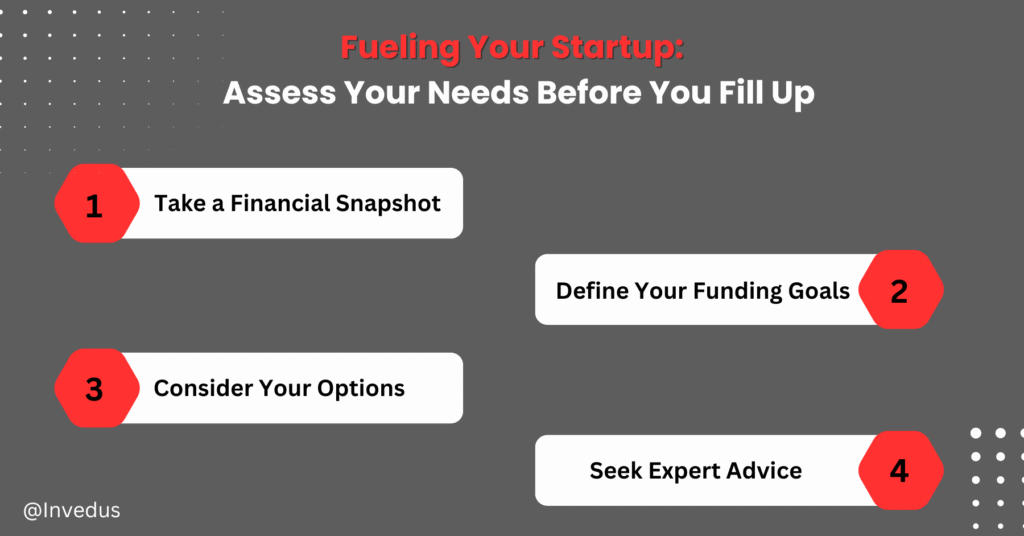
So, you’re ready to take your startup to the next level, but before you move headfirst into the funding pool, it’s important to assess your current financial situation and identify your specific needs. Check the below points that can in analyzing the prerequisites before you start with the founder.
1. Take a Financial Snapshot
- Income: List all your revenue streams, including sales, grants, and personal investments.
- Expenses: Track every penny you spend, categorizing them as essential (rent, utilities) or discretionary (subscriptions, dining out).
- Debt: Calculate your total outstanding debt, including loans and credit cards.
- Cash Flow: Analyze your income and expenses to see if you have a surplus or deficit.
2. Define Your Funding Goals
- What do you need the money for? Is it product development, marketing, hiring talent, or something else?
- How much do you think you need? Be realistic and base your estimate on research and specific needs.
- What is your timeline? Do you need the funding immediately, or can you wait a few months?
3. Consider Your Options
- Bootstrapping: Can you use personal savings, loans, or crowdfunding to get started?
- Angel investors: Do you have connections who might be interested in your idea?
- Seed funding: Are there incubators or accelerators that offer funding and mentorship?
- Venture capital: Are you ready for the scrutiny and potential loss of equity that come with VC funding?
- For capital-efficient startups, consider non-dilutive funding for hard assets. If you need vehicles, machinery, or POS/IT equipment, your VA can shortlist lenders, compare terms, and gather documentation for equipment loans. Use curated resources on equipment financing options to understand how these loans work, minimum requirements, and how much you could qualify for, then have your VA coordinate quotes and application timelines with providers. Blending investor capital with asset-backed financing preserves equity while accelerating operations and keeping runway focused on growth.
4. Seek Expert Advice
- Talk to a financial advisor: They can analyze your situation and recommend suitable funding options.
- Connect with mentors: Experienced entrepreneurs can share insights and guide your decision-making. You can also use mentoring software to track guidance, schedule sessions, and streamline communication with multiple mentors.
After considering all the aspects before you launch your startup, let us understand how many types of investors are looking to invest in your business.
Types of Investors: Who Can Invest in Your Business?
Below are the different types of investors and their typical investment styles:
- Angel Investors: High-net-worth individuals investing in early-stage ventures.
- Venture Capitalists (VCs): Firms managing pooled funds focusing on high-growth startups.
- Private Equity Firms: Invest in mature companies with established track records.
- Investor types: For founders engaging with VCs, PE firms, or fund managers, it helps to understand how these vehicles operate and move money. When your VA is mapping investor pipelines or preparing diligence materials, point them to solutions for managing alternative investment funds that cover banking setup, fee flows, compliance, and cross-border payments. This equips your outreach with sharper operational context and helps you ask smarter questions during investor calls.
Before you choose an investor for your startup, take a look at their advantages and disadvantages.
Analyze the Best Investor for your Startup
Choosing the right investor is like finding the perfect teammate for your startup journey. Each type offers unique benefits and drawbacks, so aligning their strengths with your specific needs is essential. Let’s explore:
Angel Investors
- Pros: Experienced mentors, flexible investments, quicker decisions.
- Cons: Limited reach and capital, high expectations, and potential micromanagement.
Venture Capitalists (VCs)
- Pros: Big bucks for growth, industry expertise and connections, validation boost.
- Cons: Time-consuming due diligence, significant equity dilution, pressure to perform.
Private Equity Firms
- Pros: Large investments, operational expertise, longer investment horizons.
- Cons: Mostly for mature companies, strict financial targets, potential loss of control.
Crowdfunding Platforms
- Pros: Wide reach, community building, possible validation, and extra buzz.
- Cons: Platform fees, regulatory hurdles, uncertain outcomes, and funding goals.
However, there’s no one-size-fits-all investor. Assess your stage, goals, comfort level, and external influence. Seek mentors and financial advisors to understand the implications of each option.
A good investor partnership fuels your growth while aligning with your vision.
However, as an entrepreneur, you should also analyze an investor’s qualities before taking steps for startup funding.
What Should Founders Look For in an Investor?
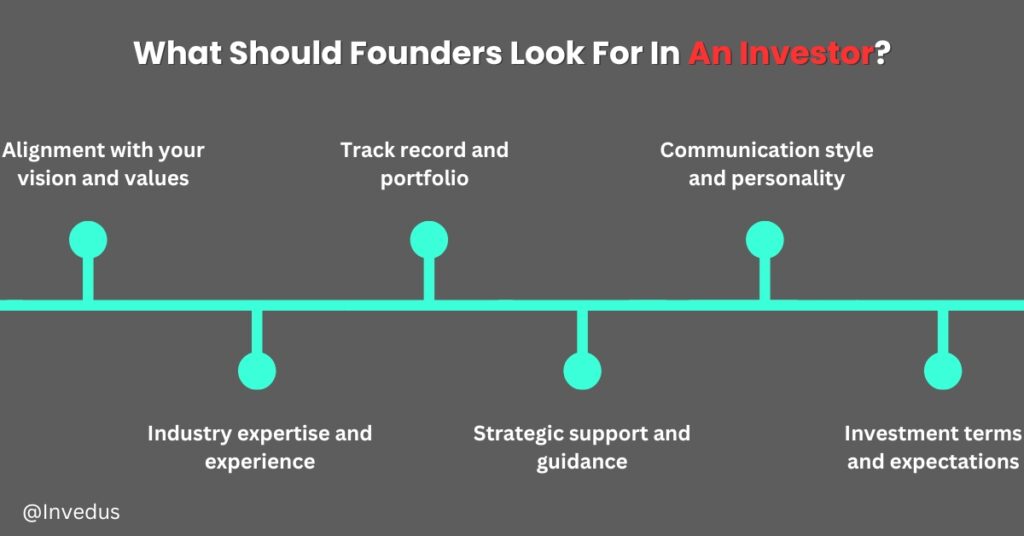
Check the key qualities to evaluate potential investors when they start to seek startup funding.
- Alignment with your vision and values: Picking an investor feels like picking a co-founder. Beyond money, seek someone who believes in you and your vision. Shared values, goals, and long-term plans create a foundation for a fruitful partnership. Choose the investor in your team, not just a spender who only puts their interest in spending money and seeking profit.
- Industry expertise and experience: Before choosing your investor, who will start funding your startup, they may have relevant experience in your business. This step can help with your startup’s progress. You can use the investor experience to develop your business strategy.
- Track record and portfolio: It is always better to analyze the past successes, failures, and investment styles of the investor. This strategy will help you analyze how long that investor can remain with your business.
- Strategic support and guidance: It is always beneficial to take advice from those who have already learned from their failures. Thus, when looking for investors to fund your startup, try to find out what kind of mentorship or advice they can offer, as well as networking opportunities. These parameters can support your company’s long-term growth.
- Communication style and personality: Clear Words are always better than misleading words. Effective communication is paramount when choosing an investor. Seek clear and concise dialogue, free of jargon and ambiguity. Prioritize respectful interactions, fostering an open and productive partnership. Remember, the ideal investor is not just a financial resource, but a valued collaborator on your entrepreneurial journey.
- Investment terms and expectations: When picking an investor for startup funding, look for fair terms that benefit both sides. Ensure expectations are clearly outlined, avoiding hidden surprises. Consider a partnership where everyone’s goals are aligned and transparent.
Undoubtedly, cash is important, but the ideal investor becomes more than just a financial resource. They’re a strategic partner, offering guidance, expertise, and access to valuable networks. They believe in your vision and values, supporting your journey every step of the way.
Finding this perfect match takes effort, though. Researching potential investors, understanding their interests and values, and building genuine relationships can be time-consuming.
That’s where a virtual assistant can be your helping hand, handling the tasks while you focus on connecting with the right people. They enable you to focus on building relationships with potential investors who share your strategic vision.
How Can a Virtual Assistant Help Find the Right Investor for Your Business?
Virtual assistant not only assists you in your business promotion. In fact, these are the helping hands who can manage multiple tasks simultaneously so that your startup can run smoothly without any hassle and can turn in SMEs.
Do not disregard their physical presence, even though they are not physically present in the office, they are still completely dedicated and committed to your organization.
Don’t confuse virtual assistants with freelancers.
They are working under the organization, which has signed an agreement with you for the services you demand. Additionally, they also streamline the investor search process through:
Market research and investor identification
They streamline your search for funding by conducting targeted market research, identifying relevant investors aligned with your needs, and managing outreach & communication. Furthermore, they allow you to free yourself to focus on what matters, growing your startup.
Additionally, they also do the following tasks:
- The Virtual Assistant enables you to use a targeted approach, allowing you to focus on the most promising leads instead of wasting time on irrelevant ones.
- They use online databases, industry publications, and networking resources. which ensures you’re reaching out to the investors most likely to be interested in your business.
Your VA creates a list of qualified investors whose investment criteria, interests, and portfolios align with your startup’s needs.
Initial outreach and communication
When you hire a VA from Invedus, they personalize messages to target investors, highlighting your unique value proposition and shared interests for your startup. They manage scheduling and logistics, ensuring smooth communication and meaningful meetings with potential partners.
Moreover, these virtual assistants will enhance your communication with your clients transparently by
- Your virtual assistant creates customized emails or responds to online queries based on the list of possible investors, sparing you time and effort.
- They schedule meetings, manage calendars, respond to inquiries, and keep track of communication with potential investors.
Due diligence and background checks
Just understand, in very clear words, that not every investor who approaches you shows interest in your startup funding. It will be very difficult for you to convince them to start funding your startup. VA digs deep, researching investor track records, reputations, and potential red flags.
They ensure you have a complete picture before making any crucial decisions using the below-stated strategies:
- Your virtual assistant can help gather information about potential investors from their websites, social media profiles, and publicly available news articles.
- They organize and compile information on your projects into a central document, making it easier for you to review and analyze.
- Virtual assistants are well versed in handling scheduling calls with other individuals who may have experience with the investor, such as portfolio companies or industry experts.
Presentation and pitch deck preparation
Your virtual assistant steps in, refining your message and polishing your materials for maximum impact. They’ll help you capture investor attention, highlight key strengths, and deliver a compelling narrative through a well-designed presentation that communicates your value clearly and confidently.
Additionally, they also assist you in
- Perform research on your competitors’ pitch decks or presentations to help identify best practices and potential weaknesses in your approach.
- A virtual assistant can assist you by gathering relevant data and information about your business, competitors, and market, making it easier to build a compelling narrative in your presentation.
- Based on your instructions and provided information, your virtual assistant can draft the initial script or outline for your presentation, ensuring clarity and conciseness.
Negotiation and deal structuring
Your VA demystifies complex terms and contracts, ensuring you understand every detail. They provide expert support during negotiations, helping you secure the best possible deal for your business. Furthermore:
- These VAs handle scheduling and managing meetings with investors and your team, ensuring everyone stays on schedule and informed.
- Working with your guidance, in creating agendas and key talking points for meetings, outlining critical points for discussion and negotiation.
Also Read: What Does A Virtual Assistant Do?
In a Nutshell
Hiring a full-time team for investor research, communication, and due diligence can be costly and time-consuming. A virtual assistant offers an efficient and cost-effective solution. They free up your time to focus on core business while expertly handling tasks, saving you both money and valuable hours. Consider it an investment in your success, not just an expense.
How we can help?
Trust Invedus for all your Virtual Assistant needs! At Invedus, our Virtual Assistants are dedicated, full-time resources, giving you complete control over their services and working hours. With excellent English proficiency, strong communication skills, and expertise in utilizing cutting-edge AI tools and technologies, they seamlessly align with your business needs. Fill out this form to discover how we can help you succeed!



Last updated on: Feb 9, 2026