



How to Hire Remote Developers in 2026: A Step-by-Step Guide

Authored By: Juhi
Juhi is an experienced content creator with a deep understanding of audience engagement and brand...

Fact-checked By: Prakhar Raj
6-year WordPress, PHP and Shopify developer for custom web solutions. He ensures clean, high-performing web...
Key Takeaways
- Companies hire remote developers in 2026 to overcome local talent shortages and access specialized engineers across AI, cloud, DevOps, and mobile.
- Successful teams hire remote software developers through clear role definition, strategic sourcing, practical assessments, and structured onboarding.
- Remote staffing services help businesses hire dedicated remote developers who integrate better than short-term freelancers.
- AI tools improve how to hire remote developers by speeding up screening, portfolio reviews, and candidate shortlisting.
- ManpowerGroup reports 74% of employers struggle to find skilled talent, making offshore remote developers valuable for faster scaling.
- Businesses that hire offshore developers must plan for compliance, payroll, IP ownership, onboarding, and communication workflows.
Hiring remote developers means choosing between three structurally different models – freelance contracts, dedicated developers through a staffing partner, or full in-house remote employees via an EOR. Each model has different costs, ramp times, and accountability profiles. This guide walks through the seven steps that determine whether a remote developer hire delivers ROI or becomes a liability.
The real question is how to hire remote developers through a process that actually works. A basic Google search may show you options, but it will not always lead you to the best remote developers to hire. A thorough, vetted process helps you find developers who can match your technical, communication, and business requirements.
This guide covers how to hire remote developers properly in 2026, from defining the role to onboarding and long-term team management.
Why Are Companies Hiring Remote Developers in 2026?
Companies hire remote developers in 2026 because local hiring limitations now slow product growth, increase recruiting costs, and restrict access to specialized technical expertise.
According to ManpowerGroup’s 2026 Global Talent Shortage Survey, 72% of employers worldwide struggle to find the skilled talent they need, while India reports an 82% talent shortage, one of the highest globally. AI-related capabilities have overtaken traditional engineering and IT skills as the hardest to find, highlighting the growing demand for advanced digital expertise. As a result, businesses that hire remote developers can access a broader global talent pool of experienced software professionals instead of competing for limited local candidates.
Meanwhile, data from Statista estimates that the global software developer workforce exceeded 28 million in 2024, making remote development services and distributed engineering teams far more practical for faster scaling, time-zone coverage, and long-term cost efficiency without sacrificing quality.
What Type of Remote Developer Should You Hire?
The right remote developer depends entirely on the business problem you are trying to solve, not just the programming language you need. Companies that hire remote developers successfully usually choose a hiring model based on product complexity, ownership expectations, scalability goals, and internal management capacity.
| Hiring Model | Best For | Main Advantage | Main Limitation |
| Freelancers | Short-term tasks | Fast hiring | Lower continuity |
| Dedicated Remote Developers | Long-term product work | Product ownership | Higher commitment |
| Staff Augmentation | Scaling internal teams | Flexible expansion | Requires internal management |
| Development Agency | End-to-end execution | Faster delivery | Higher overall cost |
Freelancers work best for isolated tasks, while dedicated remote developers are better for long-term product ownership and collaboration. Companies often struggle when they hire freelancers for roles that need ongoing accountability.
The most common remote developers include frontend, backend, full-stack, DevOps, cloud, AI/ML, QA automation, and remote app developers. Businesses that hire offshore developers or use remote staffing services can combine these roles into one scalable remote development team.
Full Process of How To Hire Remote Developers in 2026
The entire process of hiring a developer remotely includes 7 key steps, which we have mentioned below.
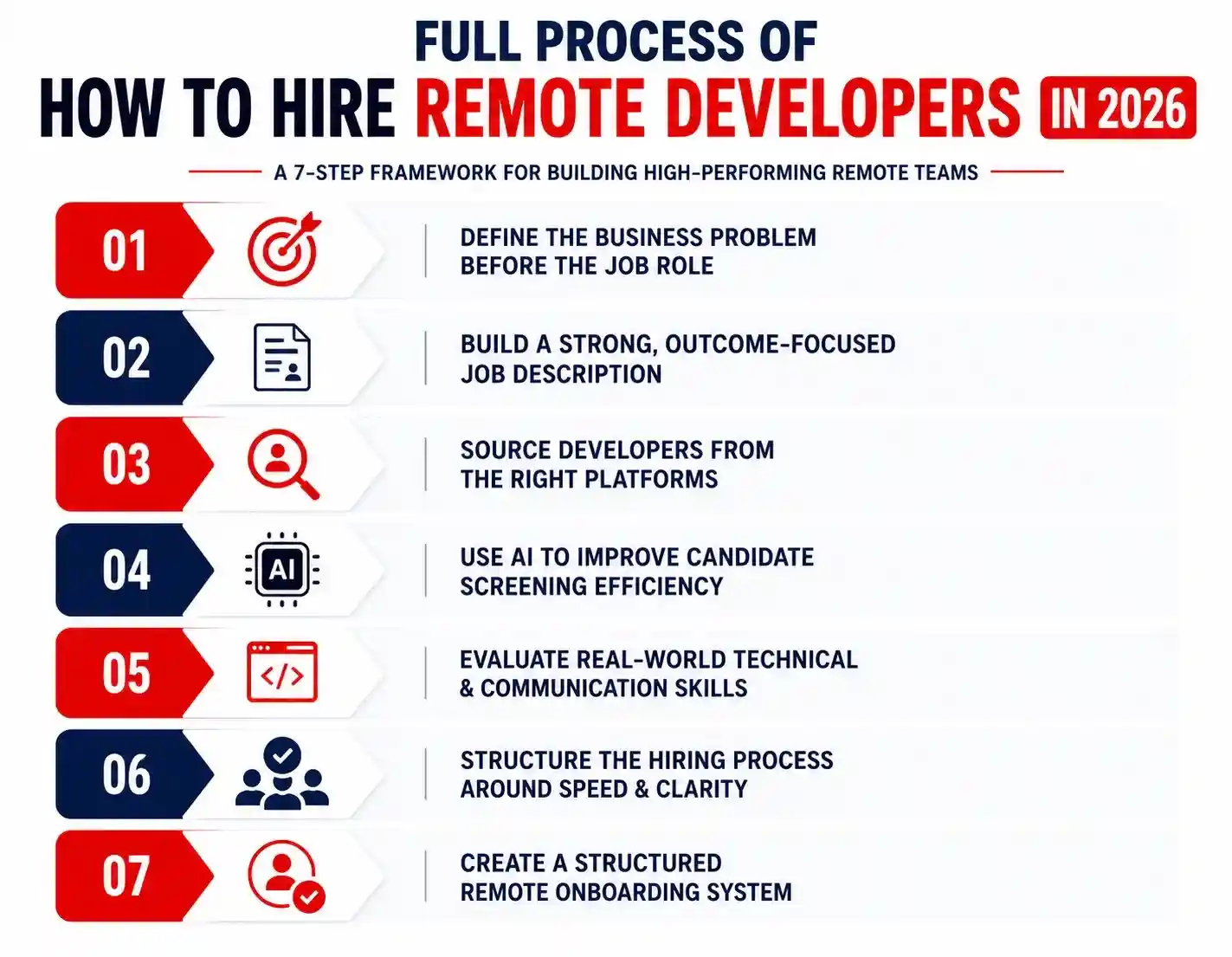
Step 1: Define the Business Problem Before the Job Role
The strongest companies hire remote developers by first identifying the actual business problem they need solved, instead of immediately listing programming languages. A startup building a SaaS platform has very different hiring needs than an enterprise modernizing legacy infrastructure. Before writing a job description, define the product stage, expected deliverables, collaboration intensity, ownership level, and technical environment.
This prevents hiring developers with the right stack but the wrong operational mindset. Companies that hire remote software developers successfully usually focus on outcomes such as scalability, API performance, or product ownership rather than vague requirements like “5+ years of React experience.”
Step 2: Build a Strong, Outcome-Focused Job Description
Your remote developer job description should explain the product, responsibilities, workflow expectations, communication standards, sprint structure, and time-zone overlap requirements. Dedicated remote developers often evaluate operational maturity before applying, especially for long-term roles.
A strong job description should clearly include:
- Product stage and business goal
- Core responsibilities and ownership level
- Required tech stack and tools
- Time-zone overlap expectations
- Sprint workflow and documentation standards
- Performance expectations for the first 30 to 90 days
Instead of writing “Need a backend engineer,” explain the real challenge, such as optimizing a multi-tenant infrastructure handling high API traffic. If you plan to hire remote engineers across multiple countries, clearly outlining expectations also improves alignment during onboarding and reduces early-stage turnover caused by mismatched expectations.
Step 3: Source Developers From the Right Platforms
Companies hire remote developers through several channels, but each comes with trade-offs.
- Outsourced virtual assistant platforms: A reliable remote developer company or remote staffing services provider, like Invedus, can pre-vet talent, support onboarding, reduce hiring delays, and help businesses hire dedicated remote developers who work as part of a stable remote development team rather than short-term freelancers.
- Developer-focused ecosystems: Platforms like GitHub help assess real technical ability, but sourcing and screening take significant internal effort.
- Freelancer platforms: These provide quick access to remote developers, but long-term ownership and consistency can be weaker.
- Staffing agencies: They help companies hire remote software developers faster, but many charge high recruitment fees without ensuring smooth team integration.
For companies building a stable remote development team, outsourced virtual assistant and remote staffing services often provide the strongest balance.
Step 4: Use AI to Improve Candidate Screening Efficiency
AI can significantly reduce screening time when hiring remote developers, especially during early-stage evaluation. This does not replace technical interviews, but it speeds up shortlisting and reduces recruiter fatigue.
AI can help hiring teams:
- Compare resumes against role-specific scorecards
- Summarize GitHub repositories and portfolio projects
- Identify missing skills or unclear experience
- Draft personalized outreach messages
- Shortlist candidates for remote app developers, DevOps, AI, or backend roles
Example AI Prompt:
“Review this resume, GitHub profile, and portfolio. Summarize the candidate’s strongest technical capabilities, remote work readiness, communication indicators, and experience relevant to scaling a SaaS application using Node.js, AWS, and PostgreSQL. Highlight potential concerns and missing experience.”
You can change parts of the prompt to fit your requirements. Used correctly, AI improves consistency while helping hiring teams focus more time on qualified candidates.
Step 5: Evaluate Real-World Technical and Communication Skills
The best way to evaluate remote developers is through practical, role-specific assessments rather than generic coding quizzes. Strong companies simulate actual engineering environments using debugging tasks, architecture discussions, pull-request reviews, or short real-world assignments. This reveals how candidates think under realistic constraints instead of how well they memorize algorithms.
Communication testing is equally important. Remote software developers must explain technical decisions clearly, document workflows properly, and communicate blockers early.
Async collaboration is often what separates effective remote developers from technically skilled but operationally difficult hires. Businesses that hire dedicated remote developers successfully usually evaluate both engineering ability and workflow compatibility.
Step 6: Structure the Hiring Process Around Speed and Clarity
Top remote developers usually receive multiple offers quickly, especially in AI, DevOps, cloud engineering, and cybersecurity roles. A strong remote hiring process should include structured stages, predefined scorecards, clear interview ownership, and fast communication between rounds.
If you want to understand how to hire remote developers without losing momentum, keep the process focused and transparent. Companies should aim to keep the process relevant to the actual role. Concentrate on fewer but higher-quality conversations covering technical capability, collaboration style, ownership mindset, and long-term alignment with the remote software development team.
Step 7: Create a Structured Remote Onboarding System
Hiring remote developers successfully does not end after signing the contract. Poor onboarding is one of the biggest reasons remote hires fail within the first few months. Before the developer’s first day, prepare documentation, tool access, security credentials, communication workflows, and project context.
A strong onboarding plan should cover:
- Tool access before day one
- Product and architecture walkthroughs
- Security and compliance guidelines
- Low-risk starter tasks
- Weekly check-ins
- 30, 60, and 90-day milestones
Strong remote development services often use the above criteria. A well-structured onboarding system improves retention, reduces confusion, and helps new developers become productive much faster.
How Much Does It Cost to Hire Remote Developers in 2026?
Remote developer costs vary based on region, seniority, specialization, and hiring model. According to compensation data from Glassdoor, Deel Salary Insights, PayScale, and Arc.dev Global Developer Rates, businesses hiring remote developers in 2026 are increasingly optimizing for long-term efficiency rather than simply choosing the cheapest rates.
Remote Developer Cost by Hiring Model
| Hiring Model | Typical Cost Range | Best For |
| Freelancers | $25-$120/hour | Short-term tasks and project-based work |
| Dedicated Remote Developers | $3,000-$12,000/month | Long-term product ownership |
| Staffing Agencies | 15%-30% recruitment markup + salary | Faster hiring support |
| Offshore Development Partner | $5,000-$40,000+/month per team | Full remote software development team scaling |
Remote Developer Salary Comparison by Region
| Region | Mid-Level Developer | Senior Developer |
| North America | $90K-$160K | $160K+ |
| Eastern Europe | $45K-$95K | $100K-$140K |
| Latin America | $40K-$85K | $90K-$130K |
| India | $25K-$70K | $75K-$120K |
| Southeast Asia | $30K-$80K | $85K-$125K |
Lower regional costs do not automatically mean lower quality. Countries like India, Poland, Brazil, and Vietnam continue producing highly skilled global software developers across AI, cloud engineering, SaaS platforms, and mobile development.
Businesses should also factor in hidden costs many competitors overlook, including onboarding, management overhead, tooling, compliance, developer turnover, and productivity loss caused by poor hiring decisions.
What Legal and Compliance Risks Should Businesses Consider?
Global remote hiring introduces compliance, payroll, IP ownership, and worker-classification risks that companies must address before scaling remote teams. Businesses that hire remote developers or build a remote software development team across multiple countries must clearly distinguish contractors from employees, since misclassification penalties can trigger back taxes, fines, and legal disputes.
According to Deel’s Global Hiring Report, international hiring continued rising sharply through 2026, increasing the need for compliant onboarding and payroll systems. Companies hiring offshore remote developers should also secure NDAs, MSAs, and explicit IP ownership clauses to protect proprietary code and customer data.
Platforms like Deel, Remote, G-P, and Oyster help businesses manage payroll compliance, international tax obligations, and Employer of Record (EOR) requirements when scaling dedicated remote developers globally.
Should You Hire Remote Developers Through an Agency or Build Internally?
The right hiring model depends on how quickly you need to scale, how specialized the role is, and whether your business already has a strong internal recruitment infrastructure.
Hiring Through an Agency
Many businesses hire remote software developers through a remote developer company or a remote staffing services provider because it significantly reduces sourcing, screening, onboarding, and compliance efforts. This approach is especially useful when companies need dedicated remote developers, offshore remote developers, or a fully managed remote software development team quickly.
Pros:
Faster hiring, pre-vetted talent, easier scaling, onboarding support, and access to specialized global software developers.
Cons:
Time zone alignment can be difficult for some companies to adapt to.
Hiring In-House
Building an internal remote development team gives businesses more direct control over hiring standards, workflows, and culture fit. This approach works best for companies with experienced technical recruiters and long-term hiring capacity.
Pros:
Greater hiring control, stronger internal integration, and direct management alignment.
Cons:
Slower hiring cycles, higher recruitment workload, and increased compliance and onboarding responsibility.
How Can Invedus Help Businesses Hire Remote Developers?
Invedus helps businesses hire remote developers through a structured offshore staffing model designed for long-term scalability, not short-term freelancing. Having partnered with clients across 30+ countries and maintaining a reported 95% client retention rate, Invedus focuses on operational reliability alongside technical hiring.
Businesses can build dedicated remote teams across multiple technology stacks, including:
- Web and mobile development
- AI and cloud engineering
- SaaS product development
- DevOps and QA automation
- WordPress and custom application development
Unlike many remote staffing services, Invedus provides office-managed infrastructure, pre-vetted remote developers, faster onboarding workflows, and flexible scaling support as projects evolve.
If you want to make the switch, hire remote software developers today!
You can also build your remote development team without overheads here!
Conclusion
Hiring remote developers in 2026 works best when businesses treat it as a structured growth decision, not a quick recruitment shortcut. The right process starts with defining the business problem, choosing the right hiring model, sourcing from trusted channels, testing real-world skills, and setting up onboarding before day one.
Whether you need frontend developers, backend engineers, AI specialists, DevOps support, or a complete remote development team, the goal is the same: hire people who can integrate, communicate, and contribute long-term.
If you are looking for a reliable outsourcing partner that has worked with 100+ IT businesses and contributed to 50+ product and website development choose Invedus.
Their remote developers offer:
- Affordable hiring at just $7.99 per hour
- 3+ years of expertise in niche markets
- Office-managed VAs with full work ownership
- Faster turnaround time than any other hiring model
- 100% on time communication and deadline met

Frequently Asked Questions
Where can I find experienced remote developers?
You can find experienced remote developers through developer-focused platforms, freelancer marketplaces, staffing agencies, and outsourced virtual assistant platforms. GitHub can help assess real technical ability, while remote staffing services can pre-vet talent, support onboarding, and help businesses hire dedicated remote developers for long-term team stability.
How much does it cost to hire remote developers?
The cost to hire remote developers depends on region, seniority, specialization, and hiring model. Freelancers may cost $25-$120 per hour, dedicated remote developers may cost $3,000-$12,000 per month, and offshore development partners may range from $5,000-$40,000+ per team. However, you can hire remote developers from Invedus starting from $7.99 hourly.
Should I hire freelancers or dedicated remote developers?
Freelancers work best for short-term tasks and isolated projects, while dedicated remote developers are better for long-term collaboration and product ownership. Companies building a stable remote development team usually achieve stronger continuity and accountability when they hire dedicated remote developers instead of task-based freelancers.
What skills matter most in remote developers?
Strong remote developers need more than technical expertise. Clear communication, async collaboration, documentation habits, ownership mindset, and problem-solving ability are equally important. Businesses that hire remote software developers successfully usually evaluate both technical skills and workflow compatibility during the hiring process.
What are the biggest risks of hiring remote developers globally?
The biggest risks include worker misclassification, payroll compliance issues, IP ownership gaps, poor onboarding, and data security concerns. Companies hiring offshore remote developers should use proper NDAs, contracts, and compliance systems to protect proprietary code and maintain operational stability across distributed teams.
How long does it take to hire remote developers?
Hiring timelines depend on role complexity and sourcing quality, but most businesses take 2 to 6 weeks to hire remote engineers properly. Companies using remote staffing services or a remote development agency often reduce sourcing and onboarding delays by accessing pre-vetted candidates faster.
Can Invedus help businesses build remote development teams?
Yes. Invedus helps businesses hire remote developers through a structured offshore staffing model with pre-vetted talent, office-managed infrastructure, flexible scaling, and long-term support. Companies can build dedicated remote teams across web, AI, cloud, mobile, DevOps, and QA technologies.
Why do businesses choose Invedus over freelance hiring platforms?
Many businesses choose Invedus because freelancers often work on short-term tasks, while Invedus provides dedicated remote developers who integrate into long-term workflows. The company also supports onboarding, infrastructure, scaling, and remote team management across multiple technology stacks.
How do I protect my intellectual property (IP) when hiring remote developers?
Protecting IP starts with strong contracts, NDAs, MSAs, and clearly defined ownership clauses before you hire remote developers. Businesses working with dedicated remote developers or offshore remote developers should also implement secure access controls, compliance policies, and repository permissions to protect source code, customer data, and proprietary systems.
What tools do remote development teams use to collaborate effectively?
Remote development teams commonly use GitHub for code management, Jira or ClickUp for project tracking, Slack for communication, and Zoom for meetings. Businesses that hire remote software developers successfully also rely on documentation tools like Confluence and Notion to improve async collaboration across distributed remote software development teams.




Last updated on: Jul 23, 2026