


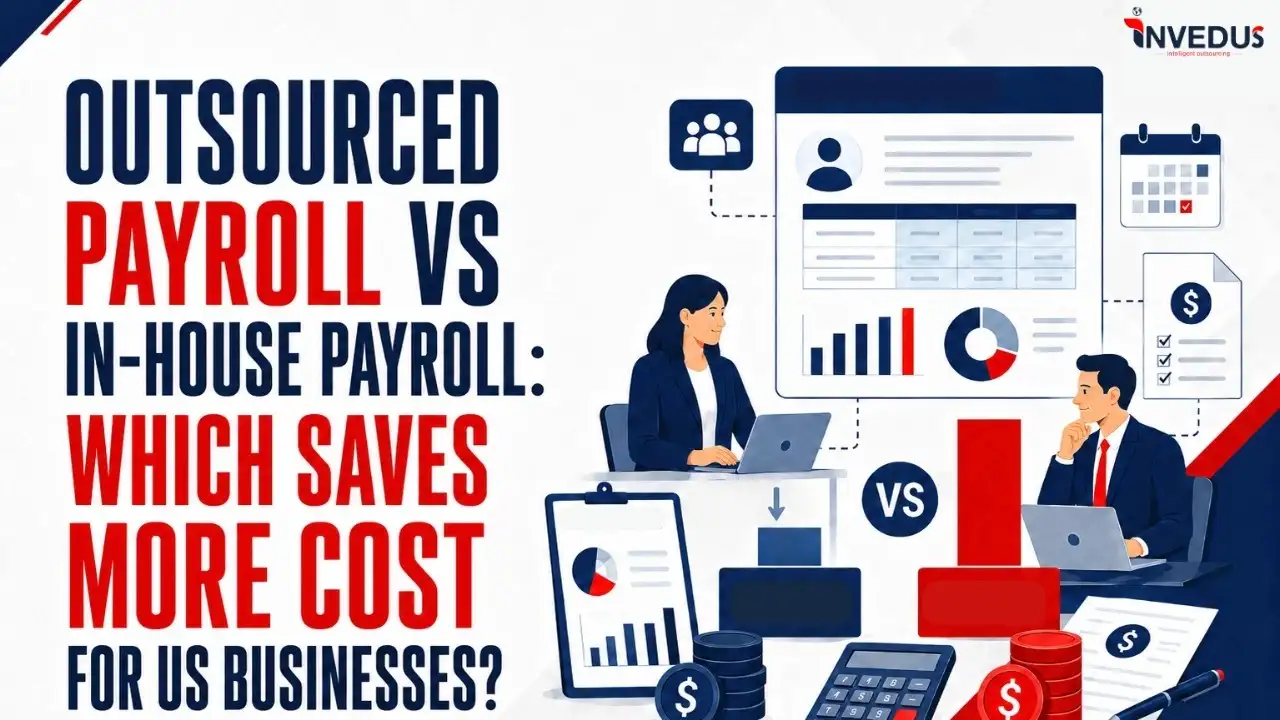
Outsourced Payroll vs In-House Payroll: Which Saves More Cost for US Businesses?

Authored By: Juhi
Juhi is an experienced content creator with a deep understanding of audience engagement and brand...
Key Takeaways
- Outsourced payroll is often more cost-effective for small and mid-sized US businesses once staff salaries, software, compliance work, tax filings, and error correction are included.
- In-house payroll may look cheaper at first, but a US payroll clerk earns around $52,240/year, while outsourced payroll can commonly cost $30-$100 per employee/month.
- Payroll mistakes can become expensive, with errors costing an average of $291 per error and IRS payroll deposit penalties reaching 10%-15% in certain cases.
- Outsourcing becomes more practical as businesses grow, especially when employees work across multiple states, payroll takes several hours each cycle, or HR and finance teams are overloaded.
- Invedus helps US businesses reduce payroll and accounting costs by providing skilled remote payroll professionals from India, starting from $999/month, compared to around $52,240/year for a US payroll clerk.
- The cheapest payroll option is not always the best one; businesses should choose the model that offers accuracy, compliance support, predictable costs, and room to scale.
Managing payroll in-house comes naturally to many businesses. However, many still suffer from tax miscalculations, penalties, and missed deadlines often. Hence, outsourcing payroll has become commonplace for US-based businesses.
But why is that the case? Is there really such a huge difference between in house payroll vs outsourcing? In fact, there is. The main differentiating factor is cost. If you compare, in some instances, outsourced payroll can cost you 50% less than in-house payroll.
What Is In-House Payroll?
In-house payroll means a business manages payroll internally using its own staff, software, systems, and processes. This includes calculating wages and overtime, managing deductions and benefits, filing federal, state, and local payroll taxes, maintaining payroll records, preparing W-2s and 1099s, handling garnishments, correcting errors, and responding to employee payroll queries.
According to the IRS, employers are generally responsible for withholding federal income tax from employee wages, which makes compliance a major part of internal payroll processing.
While in house payroll gives businesses more control and direct visibility over payroll data, it also requires payroll knowledge, software investment, staff training, and continuous compliance management. This is why many businesses compare in house payroll vs outsourcing before deciding which model is more cost-effective.
What Is Outsourced Payroll?
Outsourced payroll means hiring a third-party payroll provider or payroll specialist to manage part or all of your payroll process. This usually includes payroll processing, tax calculations and filings, direct deposits, year-end forms, compliance updates, payroll reports, employee records, deductions, and multi-state payroll support.
However, outsourcing payroll does not mean losing control. Your business still provides employee data, reviews reports, and approves payroll before payments are made. The provider simply handles the execution and compliance-heavy work.
This is one of the key benefits of outsourcing payroll, especially for businesses comparing in house payroll vs outsourcing. Deloitte’s 2024 Global Outsourcing Survey also found that 80% of executives planned to maintain or increase investment in third-party outsourcing. With Invedus, US businesses can hire payroll experts from India at a lower operational cost.
Cost Comparison of In-House Payroll vs Outsourced Payroll
Cost is where the real difference between in house payroll vs outsourcing becomes clear. At first, in house payroll may look cheaper because you are not paying a provider directly.
However, once you add staff time, software, compliance work, tax filing, and error correction, the actual expense can rise quickly. For example, QuickBooks notes that most online payroll services charge a monthly base fee of around $20-$100+ plus a per-employee fee, while hiring a dedicated in-house payroll specialist can average around $64,865 per year.
Paychex also estimates that businesses may spend $30-$100 per person per month for outsourced payroll services.
| Cost Factor | In-House Payroll | Outsourced Payroll |
| Staff cost | Payroll clerk median pay: $25.11/hour or $52,240/year before benefits. (BLS) | Commonly $30–$100 per employee/month. (Paychex) |
| Software | Payroll tools can start around $40/month and exceed $150/month before per-employee fees. (QuickBooks) | Often bundled with payroll service fees. |
| Compliance | IRS payroll deposit penalties can reach 10%-15%. (IRS) | Tax filing and compliance support are usually included in provider fees. |
| Error correction | Payroll errors cost an average of $291 per error. (Business Wire/EY) | Errors may be reduced through payroll systems and expert checks. |
| Scalability | Growth may require more staff, tools, and admin time. | Usually scales by employee count, often $30–$100 per employee/month. (Paychex) |
| Time cost | At $25.11/hour, 10 payroll hours/month equals about $251/month before overhead. (BLS) | Internal time is lower; provider handles most execution. |
| Control | More direct control, but full internal responsibility. | Shared control; business still reviews and approves payroll. |
| Predictability | Costs vary with errors, penalties, software, and staff time. | More predictable monthly or per-employee pricing. |
Hence, outsourced payroll often becomes more cost-effective when businesses calculate the full cost of payroll, not just the visible monthly expense.
The Real Reasons Why Managing Payroll In-House Is Expensive
Managing in house payroll may look affordable at first because there is no monthly outsourcing invoice. However, the real cost is often hidden inside staff time, software, compliance pressure, and payroll mistakes.
Payroll Staff Salaries
Even if a business does not hire a full-time payroll manager, someone still has to calculate wages, review hours, handle deductions, answer employee questions, and run payroll every cycle. This means HR, finance, or admin staff spend paid working hours on payroll instead of business growth.
Payroll Software and System Costs
In-house payroll also needs payroll software, setup, upgrades, integrations, staff training, and sometimes separate tools for time tracking or benefits. These costs can increase as the business grows or adds more employees.
Compliance and Tax Filing Costs
US payroll includes federal, state, and local tax rules. For multi-state businesses, this becomes even more complex. This is where many companies start comparing in house payroll vs outsourcing because compliance mistakes can become expensive.
Error Correction and Penalties
Payroll errors can lead to late payments, tax penalties, employee dissatisfaction, and extra admin work. In comparison, outsourced payroll often gives businesses access to payroll systems and specialists who reduce manual errors.
Opportunity Cost
The highest hidden cost is time. When owners, HR teams, or finance staff are stuck with payroll, they lose time that could be spent on hiring, sales, client service, or growth. That is why outsourcing payroll is often more cost-effective than it first appears.
Which Saves More Cost: In-House Payroll or Outsourced Payroll?
In the short term, in-house payroll may look cheaper for micro businesses with very few employees, simple single-state payroll, affordable software, and an owner or admin who already understands payroll. However, this only works when the internal team can manage payroll accurately without losing too much time to other priorities.
For small and mid-sized businesses, outsourced payroll usually saves more in the long run. A US payroll and timekeeping clerk earns a median wage of $25.11/hour or $52,240/year, before benefits and overhead, according to the Bureau of Labor Statistics.
In comparison, Paychex estimates that outsourced payroll services commonly cost $30-$100 per employee per month. QuickBooks payroll pricing also starts at $44/month plus $6.50 per employee/month for its discounted payroll and accounting bundle.
The difference becomes clearer when the business grows. Outsourcing payroll is usually more cost-effective when:
- Your business is hiring more employees.
- Employees work across multiple states.
- Payroll takes several hours every cycle.
- HR or finance teams are overloaded.
- Payroll errors or tax issues are becoming common.
- You want predictable payroll costs.
So, when comparing in house payroll vs outsourcing, the better long-term option is usually outsourcing. It turns hidden payroll time, compliance pressure, and staffing costs into a clearer monthly expense.
With Invedus, US businesses can also access trained payroll and accounting professionals from India, reducing long-term hiring costs while keeping reliable back-office support.
The starting price offered by outsourcing payroll agencies like Invedus is $7.99/hr, which makes the overall cost of payroll management more affordable. Also, you only pay for the work you need and the hours that you decide to clock.
Overall, outsourcing still stands on top of the list for most use cases.
Cost Factors US Businesses Should Compare Before Deciding on Outsourced Payroll
Before choosing outsourced payroll, US businesses should compare the real cost of both models. The decision is not just about monthly provider fees. It is about time, accuracy, compliance, and long-term scalability.
- Number of employees: More employees mean more wage calculations, deductions, tax filings, and payroll queries.
- Pay frequency: Weekly payroll usually requires more admin time than biweekly or monthly payroll.
- Employee locations: Multi-state teams increase tax, wage, and reporting complexity.
- Current payroll software cost: Software, upgrades, integrations, and training can make in house payroll expensive.
- Internal team time: If HR, admin, or finance spends hours on payroll, that time has a real cost.
- Errors and late filings: Mistakes can lead to penalties, corrections, and employee dissatisfaction.
- Benefits and deductions: Garnishments, commissions, bonuses, and benefits make payroll harder to manage manually.
- Year-end workload: W-2s, 1099s, and reconciliations add extra pressure.
- Data security and future hiring: Growing businesses need secure systems and scalable support.
So, when comparing in house payroll vs outsourcing, the cheapest option is not always the one with the lowest monthly fee. The better choice is the one that offers accurate payroll, compliance support, predictable costs, and room to scale.
How Invedus Helps US Businesses Reduce Payroll and Accounting Costs
If in house payroll is becoming expensive, Invedus gives US businesses a smarter way to build reliable payroll support without hiring locally. Instead of paying a US payroll clerk around $52,240/year, businesses can hire a dedicated Invedus virtual employee from $999/month, or about $11,988/year, saving nearly 77% before benefits and office costs.
Invedus payroll experts can support outsourced payroll because they bring:
- Minimum 3+ years of payroll, bookkeeping, or accounting experience
- Knowledge of payroll processing, reports, deductions, timesheets, and data entry
- Familiarity with 40+ accounting and payroll tools such as QuickBooks, Xero, Zoho, and Excel
- Strong attention to accuracy, deadlines, and confidential employee data
- Relevant finance, accounting, or payroll certifications, depending on the role requirement
For businesses comparing in house payroll vs outsourcing, Invedus offers affordable payroll services with skilled remote professionals from India.
Conclusion
Payroll is hard, but it doesn’t have to be. Rather than urging your team to take charge of in house payroll, try outsourcing it to Invedus.
At first, you may have a hard time with time zones, especially when you outsource to Asian regions. However, cost savings and time efficiency will change your mind. The benefits of outsourcing payroll are immense, starting with savings that contribute directly to your business growth.
Also, with less investment, you get low cost payroll services but a higher quality and accountability. Get office-managed payroll experts from Invedus!
Contact us directly and explore ways in which you can keep saving!

Frequently Asked Questions
What services are included in outsourced payroll?
Outsourced payroll services usually include wage calculations, direct deposit, tax filing, payroll reports, employee records, deductions, W-2s, 1099s, garnishments, and compliance updates. Some providers also support benefits and multi-state payroll requirements.
How secure is outsourced payroll?
Reputable outsourced payroll providers use secure systems, access controls, encryption, and payroll compliance processes to protect sensitive employee data. Security should be a key factor when choosing the best payroll service for small business.
What are the hidden costs of in-house payroll?
Hidden in house payroll costs include staff salaries, software, training, tax filing work, compliance updates, error correction, and year-end reporting. Even unpaid owner time has a cost when it pulls focus from revenue-generating work.
How do I choose the best payroll service for my business?
To choose the best payroll service for small business, compare pricing, tax filing support, software integrations, data security, customer support, scalability, and compliance expertise. The cheapest option is not always the best long-term payroll solution.
Can payroll outsourcing reduce payroll tax, compliance, and administrative costs?
Yes, payroll outsourcing can reduce administrative costs by shifting payroll processing, tax filings, compliance updates, and reporting to specialists. It may not reduce the actual payroll tax owed, but it can reduce errors, penalties, and internal workload.
Can small businesses benefit from outsourcing payroll?
Yes, small businesses can benefit from outsourcing payroll because it reduces the need for dedicated payroll staff, expensive software, and manual tax filing work. It also gives small teams more time to focus on sales, hiring, and operations.
Is outsourced payroll worth it for growing businesses with multi-state employees?
Yes, outsourced payroll is usually worth it for growing businesses with multi-state employees. Each state may have different tax, wage, and reporting rules, so outsourcing helps reduce compliance pressure, payroll errors, and extra admin time.
How do I switch from my current payroll provider to Invedus and save cost?
You can switch to Invedus by sharing your current payroll support needs, team size, tools, and monthly workload. Invedus then helps you hire trained payroll professionals from India, reducing dependency on high-cost local hiring or expensive providers.



Last updated on: Jul 6, 2026