


Step-by-Step Guide to the US Payroll Process in 2026

Authored By: Rifa Hussain
Rifa is a Senior Content Writer at Invedus. She focuses on creating content that aligns...
Key Takeaways
- The US payroll process in 2026 includes a higher Social Security wage base of $184,500 and updated compliance requirements.
- Employers and employees each pay 6.2% Social Security tax and 1.45% Medicare tax on eligible wages.
- The combined FICA tax rate remains 15.3%, making payroll tax planning essential for businesses.
- Payroll mistakes can trigger IRS penalties of up to 25% for late filings and 15% for late tax deposits.
- Invedus helps businesses reduce payroll costs by up to 70% with dedicated payroll experts starting at $7.99/hr or $999/month.
The US payroll process requires employers to navigate new payroll reporting requirements for overtime compensation, updated Form W-4 rules, and a higher Social Security wage. This makes payroll compliance more complex than before.
Understanding payroll processing in 2026 is equally important for small-business owners, HR managers, finance professionals, and startup founders to avoid any penalties.
This step-by-step guide breaks down the US payroll basics from employee onboarding and tax withholding to payroll calculations, tax deposits, reporting, and year-end filing requirements.
Let’s learn how to run payroll accurately, efficiently, and in line with the latest federal regulations.
What is US Payroll Process?
Payroll processing is the systematic process of collecting employee pay data, calculating wages and deductions, and distributing compensation while ensuring compliance with federal, state, and local tax regulations.
It is a core part of the US payroll process because it determines how employees are paid, how payroll taxes are withheld, and how employers meet reporting obligations.
Payroll processing has become more complex due to evolving tax rules, overtime reporting requirements, and the increased Social Security wage base of $184,500.
Employers must accurately calculate federal income tax withholdings, Social Security taxes, Medicare taxes, benefits deductions, and other payroll-related obligations.
You can initiate payroll processing manually through accounting software or by outsourcing payroll processes.
What are the Stages of Payroll Processing?
Most US payroll basics systems follow a three-stage model, including:
1. Data Collection
The payroll cycle begins with gathering employee and payroll information, including:
- Employee hours worked and overtime
- Salary or wage rates
- New hire documentation and Form W-4 data
- Paid time off, bonuses, commissions, and reimbursements
- Benefit deductions and retirement contributions
2. Payroll Calculation
Once payroll data is collected, employers calculate:
- Gross wages
- Overtime pay
- Federal, state, and local tax withholdings
- Social Security and Medicare taxes
- Benefits and voluntary deductions
- Net pay
For 2026, employers and employees each contribute 6.2% in Social Security tax on wages up to $184,500, while Medicare tax remains 1.45% with no wage cap.
3. Payroll Disbursement
The final stage involves distributing employee compensation and meeting employer filing obligations, including:
- Direct deposits or paychecks
- Payroll tax deposits
- Pay stub generation
- Payroll record maintenance
- Required federal and state payroll reporting
This stage ensures employees receive accurate and timely payment while maintaining compliance with tax authorities.
Data Collection → Payroll Calculation → Payroll Disbursement
Many organizations working with remote or overseas employees also evaluate EOR cost factors to understand how employers of record services can impact overall payroll and compliance expenses.
Required Paperwork for Processing USA Payroll
Arranging several documents before initiating the US payroll process is essential. Employers are required to report payroll taxes and wages to the IRS and other tax authorities regularly.
The organized documents have to be further presented to the relevant government bodies, and the company will also keep a copy with itself for evidence of payment to devise financial statements.
Businesses get assistance from Payroll outsourcing service providers in gathering, assembling, and presenting all the elementary documents included in processing the US payroll.
Check out the list below for identifying the basic documents required to process payroll in the USA:
Personal Details of Employees
- Form W-2 (Details about annual wages, bonuses, and withheld taxes of Employees)
- Form W-4 (The amount to be withheld from the paycheck of an employee for federal income taxes/ Withholding certificate of the Employee)
- Form W-9 (Requesting the correct taxpayer identification number and certification)
- Form I-9 (Cross-checking the identity and employment proof of Employees)
- Form 941 ( Payroll taxes reporting collected from each employee along with federal income taxes, social safety taxes, and medicare taxes)
- Form 1099 (Used for reporting payments made to independent contractors.)
- Employment Application
- Details of the Bank
- Medical insurance forms
- Documents for the retirement plan
How to Process US Payroll Step by Step?
Understanding the US payroll process is essential for paying employees accurately, staying compliant with tax laws, and avoiding costly penalties.
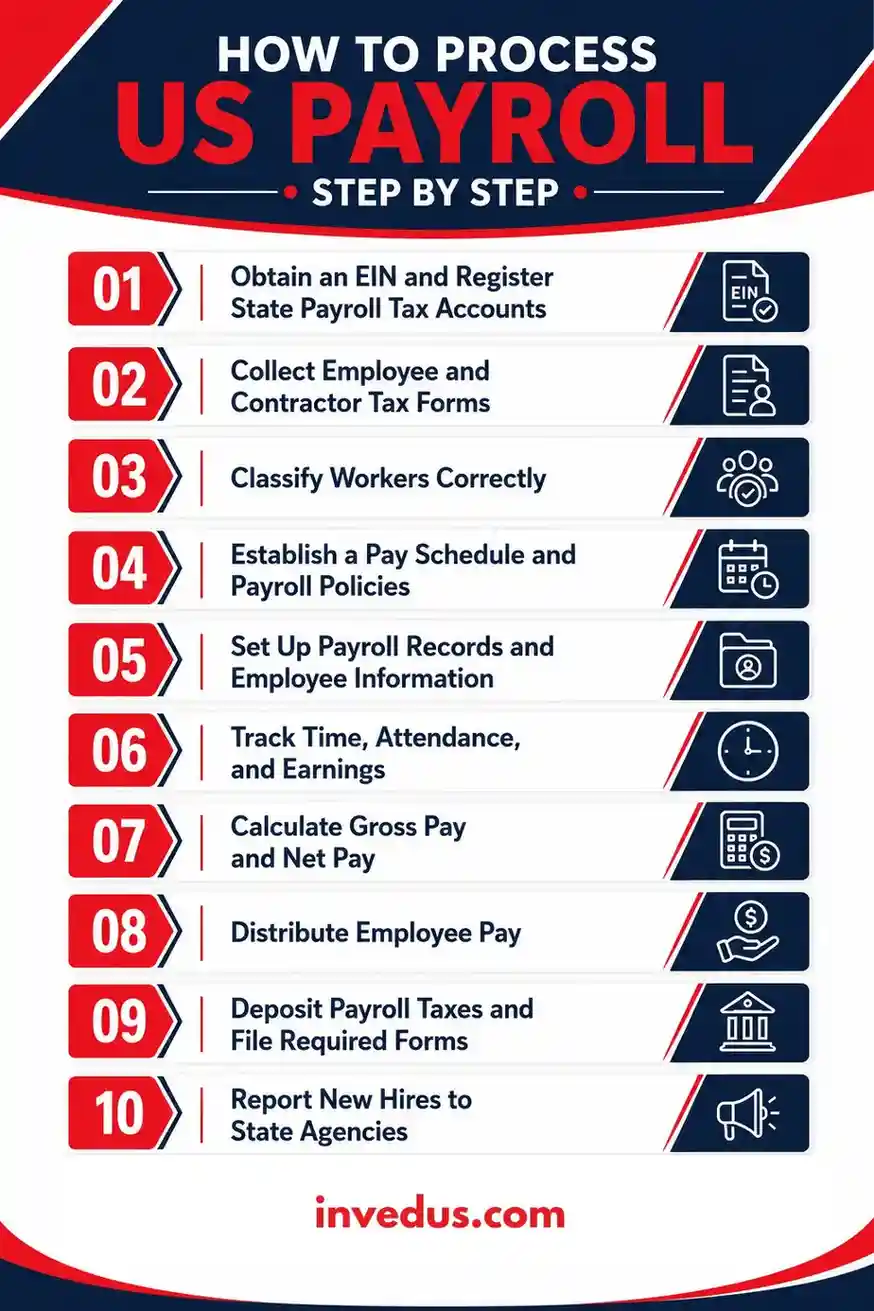
While payroll software has simplified many tasks, employers are still responsible for collecting the right information, withholding taxes correctly, filing payroll forms, and maintaining proper records.
Step 1: Obtain an EIN and Register State Payroll Tax Accounts
Before running payroll, your business must establish its payroll tax identity.
Start by obtaining an Employer Identification Number (EIN) from the IRS. This number is used to report payroll taxes, file employment tax returns, and communicate with federal agencies.
Most employers must also register for state income tax withholding and state unemployment insurance (SUTA) accounts in every state where employees work.
Without these registrations, payroll taxes cannot be reported or remitted correctly.
Step 2: Collect Employee and Contractor Tax Forms
The next step is gathering all required onboarding documents before issuing any payments.
Employees typically complete:
- Form W-4 for federal income tax withholding
- Form I-9 for employment eligibility verification
- State withholding forms, where applicable
Independent contractors should complete Form W-9, which provides the taxpayer information needed for year-end Form 1099-NEC reporting.
Accurate onboarding documentation forms the foundation of compliant Payroll processing in the US.
Step 3: Classify Workers Correctly
The FLSA is the federal law that sets minimum wage, overtime pay, recordkeeping, and youth employment standards. Contractors are generally paid without tax withholding and receive Form 1099-NEC if payments exceed reporting thresholds.
A non-exempt employee is entitled to federal minimum wage protections and must generally receive overtime.
An exempt employee is not eligible for federal overtime pay requirements if they meet specific salary and job-duty tests established under the FLSA.
Common exempt categories include:
- Executive employees
- Administrative employees
- Professional employees
- Certain computer employees
- Outside sales employees
Minimum wage: Covered non-exempt employees must earn at least the federal minimum of $7.25 per hour. Where state and federal minimum wage laws both apply, the employee is entitled to the higher rate. U.S. Department of Labor.
Overtime: Non-exempt employees must be paid at least 1.5 times their regular rate for any hours worked over 40 in a workweek.
Misclassification can result in tax liabilities, penalties, and audits.
Step 4: Establish a Pay Schedule and Payroll Policies
Employers must determine how often employees will be paid and communicate payroll policies clearly.
Common pay frequencies include:
- Weekly
- Biweekly
- Semi-monthly
- Monthly
The chosen schedule should align with state wage payment requirements and company cash flow. Many businesses also establish policies for overtime, paid time off, bonuses, commissions, expense reimbursements, and timekeeping at this stage.
Step 5: Set Up Payroll Records and Employee Information
Before the first payroll run, create payroll records for each worker.
This includes compensation details, tax withholding elections, benefit deductions, direct deposit information, retirement contributions, and other payroll-related data. Maintaining complete employee records helps in accurate calculations and simplifies future audits or reporting requirements.
Step 6: Track Time, Attendance, and Earnings
For hourly employees, payroll begins with accurate time tracking. Employers must collect information related to:
- Regular hours worked
- Overtime hours
- Paid leave
- Sick leave
- Bonuses and commissions
- Expense reimbursements
Accurate timekeeping is particularly important because wage-and-hour violations remain one of the most common payroll compliance issues.
Step 7: Calculate Gross Pay and Net Pay
Apply all required deductions, including federal income tax withholding, Social Security tax, Medicare tax, state taxes, benefits deductions, retirement contributions, garnishments, and other applicable withholdings.
Gross Pay: For hourly employees, multiply hours worked, including overtime, by the hourly wage rate. For salaried employees, determine pay by dividing the annual salary across the applicable pay periods.
Pre-Tax Deductions: Deduct eligible pre-tax benefits such as health insurance premiums, traditional 401(k) contributions, health savings accounts (HSAs), and other qualified employee benefit plans.
Tax Withholdings:
- Calculate federal income tax withholding using the employee’s Form W-4 information.
- Withhold Social Security tax at 6.2% (up to the annual wage limit) and Medicare tax at 1.45% of taxable wages.
- Apply any required state and local income tax withholdings based on the employee’s work and residence location.
The result is the employee’s net pay. It is the amount actually received through direct deposit or paycheck.
Step 8: Distribute Employee Pay
Once calculations are complete, employers can distribute wages through direct deposit, payroll cards, or paper checks.
Employees should receive detailed pay statements showing earnings, taxes withheld, deductions, and net pay. Many states require employers to provide payroll records or pay stubs each pay period.
Step 9: Deposit Payroll Taxes and File Required Forms
Payroll responsibilities do not end after employees are paid. Employers must deposit federal payroll taxes and file required employment tax returns according to IRS schedules. Common filings include:
- Form 941 for quarterly federal payroll tax reporting
- Form 940 for annual Federal Unemployment Tax (FUTA) reporting
- Form W-2 for employee wage reporting
- Form 1099-NEC for qualifying contractor payments
The IRS requires Forms 941 to be filed quarterly, while Forms W-2 and Form 940 generally have annual filing deadlines.
Step 10: Report New Hires to State Agencies
Federal law requires employers to report newly hired and rehired employees to designated state agencies within prescribed deadlines.
New-hire reporting helps states administer child support enforcement programs and prevent unemployment insurance fraud. Requirements vary by state, so employers should verify local reporting timelines.
What are US Payroll Taxes 2026 Rates?
Understanding payroll taxes is one of the most important parts of running payroll correctly in the United States.
Employers are responsible not only for withholding taxes from employee paychecks but also for matching certain taxes, depositing payments on time, and filing payroll tax returns with federal and state agencies.
Read Also:
The table below summarizes the key federal payroll tax rates that employers and payroll professionals should know in 2026.
Federal Payroll Tax Rates for 2026
|
Payroll Tax |
Employee Rate |
Employer Rate |
Wage Base / Threshold |
Who Pays? |
|
Social Security (OASDI) |
6.2% |
6.2% |
First $184,500 of wages |
Employee & Employer |
|
Medicare (HI) |
1.45% |
1.45% |
No wage cap |
Employee & Employer |
|
Additional Medicare Tax |
0.9% |
None |
Wages over $200,000 |
Employee Only |
|
Federal Unemployment Tax (FUTA) |
None |
6.0% |
First $7,000 paid to each employee |
Employer Only |
|
Effective FUTA Rate |
None |
0.6% |
First $7,000 paid to each employee |
Employer Only |
FICA Tax Breakdown for 2026
The Federal Insurance Contributions Act (FICA) consists of Social Security and Medicare taxes.
|
FICA Component |
Employee Share |
Employer Share |
Combined Rate |
|
Social Security |
6.2% |
6.2% |
12.4% |
|
Medicare |
1.45% |
1.45% |
2.9% |
|
Total FICA |
7.65% |
7.65% |
15.3% |
For most employees, the standard FICA withholding rate is 7.65%, while employers contribute an equal 7.65% match. Combined, the total FICA tax burden equals 15.3% of taxable wages.
Employees earning more than $200,000 annually may also owe the Additional Medicare Tax of 0.9%.
Example
Suppose an employee earns $100,000 annually in 2026:
- Social Security Tax: $100,000 × 6.2% = $6,200
- Medicare Tax: $100,000 × 1.45% = $1,450
- Total Employee FICA Withholding: $7,650
- Employer FICA Match: $7,650
- Total FICA Contribution: $15,300
This example illustrates why payroll tax compliance is a critical component of payroll budgeting and workforce planning.
Sources
- IRS Topic No. 751 – Social Security and Medicare Withholding Taxes
- IRS Topic No. 560 – Additional Medicare Tax
- Social Security Administration – Maximum Taxable Earnings 2026
- IRS Publication 926 (2026)
Understanding Payroll Cycles & Scheduling in the US
The right payroll cycle affects employee satisfaction, cash flow management, overtime calculations, and administrative workload.
In the United States, employers typically choose between four payroll frequencies: weekly, biweekly, semi-monthly, and monthly.
According to Bureau of Labor Statistics data, biweekly payroll is the most common pay schedule among private employers, accounting for nearly half of all payroll arrangements.
Weekly payroll is especially common in industries with hourly workers, while semi-monthly and monthly schedules are more frequently used for salaried employees.
|
Payroll Schedule |
Paychecks Per Year |
Typical Pay Dates |
Best For |
Pros |
Cons |
|
Weekly |
52 |
Every Friday or fixed weekday |
Construction, hospitality, retail, manufacturing, hourly workers |
Employees receive wages faster, overtime calculations are simpler, improves employee satisfaction |
Highest administrative burden and payroll processing costs |
|
Biweekly |
26 |
Every other Friday |
Most small and mid-sized businesses |
Most popular option, easier overtime calculations, predictable schedule, balances efficiency and employee expectations |
Some months contain three paydays, requiring additional cash flow planning |
|
Semi-Monthly |
24 |
15th and last day of month |
Salaried and professional employees |
Aligns well with monthly accounting and benefits administration, lower processing costs than weekly payroll |
Overtime calculations can become more complex because pay periods rarely align with workweeks |
|
Monthly |
12 |
One fixed date each month |
Executives, international teams, some professional firms |
Lowest payroll administration cost and fewest payroll runs |
Long gap between paychecks, less popular with employees, restricted by many state laws |
State Pay-Frequency Laws Can Override Employer Preferences (Important)
Although federal law does not specify how often employees must be paid, most states have payday laws that establish minimum pay-frequency requirements. These laws vary significantly by state and sometimes by employee classification.
For example:
- New York generally requires manual workers to be paid weekly, while most other employees must be paid at least semi-monthly.
- California generally requires wages to be paid at least twice each calendar month.
- Connecticut generally requires employees to be paid at least biweekly.
- Texas allows employers greater flexibility but still requires compliance with designated payday rules.
Because pay rules vary by state, employers should check the laws in each state where employees work. They should do this before they set a payroll schedule.
Common US Payroll Penalties to Avoid
- Failure to Deposit Penalty: This applies to late or incorrect federal tax deposits. The IRS charges it on a four-tier scale. The penalty is 2% of the unpaid deposit if it is 1 to 5 days late, 5% if it is 6 to 15 days late, 10% if it is more than 15 days late. It can go upto 15% if it remains unpaid for more than 10 days after an IRS notice. irs
- Form 941 Late-Filing Penalty: If you file your quarterly federal payroll tax return late. The penalty is 5% of the unpaid tax for each month, or part of a month. The maximum penalty is 25%. Taxzerone
- Trust Fund Recovery Penalty: If you fail to pay withheld taxes, the IRS may assess this penalty. It can apply to responsible individuals personally. It equals 100% of the trust fund taxes withheld or required from employee paychecks. W Tax Group
- Worker Misclassification Penalties: Treating an employee as an independent contractor can lead to back taxes. It may also result in penalties and interest. If fraud is suspected, more penalties may apply. In some cases, it can lead to criminal charges. W Tax Group.
Most of these penalties trace back to the same root cause: how payroll gets handled in the first place. That is why choosing the right payroll processing method and the right partner is the single biggest factor in whether your business stays compliant or ends up paying for avoidable mistakes.
How to Choose the Right Payroll Processing Method?
Every US business runs payroll one of three ways: manually in-house, with payroll software, or by outsourcing to a provider.
Here’s an honest look at all three:
1. In-House US Payroll Process
You hire a payroll expert to calculate wages, withholdings, and tax deposits by hand or in a spreadsheet, then file every form directly with the IRS and state agencies.
Cost: According to the U.S. Bureau of Labor Statistics, the median annual wage for payroll and timekeeping clerks was tied to a broader financial clerk median of $48,650.
How it’s handled: Every calculation, deposit deadline, and year-end form is your responsibility, with no automation or external safety net to catch an error before the IRS does.
|
Pros |
Cons |
|
No subscription or service fee |
Highest risk of the costly errors behind employment-tax penalties |
|
Complete control over every step |
Extremely time-consuming and hard to scale |
|
No third-party data sharing |
You alone must track every tax-law and wage-base change |
2. Payroll Software
Payroll software automates wage calculations, applies current tax tables, runs direct deposit, and on most plans files your payroll taxes.
Cost: A recurring subscription that scales with headcount, typically billed as a base fee plus a per-employee charge each month. It reduces manual effort, but the cost climbs as you add employees, run payroll more frequently, or file in additional states.
How it’s handled: Mostly automated, but you still own the outcome. You enter the data, approve each run, confirm every filing, and remain legally responsible.
|
Pros |
Cons |
|
Automates calculations and most tax filing |
You remain fully responsible for accuracy and deadlines |
|
More affordable than hiring in-house staff |
Multi-state setup and complex pay still fall on you |
|
Scales with small to mid-sized teams |
Recurring cost grows with every employee and pay run |
3. Outsourcing / Payroll Processing Services
With outsourcing, a dedicated provider runs payroll end-to-end.
Cost: A predictable monthly fee that, for most businesses, costs less than the all-in price of an in-house hire. Set against the cost of an in-house payroll hire and the $255.5 billion in penalties the IRS assessed on businesses in 2025, outsourcing converts an unpredictable risk into a fixed, manageable line item.
Also Read-: How Much Does Payroll Outsourcing Cost in 2026?
How it’s handled: Almost entirely by the provider. Their specialists track changing tax rates, the $184,500 wage base, new tip and overtime reporting rules, and multi-state filing requirements, while your team simply approves each run.
|
Pros |
Cons |
|
Lowest compliance and error risk. Experts own the filings |
Monthly fee can be costly in US |
|
Frees your team from nearly all payroll admin |
Requires sharing employee data |
|
Handles multi-state, tips, and complex pay automatically |
Less hands-on, day-to-day control of the process |
Choosing the Right Payroll Processing Services Provider in the US
Hiring payroll professionals in the United States can be expensive. According to Glassdoor, the average Payroll Specialist earns approximately $66,000 per year, while Senior Payroll Specialists earn more than $70,000 annually.
In addition to salaries, employers must invest in payroll software, compliance training, tax filing support, employee benefits, and ongoing payroll administration. This is one of the primary reasons many organizations now outsource Payroll processing in the US.
Offshore payroll support offers a more cost-effective alternative. By leveraging qualified payroll professionals in global talent markets, businesses can often reduce payroll administration costs by up to 70%.
With Invedus, businesses can hire a dedicated payroll expert or a VA starting at $7.99/hr or $999/mo for full-time. Our specialists support payroll administration, employee onboarding documentation, payroll data management, reporting, and compliance activities while helping organizations significantly reduce operating costs.





Last updated on: Jul 1, 2026