


How to Hire a Remote Tax Preparer for Your Business in 2026

Authored By: Rifa Hussain
Rifa is a Senior Content Writer at Invedus. She focuses on creating content that aligns...

Fact-checked By: Abhishek Sharma
10 years of experience in accounting, AP (P2P), invoice processing, and international payments across MNC...
Key Takeaways!
- The U.S. Bureau of Labor Statistics projects around 124,200 accountant and auditor openings every year between 2024 and 2034, making tax talent harder to hire.
- Outsourcing routine tax returns like Form 1040s, W-2s, and 1099s helps firms increase capacity while allowing in-house CPAs to focus on complex advisory work.
- Hiring a remote tax preparer requires more than technical skills, secure onboarding, clear KPIs, workflow tracking, and IRS-compliant data security are equally important.
- The cost of hiring a tax professional typically ranges from $150 to $1,500+, while outsourcing models offer flexible pricing based on workload and engagement type.
- Before choosing a tax outsourcing partner, evaluate U.S. tax expertise, security practices, transparent pricing, certifications, scalability, and proven client experience.
Every tax season brings the same question: how do you handle more work with fewer qualified accountants? For many firms, the answer is to hire remote tax preparers. Remote talent helps businesses expand capacity, meet tight filing deadlines, and deliver consistent service without being limited by local hiring.
As the AICPA’s 2025 Trends Report shows, the accounting talent pipeline continues to shrink, with graduates down 6.6% year over year even as most firms plan to maintain or increase hiring. Combined with secure cloud-based tax software and digital workflows, remote tax preparation has become a practical solution.
However, outsourcing delivers the best results only when you know what to outsource, when to do it, and how to manage the process effectively.
How To Hire a Tax Preparer?
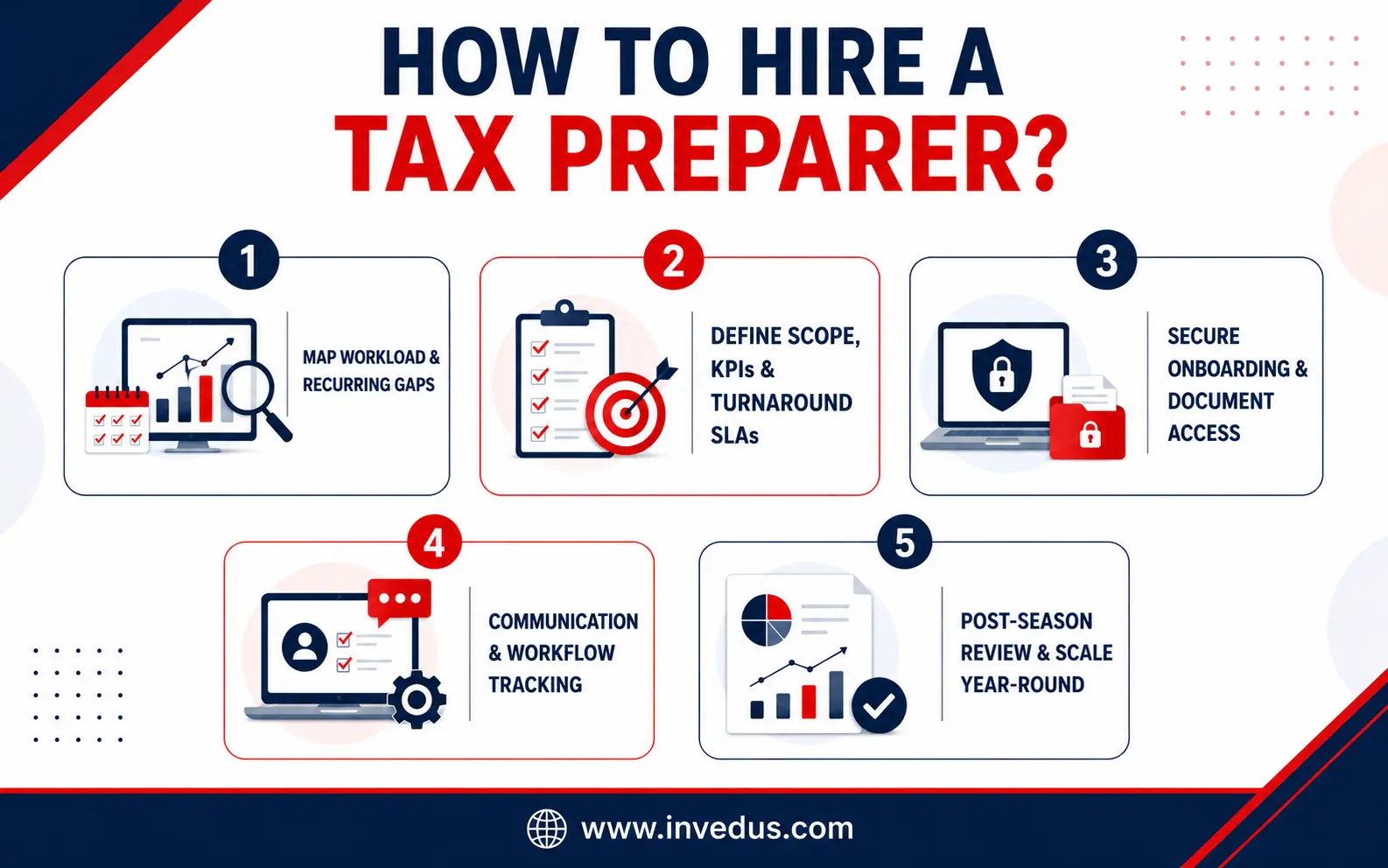
Outsourcing works best when it’s treated as an extension of your firm and not a one-time staffing fix. The goal is to add capacity without disrupting quality, deadlines, or client experience. Here’s a practical process that many successful firms follow.
1. Map Your Seasonal Workload and Recurring Gaps
Start by reviewing the last two or three tax seasons. Identify when your team gets overloaded, which return types create bottlenecks, and where turnaround times begin slipping. Look at metrics such as pending returns, overtime hours, review backlogs, and client extensions.
Instead of outsourcing everything, focus on repetitive, high-volume work that consistently slows your firm down.
2. Define Scope, KPIs, and Turnaround SLAs
Before you hire a tax preparer, decide which returns the remote team will prepare, who will perform the final review, and where responsibilities will end.
Establish measurable KPIs such as:
- Turnaround time per return
- Accuracy and rework rate
- On-time delivery percentage
- Review completion time
- Client deadline compliance
Clear service-level agreements (SLAs) reduce confusion, improve accountability, and keep both in-house and outsourced teams working toward the same expectations.
3. Secure Onboarding and Document Access
Security should be built into the onboarding process from day one. Provide access only to the applications, client files, and tax software required for assigned work. Use role-based permissions, multi-factor authentication (MFA), encrypted document sharing, and secure remote access.
Document your workflows, naming conventions, review procedures, and escalation process so every remote tax preparer follows the same standards as your internal staff.
4. Communication Rhythm and Workflow Tracking
Set a predictable rhythm from the beginning. Daily check-ins during peak season, shared task dashboards, and centralized workflow software help everyone understand priorities, deadlines, and review status. Questions should be resolved quickly instead of sitting in email threads for hours.
When work is tracked in one system rather than across spreadsheets and inboxes, partners gain better visibility into capacity, workload, and project progress throughout the season.
5. Post-Season Review and Scale Year-Round
Don’t wait until the next busy season to evaluate your outsourcing strategy. After filing deadlines, review performance against the KPIs you established. Measure turnaround times, error rates, communication efficiency, and overall workload reduction.
Many firms begin with seasonal support and gradually expand services into bookkeeping, payroll, sales tax, financial statement preparation, or recurring compliance work.
Which Tax Returns Can You Outsource?
The best-performing firms don’t outsource everything; they outsource the right work. This approach helps firms increase capacity without compromising quality or client relationships.
Tier 1: Simple 1040s, Data Entry, and 1099s (Outsource)
Simple individual returns, routine data entry, W-2 and 1099 processing, document organization, and basic Form 1040 preparation are well-suited for outsourcing.
A skilled remote tax preparer can collect source documents, enter data into tax software, reconcile information, and prepare returns for final review.
The IRS defines Form 1040 as the standard federal income tax return for individuals, making it one of the most common returns prepared during tax season.
Tier 2: Business Returns (1065, 1120, 1120S) and Multi-State Filings (Outsource with Review)
Partnership returns (Form 1065), C corporation returns (Form 1120), and S corporation returns (Form 1120-S) often involve financial reconciliations, depreciation schedules, K-1 reporting, and entity-specific tax rules.
The IRS specifies that Form 1120 is used by domestic corporations to report income, deductions, credits, and tax liability, while Form 1120-S is used by S corporations to report business income and shareholder information.
Tier 3: Complex Returns, High-Net-Worth Clients, and Advisory Work
Returns involving high-net-worth individuals, international taxation, trusts, estates, business restructuring, or unusual tax positions. These engagements require professional judgment, client-specific planning, risk assessment, and strong communication.
The AICPA has published guidance and recommendations on complex tax issues involving areas such as foreign investments, trusts, estates, charitable deductions, and electronic filing because these engagements often require interpretation rather than routine preparation.
Why Outsource Tax Preparation Services?
Outsourcing tax preparation allows firms to maintain consistent turnaround times, accept more clients during peak season, and dedicate more time to advisory services instead of routine compliance work.
This improves client satisfaction while helping firms grow without compromising service quality.
The Accountant Shortage
Finding experienced tax professionals isn’t as easy as it used to be. The accounting talent pipeline has been shrinking for years, while demand for qualified professionals continues to grow.
According to the U.S. Bureau of Labor Statistics (BLS), employers will need to fill approximately 124,200 accountant and auditor positions each year between 2024 and 2034.
At the same time, the AICPA has acknowledged an ongoing talent pipeline challenge and continues to invest in long-term initiatives to address the shortage. Fewer accounting graduates and CPA candidates mean firms are competing for a smaller pool of qualified professionals.
Burnout and the Turnover Cycle
Every tax season follows the same pattern. Returns pile up, deadlines tighten, and existing staff work longer hours to keep clients satisfied. Over time, that pressure leads to burnout, and burnout leads to resignations. This makes the staffing problem even worse the following season.
Replacing experienced tax professionals isn’t quick or inexpensive. New hires require recruiting, onboarding, and training before they become fully productive.
Rather than repeatedly rebuilding their teams, many firms use remote tax services to reduce pressure on in-house staff. This allows permanent employees to focus on advisory work, complex tax planning, and client relationships.
The Capacity-vs-Demand Mismatch
During filing season, workloads can multiply in just a few weeks, creating a capacity problem rather than a productivity problem. Even large firms can struggle when client demand suddenly exceeds the number of available preparers.
Hiring permanent employees for a short seasonal spike rarely makes financial sense. Instead, firms bring in additional tax professionals only when demand increases.
Margin Compression vs. Rising Salaries
The cost of hiring accounting talent continues to rise, but clients don’t always accept equivalent fee increases. As salaries, employee benefits, office expenses, and recruitment costs grow, profit margins become harder to maintain.
Outsourcing helps firms control those costs without compromising service quality. Instead of carrying year-round payroll for seasonal demand, firms can hire a tax preparer on demand.
Cost of Hiring a Tax Professional
The cost of hiring a tax professional in the U.S. generally ranges from $150 to $1,500+, depending on the complexity of your tax return, the preparer’s credentials, and your location.
Simple individual returns cost significantly less than business, investment, or rental property filings, while professionals in large cities typically charge higher fees than those in smaller markets.
Average Cost by Tax Return Type
The more forms, schedules, and documentation your return requires, the more you’ll pay for professional preparation.
|
Tax Return Type |
Typical Cost |
Source |
| Simple W-2 (Form 1040, standard deduction) | $200–$300 | |
| Itemized Deductions (Schedule A) | $300–$450 | |
| Self-Employed / Freelancer (Schedule C) | $400–$800 | |
| Rental Property or Investments (Schedule E) | $500–$1,500+ |
Average Cost by Tax Professional
Who you hire also affects the final price.
|
Tax Professional |
Typical Cost |
Source |
| Enrolled Agent (EA) | $150–$400 per hour (≈$200–$400 per standard return) | |
| Certified Public Accountant (CPA) | $175–$500 per hour, or ~$220–$800+ per standard return | |
| Tax Attorney | $200–$600+ per hour |
What Affects the Cost to Hire a Tax Preparer?
- Complexity of your tax return and required schedules.
- Professional credentials (EA, CPA, or tax attorney).
- Business ownership, investments, or rental properties.
- Geographic location, with coastal and metropolitan areas generally charging more.
- Whether the preparer charges a flat fee or an hourly rate.
Onshore vs. Offshore Outsourcing Models
Understanding each outsourcing model makes it easier to choose the one that fits your practice.
Per-return model
This model charges a fixed fee for each completed tax return. It’s ideal for firms with seasonal or unpredictable workloads because you only pay for the work completed. If you occasionally need a remote tax preparer during busy months, this option provides flexibility without a long-term commitment.
Dedicated FTE (Full-Time Equivalent)
With a dedicated FTE model, you hire a full-time remote tax professional who works exclusively for your firm. This provides consistent capacity, deeper familiarity with your workflows, and better productivity for firms handling a steady volume of tax returns throughout the year.
Managed partner model
A managed outsourcing partner provides an entire team rather than a single preparer. The provider handles recruitment, training, quality assurance, scheduling, and operational management while your firm focuses on reviewing returns and serving clients.
Cost Comparison by Model
While pricing varies by complexity and provider, the differences between engagement models are consistent.
|
Outsourcing Model |
Typical Cost |
Source |
| Per-return | Offshore: $10–$25 per individual return; Onshore: $35–$75 per individual return | Countsure |
| Dedicated FTE | Offshore dedicated professionals typically $1,200–$3,500 per month, depending on experience and responsibilities | Countsure |
| Managed partner | Monthly retainers generally $1,500–$5,000+ depending on team size and scope of services | Countsure |
For comparison, the U.S. Bureau of Labor Statistics reports that tax preparers earn an average annual wage of approximately $58,000, before adding payroll taxes, employee benefits, office space, software, and recruitment costs.
Is Hiring a Remote Tax Preparer Compliant?
Outsourcing tax preparation is legal, but it comes with clear responsibilities. If you hire a remote tax preparer or offshore team, compliance with Internal Revenue Code (IRC) Section 7216 isn’t optional.
The IRS has specific rules about when taxpayer information can be shared and when written consent is required.
What does Section 7216 Requires?
IRC Section 7216 protects a taxpayer’s return information from being disclosed or used for purposes other than preparing their tax return.
In general, a tax return preparer cannot knowingly or recklessly disclose a client’s tax information without authorization unless a specific exception applies under the Treasury Regulations. Violations can result in criminal penalties, including fines and possible imprisonment.
The regulations also distinguish between disclosures that are automatically permitted and those that require the taxpayer’s written consent.
The Separate Signed-Consent Rule for Offshore Preparation
If you hire a tax preparer located outside the United States and that preparer will have access to a client’s tax return information, the IRS generally requires a separate, informed, written consent from the taxpayer before the information is disclosed overseas.
This consent cannot be bundled into an engagement letter or hidden within other documents. It must clearly explain what information will be shared, with whom, and for what purpose.
Is Hiring Remote Tax Preparer Secure?
When you work with a remote tax preparer or use remote tax services, security should be your first concern.
Tax returns contain Social Security numbers, financial records, and other sensitive taxpayer information. Before you hire a tax preparer or share a single client file, verify that the provider follows recognized security standards and IRS requirements.
SOC 2 Type II & ISO 27001
You’ll often see providers advertise SOC 2 Type II or ISO 27001 certifications, but they serve different purposes.
- SOC 2 Type II evaluates whether a company’s security controls are not only properly designed but also operate effectively over a period of time. Instead of reviewing security at a single point, it measures how consistently those controls are followed in daily operations. (IBM)
- ISO/IEC 27001 is an international standard for establishing and maintaining an Information Security Management System (ISMS). It requires organizations to identify risks, implement security controls, and continually improve their information security practices.
Neither certification guarantees that a provider will never experience a cyberattack, but they do show that independent audits have assessed the organization’s security processes against established standards.
Encrypted Transfer, Role-Based Access & WISP
Security doesn’t stop with certifications. The way taxpayer data is handled every day matters even more.
The IRS requires tax professionals to maintain a Written Information Security Plan (WISP) under the FTC Safeguards Rule. A WISP documents how taxpayer information is collected, stored, shared, protected, and how the firm responds to security incidents. The IRS also recommends reviewing and updating the plan regularly as risks and business operations change.
When evaluating remote tax services, confirm that they use:
- End-to-end encrypted file transfers instead of email attachments.
- Role-based access controls, so employees only access the client information necessary for their work.
- Multi-factor authentication (MFA) for all systems handling taxpayer data.
- A documented WISP and incident response plan that complies with IRS and FTC security requirements.
A Step Closer to a Stronger Partner
If you’re looking for a partner that checks all these boxes, Invedus offers a practical solution for firms that want to scale without increasing permanent overhead. The company provides dedicated tax preparers as part of its accounting and finance outsourcing services, allowing businesses to build remote teams that work as an extension of their in-house staff.
Unlike freelance marketplaces, Invedus provides office-managed, pre-vetted professionals backed by an operations team.
Businesses benefit from vetted talent, English-language proficiency, IP protection, non-disclosure agreements, and the flexibility to scale resources as workloads change.
We also offer monthly rolling contracts for firms to increase or reduce capacity without long-term commitments.

FAQs
How do I hire a remote tax preparer for my firm?
Start by identifying seasonal workload gaps and defining the scope of work. Set clear KPIs, turnaround expectations, and service-level agreements. Ensure secure onboarding with role-based access, encrypted document sharing, workflow documentation, and regular communication to maintain quality and productivity.
Can a remote tax preparer meet my firm's filing deadlines?
Yes. A remote tax preparer can help firms meet filing deadlines by increasing capacity during busy seasons. With defined KPIs, shared workflow tracking, daily check-ins, and clear turnaround expectations, firms can maintain consistent delivery without compromising service quality.
What hours does a remote tax preparer typically work?
A dedicated remote tax preparer typically works 40 hours per week, just like an in-house employee. They integrate with your team, follow your preferred schedule, and provide consistent support throughout tax season and year-round.
Is it secure to share client tax documents with a remote preparer?
Yes, provided proper security measures are in place. The blog recommends encrypted file transfers, role-based access controls, multi-factor authentication, a Written Information Security Plan (WISP), and providers with security frameworks like SOC 2 Type II or ISO 27001.
Can a remote tax preparer work with my U.S. tax software?
Yes, choosing a provider experienced with U.S. tax laws and familiar with leading tax software such as UltraTax CS, Drake, ProSeries, Lacerte, and CCH Axcess, enabling seamless integration with your firm's existing workflow.
Is hiring a remote tax preparer cost-effective?
Yes. Hiring a remote tax preparer helps firms reduce overhead by avoiding year-round payroll, recruitment, and office expenses. Flexible outsourcing models allow businesses to pay based on workload while maintaining service quality and improving profit margins during peak seasons.
Why choose Invedus to hire a remote tax preparer?
Invedus provides pre-vetted, office-managed remote tax professionals supported by an operations team. Businesses benefit from English-speaking talent, IP protection, NDAs, scalable staffing, and flexible monthly rolling contracts, making it easier to expand or reduce capacity as workloads change.




Last updated on: Jul 6, 2026