


How Much Does Payroll Outsourcing Cost in 2026?

Authored By: Aleeza
Aleeza is a passionate content writer at Invedus, specializing in creating engaging and insightful content...

Fact-checked By: Pritpal Singh
UK accountant with 9+ years’ experience in taxation, audit, budgeting and management reporting.. He has...
Key Takeaways!
- Payroll outsourcing cost in 2026 ranges from $50–$500/month for small businesses, while larger companies may spend $2,500–$25,000+ annually, depending on workforce size and compliance requirements.
- Most payroll providers follow a pricing structure of a $20–$100 monthly base fee plus $4–$15 PEPM, making payroll services costs scalable as businesses grow.
- In-house payroll teams can cost businesses $54,000–$82,000 annually, making outsource payroll cost models a practical option for companies focused on reducing overhead.
- Outsourcing payroll services cost varies widely because payroll frequency, employee count, compliance complexity, HR involvement, and workforce distribution directly impact pricing.
- Hidden charges like W-2 processing, payroll corrections, off-cycle payroll runs, and multi-state tax filing can significantly increase payroll outsourcing cost if businesses only compare advertised monthly pricing.
One payroll mistake can trigger tax penalties, compliance issues, frustrated employees, and hours of administrative chaos. Yet in 2026, thousands of businesses still rely on outdated spreadsheets, manual calculations, or overloaded in-house teams to manage payroll operations.
Payroll outsourcing cost is by far more manageable than sudden penalties. With changing tax regulations, remote workforce policies, overtime compliance rules, and multi-state employment laws, payroll management has become far more complex than simply processing salaries on time.
On the other hand, the IRS continues to impose penalties for late deposits, incorrect filings, and payroll tax errors, with penalties reaching up to 25% of unpaid taxes in certain cases.
This blog will tell why outsourcing payroll to a dedicated team or hiring payroll experts is a need in 2026!
What is Payroll Outsourcing?
Payroll outsourcing is the process of hiring a third-party provider to manage payroll-related tasks. This includes salary processing, tax calculations, direct deposits, compliance reporting, employee benefits deductions, and payroll tax filings.
Instead of handling payroll manually through an in-house team, businesses outsource these responsibilities to specialized payroll professionals who use automated systems and compliance expertise.
Payroll outsourcing has become increasingly popular among startups, SMBs, and global companies. This is mainly due to rising compliance complexities and changing labor regulations. It is also a cost-effective option!
Payroll outsourcing cost usually depend on factors such as company size, number of employees, payroll frequency, tax requirements, and additional HR services.
Let us discuss how much does a payroll service cost in 2026!
What Is the Cost of Payroll Outsourcing in 2026?
Payroll service pricing in 2026 varies significantly based on company size, payroll complexity, and compliance requirements. However, industry-wide pricing data shows that most U.S. businesses follow a fairly consistent payroll pricing structure built around a monthly base fee plus a per-employee charge.
For example, a business with 15 employees typically spends around:
|
Payroll Model |
Estimated Monthly Cost |
|
Basic payroll software |
$70–$150 |
|
Full-service payroll |
$150–$350 |
|
Advanced payroll + HR support |
$300–$900+ |
These costs generally include:
- Direct deposit processing
- Payroll tax calculations
- W-2 and 1099 generation
- Basic compliance reporting
- Employee self-service portals
- Standard payroll support
Payroll outsourcing cost is largely influenced by the business size. Given that, here is what you can expect when you hire payroll experts:
|
Business Size |
Software-Based Range (2026) |
Delegated Team Estimate (2026) |
Notes |
|
Solo / Freelancer |
$35–$90/month |
Not typically required |
Most solo businesses rely on cloud payroll software with base fees + contractor support |
|
1–10 Employees |
$50–$250/month |
$250–$700/month |
Full-service payroll outsourcing becomes practical once compliance and tax filing complexity increase |
|
11–50 Employees |
$250–$900/month |
$800–$2,500/month |
Businesses often add HR support, benefits administration, and multi-state payroll management |
|
51–100 Employees |
$900–$2,500/month |
$2,500–$6,000/month |
Mid-sized firms increasingly outsource payroll operations to reduce compliance burden and staffing overhead |
|
100–500 Employees |
$2,500–$8,000+/month |
$6,000–$25,000+/month |
Enterprise payroll pricing rises due to integrations, global payroll, benefits, workforce compliance, and dedicated payroll teams |
In 2026, payroll services in the U.S. typically cost between $50–$500/month for small businesses, while mid-sized and enterprise companies can spend anywhere from $2,500 to $25,000+ annually or more, depending on workforce size, compliance needs, and HR support requirements.
Most payroll providers follow a pricing model that includes a monthly base fee ($20–$100) plus a per-employee charge of $4–$15 PEPM, with outsourced payroll teams costing significantly more than software-only solutions.
What Payroll Outsourcing Includes
Some providers just run the basics, like cutting checks, handling tax filings, and sending over standard reports. Others offer more hands-on help or even take the entire payroll function off your plate.
If you’re not clear on which model you’re getting, you might end up paying for more and still doing too much yourself.
Take a quick look to understand how the three main models work:
|
Model |
Who Does the Work |
What You Manage |
Best For |
|
DIY Software(e.g., QuickBooks, Gusto) |
You |
Everything: setup, taxes, filings |
Very small teams or solo founders |
|
Shared Portals(e.g., Paychex, ADP) |
Provider + You |
Data entry, review, some compliance |
Mid-size teams with basic needs |
|
Fully Delegated Team(e.g., Invedus) |
A dedicated team (not software) |
Nothing—your team handles it end to end |
Growing businesses that want payroll off their plate |
This matters because outsourced payroll costs aren’t just about the monthly fee. You have to see how much work gets offloaded and how much still lands on your desk.
So if you’re looking for payroll services for small businesses that truly save time and reduce administrative hassle, you have to find a provider after choosing the right model.
Related Reading: Reasons to Outsource Your Payroll Services
The 4 Categories of Payroll Outsourcing
When businesses research payroll outsourcing cost, they often assume every payroll provider offers the same type of service. That is where the confusion begins.
In reality, payroll outsourcing includes four very different models. Each option comes with different responsibilities, compliance coverage, operational control, and pricing structures.
This is also why outsourcing payroll services cost can vary from under $100 per month to thousands of dollars monthly.
Here is a simple breakdown of the four major payroll outsourcing categories in 2026:
|
Payroll Model |
Who Handles Payroll? |
Employer Liability |
Typical Cost Range |
|
Self-Service Software |
Your internal team |
Fully yours |
Lowest |
|
Full-Service Managed Payroll |
Payroll provider |
Mostly yours |
Moderate |
|
Delegated Offshore Team |
Dedicated offshore staff |
Yours |
Flexible/scalable |
|
PEO / Co-Employment |
PEO provider |
Shared liability |
Highest |
Self-Service Software (DIY Platform)
This is the most common entry-level payroll solution for startups, freelancers, and very small businesses.
Under this model, businesses purchase payroll software that automates calculations, tax deductions, and direct deposits. However, the company still manages payroll approvals, compliance oversight, tax accuracy, and reporting internally.
The biggest advantage is lower payroll services costs. Most providers charge a monthly platform fee plus a per-employee cost, making it affordable for small teams.
Businesses remain fully responsible for:
- Payroll errors
- Tax compliance
- Filing accuracy
- Employee classification
That is why software-only payroll works best for businesses with simple payroll structures and minimal compliance complexity.
Full-Service Managed Payroll
This is where businesses begin outsourcing actual payroll operations rather than simply using software tools.
A managed payroll provider handles payroll processing, tax filing, reporting, and payroll administration on behalf of the business. Companies still remain the legal employer, but the provider reduces operational workload significantly.
For many SMBs, this is the most practical balance between cost and operational support.
Typical managed payroll services include:
- Payroll processing
- Tax filing
- Compliance reporting
- Payroll corrections
- Multi-state payroll support
- Payroll customer support
The overall outsource payroll cost increases here because businesses are paying for both software infrastructure and payroll expertise.
This model is popular among:
- Growing SMBs
- Remote teams
- Multi-state businesses
- Companies with limited HR staff
Delegated Offshore Team
This category is often misunderstood because it operates differently from traditional payroll providers.
Instead of purchasing a packaged payroll service, businesses build a dedicated offshore payroll support team that works directly with internal operations. The offshore team supports payroll administration, reporting, reconciliation, compliance coordination, HR workflows, and back-office operations.
In this model:
- The business retains full control
- The company remains the employer
- Internal systems and approvals stay centralized
This model is increasingly used by companies that want scalable payroll support without dramatically increasing internal overhead.
Common offshore payroll support functions include:
- Payroll data management
- Payroll reporting
- HR administration
- Tax document preparation
- Employee records support
- Benefits coordination
For larger businesses, this model can significantly reduce long-term payroll outsourcing cost while still maintaining operational control.
PEO / Co-Employment
A PEO (Professional Employer Organization) is the most comprehensive payroll outsourcing model available.
Under a co-employment arrangement, the PEO becomes the employer of record for tax and compliance purposes while the client company manages day-to-day employee activities.
This is why PEOs usually have the highest payroll services costs among all outsourcing categories.
Many PEOs charge per-employee monthly pricing or a percentage of total payroll costs.
This model works best for:
- Rapidly scaling businesses
- Companies without internal HR departments
- Multi-state employers
- Businesses needing compliance-heavy support
Different Pricing Models of Payroll Outsourcing
The final payroll outsourcing cost depends on factors such as workforce size, payroll frequency, compliance requirements, HR involvement, and the level of operational support required.
As businesses expand remote teams, manage multi-state compliance, and automate workforce operations, payroll providers increasingly use flexible pricing structures tailored to different business models.
Base Fee + Per Employee (Most Common)
This is the most common payroll pricing model used by small and mid-sized businesses.
Companies pay:
- A recurring platform or service fee
- An additional fee for each employee processed
This structure is popular because it scales alongside employee growth and keeps payroll expenses relatively predictable. Most providers include payroll tax calculations, direct deposits, employee portals, and standard reporting within this model.
For many businesses, this structure offers the best balance between affordability, automation, and payroll management support.
Per Payroll Run
Under this model, businesses are charged each time payroll is processed rather than paying a fixed monthly rate.
This pricing structure is commonly used by weekly payroll businesses, seasonal employers, or those functioning on hourly workforce operations.
Payroll frequency plays a major role in outsourcing payroll services cost. Businesses running payroll multiple times per month often experience higher administrative expenses due to repeated calculations, overtime adjustments, and tax processing requirements.
PEPM (Per Employee Per Month)
The PEPM model charges businesses a recurring monthly fee for every active employee.
This structure has become increasingly common in:
- Cloud payroll systems
- Remote workforce management
- Global payroll outsourcing
- HR-integrated payroll platforms
PEPM pricing is widely preferred because it offers predictable budgeting and scales directly with workforce size. Many modern payroll systems now bundle compliance tracking, employee self-service tools, automation features, and workforce analytics within this structure.
For companies managing distributed or growing teams, PEPM pricing often simplifies long-term payroll planning.
Percentage of Total Payroll
Some providers calculate payroll pricing as a percentage of the company’s total payroll expenses.
This model is commonly used for enterprise payroll operations or large workforce management.
As payroll volume increases, providers typically take on greater compliance responsibility, tax administration complexity, and reporting obligations. Because of this, percentage-based payroll pricing is often associated with fully managed payroll services and broader operational support.
Businesses using this model often receive additional HR, compliance, and workforce management services alongside payroll processing.
PEO Bundled Flat Rate
Professional Employer Organizations (PEOs) use a bundled pricing structure that combines payroll with broader HR and workforce administration services.
Unlike traditional payroll providers, PEOs often manage:
- Payroll processing
- Employee benefits
- HR administration
- Compliance management
- Workers’ compensation
- Onboarding and documentation
PEO pricing is generally more comprehensive because businesses outsource multiple operational functions instead of payroll alone.
Which Payroll Pricing Model Is Best in 2026?
The best payroll pricing structure depends on:
- Company size
- Payroll frequency
- Workforce distribution
- HR requirements
- Compliance complexity
- Growth stage
Smaller businesses often prefer simple software-based pricing models, while larger organizations increasingly outsource payroll operations to reduce compliance risks, improve scalability, and streamline workforce administration.
The Hidden Fees Most Providers Don’t Show
Many businesses compare providers based only on the advertised monthly subscription price. However, the real payroll outsourcing cost is often much higher once hidden administrative, compliance, and processing fees are added throughout the year.
Understanding these hidden costs is essential before evaluating the true outsource payroll cost!
Setup & Data Migration Fees
Many payroll providers charge onboarding or migration fees when transferring employee records, tax information, payroll history, and compliance data into a new system. Businesses moving from spreadsheets, legacy payroll platforms, or manual payroll systems often face higher setup costs due to data cleanup and compliance verification requirements.
The final setup fee usually depends on:
- Number of employees
- Historical payroll data volume
- Multi-state tax setup
- Benefits integrations
- HR software synchronization
Year-End W-2 / 1099 Processing
Year-end tax reporting is one of the most commonly overlooked payroll expenses. Many providers charge separately for W-2 generation, 1099 contractor forms, printing and mailing, electronic filing, and state tax reconciliation.
Some payroll systems also apply rush processing fees if employers submit year-end data close to filing deadlines.
Off-Cycle Payroll Runs
Businesses with high overtime variability, commission-based teams, or frequent employee turnover often experience significantly higher annual outsourcing payroll services cost due to repeated off-cycle payroll processing.
This includes the following:
- Bonuses
- Final paychecks
- Retroactive salary adjustments
- Commissions
- Payroll corrections
- Emergency payroll processing
Multi-State Tax Filing Surcharges
Remote work and distributed teams have made multi-state payroll compliance one of the fastest-growing payroll cost drivers in the United States. Payroll providers frequently charge additional monthly fees for each state where employees are located.
These fees generally cover state tax registrations, state unemployment insurance filings, local payroll tax calculations, state-specific compliance updates, or paid leave contribution tracking.
Payroll Corrections & Garnishment Fees
Payroll errors often trigger additional administrative fees that are rarely included in initial pricing quotes.
Providers commonly charge extra for:
- Payroll reversals
- Corrected direct deposits
- Voided checks
- Wage garnishment processing
- Child support deductions
- Tax filing amendments
- Retroactive payroll adjustments
Research on hidden payroll charges shows that payroll correction fees can range from moderate administrative charges to high rush-processing costs, depending on urgency and complexity.
Know Your Options: QuickBooks vs Xero: Is QuickBooks better than Xero for accounting in 2025-2026?
Factors That Help Reduce Payroll Service Costs
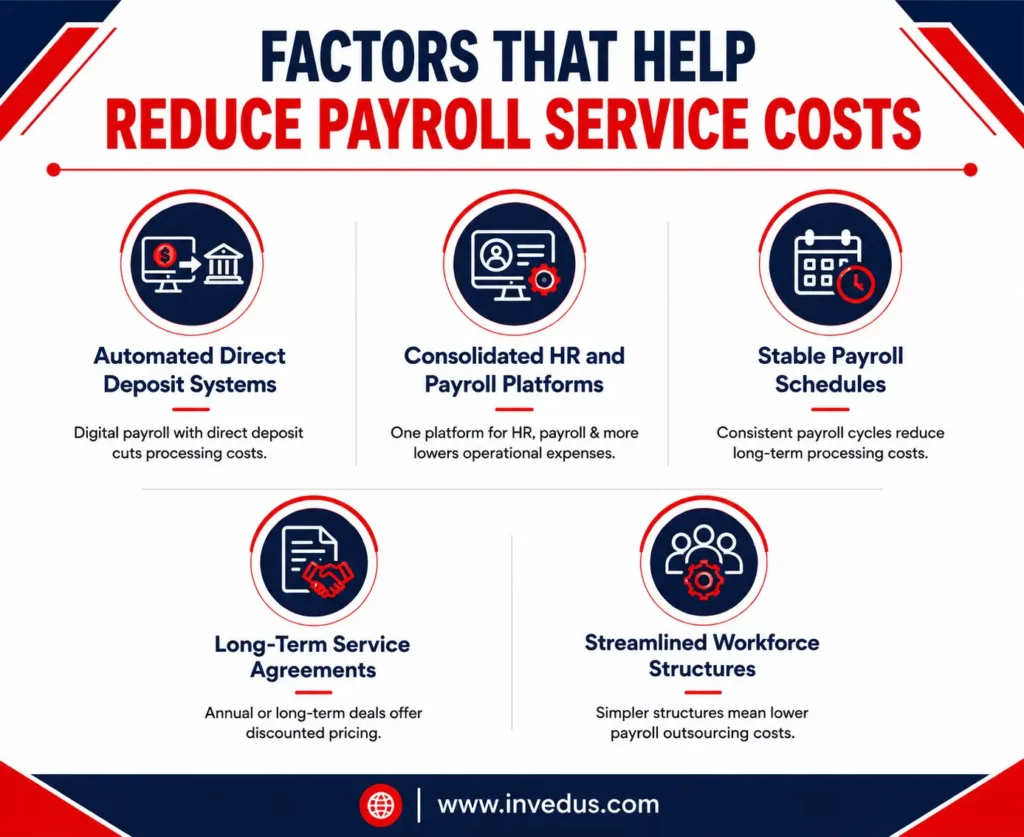
Automated Direct Deposit Systems
Businesses using fully digital payroll systems with direct deposit and employee self-service portals typically reduce processing costs and administrative overhead.
Consolidated HR and Payroll Platforms
Combining payroll, HR, benefits, and workforce management under one provider often lowers total operational expenses while simplifying compliance management.
Stable Payroll Schedules
Companies running consistent biweekly or monthly payroll cycles usually experience lower long-term payroll processing costs compared to businesses with frequent adjustments or off-cycle payments.
Long-Term Service Agreements
Some payroll providers offer discounted pricing for annual contracts or long-term payroll management agreements, helping businesses stabilize recurring payroll expenses.
Streamlined Workforce Structures
Businesses with fewer compliance complications, limited overtime variability, and single-state operations generally maintain much lower ongoing payroll outsourcing cost levels.
Get further insights: The Hidden Costs of In-House Accounting
In-House Payroll vs. Software vs. Fully Outsourced vs. Delegated
When businesses compare the overall payroll outsourcing cost, payroll software often appears to be the cheapest option upfront. However, the real expense goes far beyond subscription pricing. Manual processing time, compliance risks, payroll errors, tax filings, reporting responsibilities, and administrative workload all contribute to the true long-term cost of payroll management in 2026.
Today, businesses generally choose between four payroll management models depending on their workforce size, compliance complexity, and internal resources.
|
Method |
Avg. Cost (2026) |
Billing Cycle |
Admin Burden |
Best For |
|
In-House Payroll Staff |
Salary + benefits |
Very High |
Large businesses with dedicated HR and finance departments |
|
|
Payroll Software |
Monthly or annual subscription |
High |
Small businesses comfortable managing payroll internally |
|
|
Fully Outsourced Payroll Provider |
$100–$2,500+/month |
Monthly service pricing |
Moderate to Low |
SMBs needing compliance support and payroll administration |
|
Delegated Payroll Team (Invedus) |
Starting $7.99/hr or $999/mo |
Monthly retainer |
Very Low |
Businesses seeking fully managed payroll operations without building in-house teams |
Disclaimer* The pricing is only for estimation purposes. Real pricing may vary.
While a software might look like a low cost payroll services option at first, it often shifts the burden of compliance and accuracy onto your team. If you’re looking for true relief, the cost of outsourcing payroll services through a dedicated team can be a smarter long-term move.
Payroll Costs by Country: Employer Obligations You Still Need to Cover
When outsourcing payroll, it’s important to remember that payroll outsourcing costs don’t eliminate your core employer obligations.
In every country, businesses are still responsible for payroll cost per employee in the form of taxes, insurance, and social contributions, regardless of whether they run payroll internally or hire a provider.
If you’re hiring globally or comparing countries for delegation, here’s what payroll-related employer expenses typically look like:
|
Country |
Employer Obligations You Still Need to Cover |
Estimated Payroll Earnings |
Source |
|
Canada |
Canada Pension Plan (CPP) + Employment Insurance (EI) |
CPP employer contribution rate: 5.95%; EI employer premium rate: 2.212% (1.4× employee premium rate) |
https://www.canada.ca/en/revenue-agency/services/tax/businesses/topics/payroll.html |
|
Australia |
Superannuation Guarantee |
12% of ordinary time earnings |
|
|
United Kingdom |
Employer National Insurance Contributions |
15% on earnings above threshold |
https://www.gov.uk/guidance/rates-and-thresholds-for-employers-2026-to-2027 |
|
Spain |
Social Security contributions |
Employer social contribution approximately 29.9%, plus variable occupational rates |
|
|
India |
EPF + ESI employer obligations |
EPF employer contribution: 12%; ESI employer contribution: 3.25% (where applicable) |
These costs are independent of the payroll provider’s fee. Even if you hire one of the best payroll outsourcing companies, these contributions remain your responsibility.
Knowing the cost of payroll per employee in each region is useful when budgeting for international expansion or choosing a provider with global capabilities.
Is Delegating Payroll Worth It?
If you’re still manually managing payroll or toggling between software, spreadsheets, and tax deadlines, it’s costing more than you think: In time. In compliance risk. In opportunity cost.
When you delegate payroll, you stop multitasking and start scaling. Here’s what you actually gain:
- No overhead: no HR hire, no training, no tools
- No software: no dashboards to learn or licenses to renew
- No stress: just accurate, on-time payroll handled by real people
For the cost of a single HR hire, you get a full-function payroll team working behind the scenes filing taxes, handling employee pay, managing reports, ensuring compliance, and more.
That’s what we do at Invedus.
We’re not just another tool. We’re one of the best payroll outsourcing companies for businesses that want reliable, low-cost payroll services without giving up control or visibility.
So, is outsourcing payroll cost-effective?
If you’re ready to stop “managing payroll” and start focusing on actual business growth, yes, it is. We’ll make sure of it. Contact us today!
Frequently Asked Questions
What factors affect payroll outsourcing cost?
Payroll outsourcing cost depends on company size, payroll frequency, tax requirements, workforce distribution, compliance complexity, HR involvement, and support level. Outsourcing payroll services cost also changes based on employee count, multi-state payroll needs, and pricing structure.
Is outsourcing payroll cheaper than hiring an in-house payroll employee?
In many cases, yes. In-house payroll staff can cost $54,000–$82,000 yearly, while outsource payroll cost options start much lower. Businesses may also reduce administrative burden, compliance risks, and overhead by outsourcing payroll operations.
Are there hidden fees in payroll outsourcing?
Yes. Payroll services costs may include setup fees, W-2 and 1099 processing charges, off-cycle payroll runs, payroll corrections, garnishments, and multi-state filing surcharges. Reviewing outsourcing payroll services cost details helps businesses avoid unexpected expenses.
Can payroll outsourcing help with tax compliance?
Yes. Payroll outsourcing providers often handle payroll tax calculations, tax filings, compliance reporting, and corrections. Businesses that hire payroll experts can reduce compliance pressure and minimize payroll errors that may lead to penalties or filing issues.
Can payroll outsourcing support remote or global teams?
Yes. Payroll outsourcing supports remote and global teams through multi-state payroll management, compliance coordination, workforce administration, and global payroll support. Businesses managing distributed employees often use outsourced payroll solutions to improve scalability and workforce operations.
Does Invedus offer dedicated payroll experts for growing businesses?
Yes. Invedus offers a delegated payroll team model where businesses get dedicated payroll support instead of software alone. Growing businesses can hire payroll experts to manage payroll operations end-to-end while reducing internal workload and administrative burden.




Last updated on: May 29, 2026