


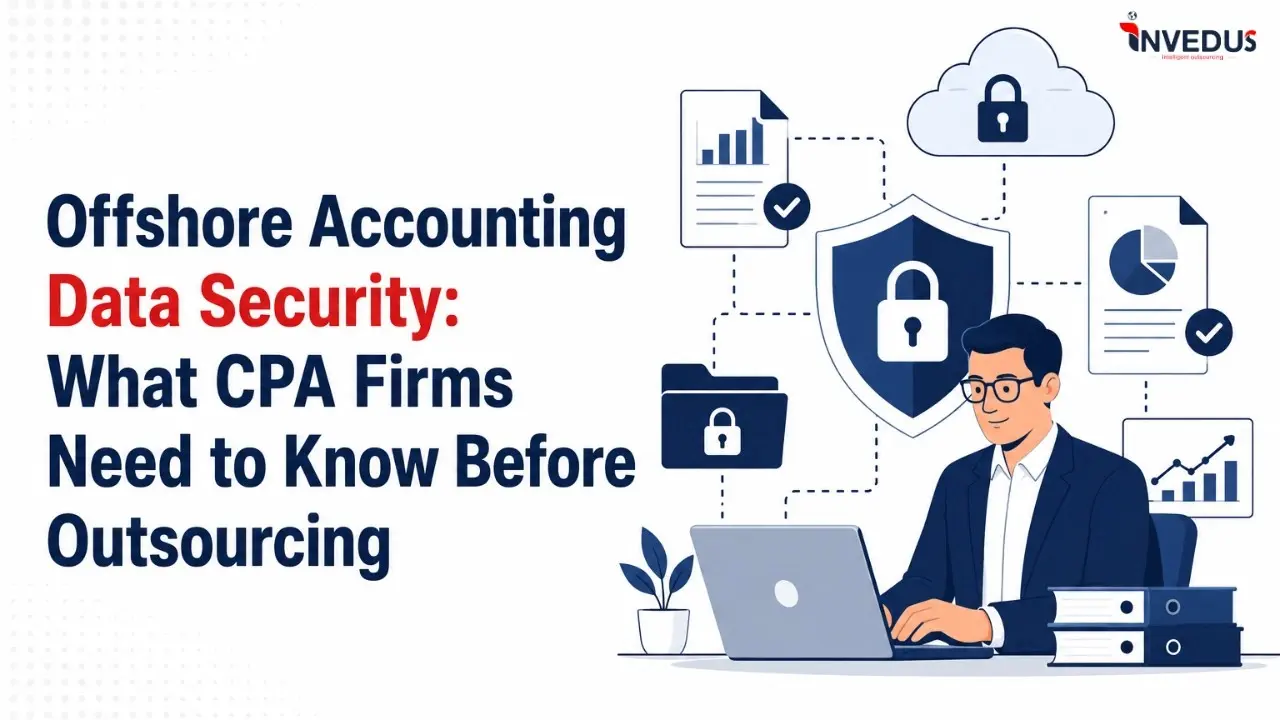
Offshore Accounting Data Security: What CPA Firms Need to Know Before Outsourcing

Authored By: Juhi
Juhi is an experienced content creator with a deep understanding of audience engagement and brand...

Fact-checked By: Abhishek Sharma
10 years of experience in accounting, AP (P2P), invoice processing, and international payments across MNC...
Key Takeaways
- The global average cost of a data breach reached USD 4.44 million in 2025, making secure provider selection essential for CPA firms.
- Offshore accounting is safest when firms use individual accounts, role-based access, multi-factor authentication, secure portals, and client-specific permissions.
- NDAs, approved software lists, no-local-storage policies, activity monitoring, and immediate offboarding should be established before sharing client data.
- Sensitive financial information should never be entered into unauthorised public AI tools. AI-assisted accounting work must remain within firm-approved systems and undergo senior review.
- Structured tasks such as bookkeeping, reconciliations, AP, AR, payroll support, invoice processing, reporting, and data cleanup can be delegated offshore, while final approval and compliance responsibility remain in-house.
- Invedus provides office-managed accounting professionals backed by 10+ years of outsourcing experience, ISO 27001 and SOC 2-certified systems, detailed NDAs, transparent tracking, and client-controlled access.
Since CPA firms have started integrating AI internally or through offshore accounting providers, the data security risk has increased significantly. Even though offshore accounting can reduce hiring costs and help during tax season, data security still becomes the biggest hesitation for outsourcing.
The concern is valid because firms handle bank statements, payroll records, tax documents, client IDs, financial reports, and confidential business data.
However, the real risk is not offshore accounting itself. The real risk is working with a provider that has weak access controls, unclear confidentiality terms, poor staff training, and no structured onboarding process.
We have broken down what CPA firms should check before outsourcing accounting work offshore and how choosing the right offshore accounting partner can help them protect client data while reducing workload, cost, and staffing pressure.
Can CPA Firms Outsource Accounting Offshore Without Risking Client Trust?
Yes, CPA firms can outsource accounting offshore without risking client trust, but only when the provider gives your firm control over access, workflow, confidentiality, and review.
Clients may not object to offshore support, but they will lose confidence if payroll records, tax documents, or bank data are mishandled.
IBM’s 2025 Cost of a Data Breach Report found the global average breach cost was USD 4.44 million, showing why secure vendor selection matters. The safer approach is to delegate accounting work through defined permissions, signed NDAs, secure tools, and firm-led review instead of handing over unrestricted access.
What CPA Firms Should Prepare Before an Offshore Accountant Starts Work?
Before your offshore accountant starts work, your CPA firm should have the onboarding setup documented, agreed, and reviewed with the provider. The following documents/processes are of utmost importance to approve before you start collaborating:
Signed NDA
The NDA should be signed before any client file, software access, or document sharing begins. It should specifically cover client financial data, tax records, payroll files, bank statements, client identity, and business information. It should also define permitted use, confidentiality duration, restrictions on third-party sharing, data handling rules, and what happens to client information after the engagement ends.
Clearly Defined Scope Of Work
Your CPA firm should define exactly what the offshore accountant will handle, such as bookkeeping, reconciliations, AP, AR, payroll support, reporting, data cleanup, or tax-season admin. This prevents confusion and ensures the accountant only accesses systems and files required for their assigned work.
Client Access Boundaries
Access should be granted client by client, not across your entire firm. If the offshore accountant works on selected clients, they should only access those specific accounts, folders, payroll records, and software modules. This reduces unnecessary exposure and keeps control with your firm.
Approved Software List
List the tools the offshore accountant is allowed to use, such as QuickBooks, Xero, payroll software, cloud storage, practice management tools, and communication platforms. This prevents the use of personal apps, informal file-transfer tools, or unapproved systems.
File-Sharing Rules
Sensitive documents such as bank statements, payroll files, tax records, invoices, and reports should move through secure portals or permission-based folders. Regular email attachments should be avoided because they are harder to control, track, and revoke once shared.
No Local Storage Policy
Your firm should clarify whether client files can be downloaded at all. If downloads are required, define where files may be stored, how long they can remain there, and how deletion must be confirmed. USB drives and personal folders should not be allowed.
Communication Channels
Set approved channels for daily updates, document requests, task questions, urgent issues, and review comments. Keeping communication inside email, Slack, Teams, Asana, ClickUp, or practice management software makes instructions easier to track and reduces informal sharing of client information.
Review And Approval Process
Your firm should define who reviews reconciliations, approves reports, checks payroll support work, and handles final client-facing decisions. Offshore accountants can prepare and process work, but final review should stay with your CPA firm’s senior team.
Offboarding Process
Access removal should be immediate when a resource changes, leaves, or the engagement ends. This includes accounting software, cloud folders, payroll tools, communication channels, and task systems. Pending work should also be reassigned and any stored files confirmed deleted.
Escalation Process If Something Goes Wrong
Your provider should explain who is contacted if there is a mistake, missed deadline, access issue, or possible data exposure. The process should define reporting timelines, corrective steps, and who is responsible for resolving the issue.
AI Integration Without Data Risk
If your CPA firm uses AI tools for summaries, reporting, document review, or workflow support, client data should not be copied into unsecured or public AI platforms. Define which AI tools are approved, what data can be used, and who reviews AI-assisted output. Offshore accountants should follow your firm’s AI policy, avoid uploading sensitive client files into unauthorized tools, and keep all AI-supported work within controlled, approved systems.
Invedus can help CPA firms onboard offshore accounting professionals around their own tools, access rules, review flow, and client confidentiality expectations, so outsourcing feels structured from day one.
How CPA Firms Can Use AI Efficiently Without Creating Data Leak Risks?
CPA firms can use AI to improve speed, reporting, document review, and workflow efficiency, but only when client data is handled carefully. The goal is not to avoid AI completely, but to use it inside clear security boundaries.
Step 1: Approve specific AI tools
Your firm should decide which AI tools can be used for accounting support, reporting, summaries, research, or document assistance. Offshore accountants should not use personal or public AI tools unless approved.
Step 2: Restrict sensitive client data
Payroll records, tax documents, bank statements, client IDs, and financial reports should not be copied into unsecured AI platforms. If AI is used, data should be anonymized or limited wherever possible.
Step 3: Keep AI work inside firm-approved systems
AI-supported work should happen within tools your CPA firm controls or has reviewed. This reduces the chance of client data being stored, reused, or exposed outside your workflow.
Step 4: Review AI-assisted output
AI can help prepare summaries, reports, or checklists, but final review should stay with your senior CPA team. This prevents errors, missing context, or inaccurate client-facing information.
Step 5: Include AI rules in your outsourcing process
Your offshore accountant should follow your firm’s AI policy, access rules, and confidentiality expectations. With Invedus, CPA firms can structure offshore accounting support around approved tools and review processes.
The Real Risk Is Not Offshore Accounting; It Is an Uncontrolled Outsourcing Setup
The real risk in offshore accounting is not the location of the outsourced accountant but its weak outsourcing setup. CPA firms should watch for these risks before sharing client data:
- Unrestricted access: Offshore staff should not have access to every client file, folder, or accounting system unless the work requires it.
- Shared credentials: Shared logins make it difficult to track activity or identify who accessed sensitive data.
- No MFA: Without multi-factor authentication, one compromised password can expose payroll records, tax documents, or bank information.
- Weak file sharing: Sending bank statements or tax files through normal email attachments increases unnecessary exposure.
- Poor offboarding: If access is not removed quickly after a staff change, former users may still reach client systems.
- No written security expectations: Without clear rules, confidentiality, downloads, storage, and communication become inconsistent.
- No review structure: Work should be monitored by the CPA firm to catch errors, gaps, or unusual activity early.
The Security Setup Your CPA Firm Should Expect Before Sharing Access
Before sharing access with an offshore accountant, your CPA firm should expect a clear security setup, not vague reassurance. Start with role-based access, where the accountant only receives permissions needed for the assigned work and specific clients.
Use individual user accounts instead of shared logins so activity can be traced properly. Enable multi-factor authentication for accounting software, cloud storage, payroll tools, and communication platforms.
Client documents should be stored in permission-based cloud folders or secure portals, not passed around through regular email attachments. Downloads should be restricted or clearly approved, especially for bank statements, payroll records, tax documents, and reports.
Your firm should also have activity visibility, so you can review who accessed what and when. If the engagement ends or a resource changes, access removal should happen immediately, not days later. Finally, there should be clear reporting and supervision, so work is reviewed, pending tasks are visible, and sensitive issues are escalated quickly.
The FTC also highlights safeguards such as access control, encryption, MFA, user activity monitoring, staff training, service provider monitoring, and incident response planning. A reliable offshore accounting partner should be able to explain this setup before asking for access to any client file.
Which Accounting Tasks Can CPA Firms Safely Delegate Offshore?
If you are uncertain about which tasks to actually outsource to offshore accounting partners, here is a list we recommend.
Bookkeeping
Bookkeeping is one of the safest offshore accounting tasks because it follows a structured process. Offshore accountants can record transactions, categorize expenses, update ledgers, and maintain books inside your existing accounting software while your internal team reviews the final work.
Bank Reconciliation
Bank reconciliation can be delegated offshore when access is limited to selected client accounts. Offshore accountants can match transactions, identify missing entries, flag discrepancies, and prepare reconciliation reports for review without needing broader administrative permissions.
Accounts Payable
Accounts payable support is suitable for offshore teams because it is process-driven. They can organize vendor bills, enter payment details, track due dates, match invoices with records, and prepare payment files for approval by your internal team.
Accounts Receivable
Offshore accountants can support accounts receivable by preparing invoices, tracking outstanding payments, updating aging reports, and following internal collection workflows. Final client communication or sensitive payment discussions can still remain with your in-house team.
Payroll Support
Payroll support can be delegated carefully when access is controlled. Offshore accountants can help organize timesheets, update payroll data, check calculations, and prepare payroll reports, while final approval and compliance review stay with senior CPA firm staff.
Invoice Processing
Invoice processing is a repeatable task that works well offshore. Offshore accountants can collect invoices, verify details, enter them into accounting systems, attach supporting documents, and flag missing or inconsistent information before final approval.
Expense Categorization
Expense categorization can be handled offshore using your firm’s chart of accounts and coding rules. Offshore accountants can classify transactions, apply consistent categories, and flag unclear expenses for review instead of making judgment-based decisions independently.
Financial Reporting Support
Offshore accountants can prepare standard reports such as profit and loss statements, balance sheets, cash flow summaries, and management reports. Your internal team should review the numbers, interpret results, and handle client-facing explanations.
Tax Season Admin Support
During tax season, offshore accountants can organize documents, update client checklists, enter basic data, follow up on missing files, and prepare workpapers. Senior CPAs should still manage tax strategy, final review, and filing responsibility.
Data Cleanup
Data cleanup is a practical offshore task because it is time-consuming but structured. Offshore accountants can identify duplicate entries, missing records, uncategorized transactions, and outdated vendor or customer details before your internal team approves changes.
Month-End Closing Support
Offshore accountants can support month-end close by preparing reconciliations, updating schedules, checking accruals, organizing reports, and completing checklist items. Final adjustments, review, and sign-off should remain with senior in-house accounting professionals.
CPA firms do not need to outsource everything at once. Final review, client advisory, tax strategy, complex judgment-based decisions, client-facing explanations, sign-off, and compliance ownership should usually stay with senior in-house CPAs. This allows firms to start with controlled, repeatable tasks and scale offshore support gradually with Invedus.
Why Invedus Is a Practical Offshore Accounting Partner for Security-Conscious CPA Firms
For CPA firms that want offshore accounting support without losing control of client work, Invedus offers a structured way to hire dedicated accounting professionals from India. With 10+ years of outsourcing experience and ISO 27001 certification and SOC 2 certification, Invedus supports firms that need cost-effective staffing with stronger visibility and process control.
Key advantages include:
- Dedicated offshore accounting staff working as an extension of your firm
- Detailed NDAs with strict actionable privacy clauses
- Candidate interview and selection before hiring
- Support for bookkeeping, payroll, reconciliation, AP, AR, reporting, and tax-season workload
- Office-managed teams, not unmanaged freelancers
- 100% work transparency through remote screen sharing and daily tracking
- Fully recorded VA daily work sessions, where agreed
- Client-controlled access, review, communication, and final approval
Hire the best offshore accounting data security partners!
Conclusion
Offshore accounting security should never be based on promises alone. CPA firms need specifics before sharing client files. At Invedus, we provide data security through multiple measures.
The quick runthrough is: ISO 27001 and SOC 2 certified systems, Accountant/Adviser role access within your software, no local data storage, NDA before access, office-managed teams, transparent remote sharing, and written answers to every security question on request.
If you want certificate details, NDA terms, or the exact QBO/Xero access role before onboarding, we provide them upfront. That is the professional standard CPA firms should expect.
If your CPA firm wants offshore accounting support but is cautious about client data security, Invedus can help you build a dedicated offshore accounting team that works within your systems, processes, and supervision.

Frequently Asked Questions
Does Invedus sign an NDA before accessing any client data?
Yes. NDAs are signed at both the company and individual-accountant level before any client file, login, or document is shared. The agreement covers financial data, tax records, and payroll files, and defines what happens to client information once the engagement ends - so confidentiality is contractually locked in from day one.
Is offshore accounting actually cheaper than hiring an in-house bookkeeper or accountant in the US?
For routine, repeatable work it usually is, because you avoid US payroll, benefits, recruitment, and workspace costs while still accessing qualified staff. The exact saving depends on the role and hours, but for most firms the bigger win is capacity - freeing senior CPAs from repetitive tasks. Keep final review and advisory in-house and you get the cost benefit without giving up control.
What security certifications should a CPA firm require from an offshore accounting provider?
At minimum, ask for ISO 27001 (information security management) and SOC 2 (controls over how data is handled), and confirm they're current rather than expired or "in progress." Also ask how access is restricted per client, whether MFA is enforced, and how offboarding removes access. A credible provider will share certificate details and access terms upfront instead of offering vague reassurance.
Can we interview and approve the offshore accountant before we hire?
Yes. With Invedus you review pre-screened candidates, interview the ones you shortlist, and only sign once you're confident in the fit, there's no obligation to hire. The selection decision stays entirely with your firm.
How quickly can an offshore accountant start working with our firm?
Once you've selected a candidate and signed the NDA and engagement terms, onboarding is typically fast. The main variables are your access setup, individual logins, role-based permissions, MFA - and a short handover of your workflows and chart of accounts. Firms that have software access and their review process ready can usually have a resource productive within days.
Can we start with one offshore accountant and scale up later?
Yes, you don't need to outsource everything at once. Most firms begin with a single dedicated accountant on controlled tasks like bookkeeping or reconciliations, then add resources as trust and workload grow. The dedicated model makes it easy to scale support up or down without long-term headcount risk.
How do we switch offshore accounting providers without disrupting client work or data security?
Plan the handover before cutting access: document open tasks, move working files through secure folders (never personal email), and confirm the outgoing provider's access is fully revoked and any local copies deleted. Bring the new dedicated accountant in under your own logins and permissions so client data stays inside systems you control throughout the transition.
Who is responsible if an offshore accountant makes an error or a data issue occurs?
Because offshore accountants prepare and process work while your senior team keeps final review and sign-off, your firm retains professional responsibility for client-facing output - which is exactly why the review layer matters. On security, a serious provider defines an escalation process, signs NDAs, and operates inside your controlled access, so reporting lines are clear before anything goes wrong. Confirm these terms in writing during onboarding.
Why should a security-conscious CPA firm choose Invedus for offshore accounting?
Invedus provides dedicated, office-managed accountants - not unmanaged freelancers - backed by ISO 27001- and SOC 2-certified systems, company- and employee-level NDAs, and client-controlled access, review, and approval. You interview and choose your own resource, work stays inside your tools and permissions, and certificate details, NDA terms, and exact QBO/Xero access roles are provided on request.



Last updated on: Jul 31, 2026