


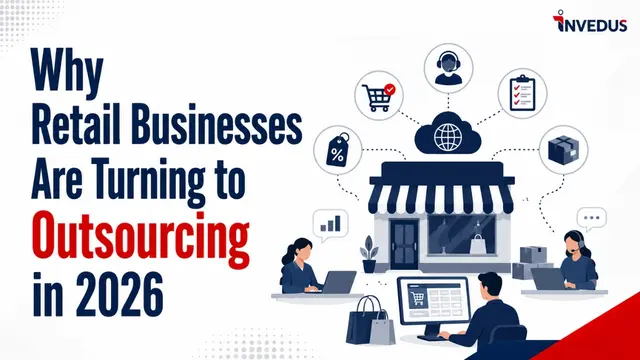
Why Retail Businesses Are Turning to Outsourcing in 2026

Authored By: Juhi
Juhi is an experienced content creator with a deep understanding of audience engagement and brand...
Key Takeaways
- US retail sales are forecast to reach $5.6 trillion in 2026, although 95% of retail executives expect operating costs to increase.
- Ecommerce sales grew 9.8% year on year in Q1 2026, creating more work across product management, orders, customer service and returns.
- Retail outsourcing can provide flexible capacity for seasonal peaks without requiring businesses to maintain permanent in-house headcount.
- Customer support, ecommerce operations, finance, marketing, IT and supply-chain administration are among the functions best suited to outsourcing.
- Retailers should compare the total costs of in-house and outsourced teams rather than relying solely on salaries or quoted provider fees.
- Businesses should outsource repeatable execution while retaining control of strategy, pricing, cybersecurity, compliance and high-risk decisions.
US retail sales are on pace to hit $5.6 trillion in 2026, but 95% of retail executives still expect operating costs to rise. That gap is pushing more retailers toward outsourcing: shifting customer support, ecommerce operations, finance and IT execution to external teams while keeping strategy and pricing in-house.
Not every partner or model fits every business, though. This guide breaks down what to outsource, what it actually costs versus an in-house team, and how to protect your brand and data along the way.
Learn how you can grow by outsourcing retail functions!
What Does Retail Outsourcing Mean in 2026?
Retail outsourcing is the practice of assigning customer-facing, technical or back-office functions to an external specialist, remote employee or managed service provider. This can include customer support, ecommerce administration, finance, marketing and IT operations, helping retailers access skills and flexible capacity without building every capability internally.
Outsourcing means an external provider performs work, while offshoring means work is delivered from another country. Automation uses software to complete tasks. Staff augmentation adds professionals to an internal team, whereas managed services make the provider accountable for a process and its outcomes.
These models can overlap. For example, an offshore support team may use AI while remaining retailer-managed. In 2026, retail outsourcing may also involve end-to-end automation based on tasks and outcomes.
Why Are Retail Businesses Outsourcing More in 2026?
There are several reasons why many businesses have moved toward outsourcing retail tasks. According to the latest industry trends and resources, these are the top causes of retail outsourcing.
1. Revenue Growth Is Not Eliminating Margin Pressure
US retail sales are forecast to grow 4.4% to $5.6 trillion in 2026, but 95% of retail executives expect higher costs. Deloitte found that 76% may adjust investment priorities, while 71% report a competitive advantage from stronger cost control.
This supports retail outsourcing, which can shift selected fixed costs into flexible service expenses. Savings depend on the role, provider, geography, service level and internal management required.
2. Ecommerce Is Growing Faster Than Total Retail
US ecommerce sales rose 9.8% year on year in the first quarter of 2026, compared with 3.9% for total retail, and accounted for 16.9% of sales. Ecommerce outsourcing can absorb product uploads, digital merchandising, marketplace administration, inventory updates, order processing, customer inquiries and returns, even when internal headcount remains unchanged.
3. Customers Expect Continuous and Faster Support
Zendesk reports that 74% of consumers expect 24/7 service because of AI, while 88% expect faster responses than one year ago. Retail customer service outsourcing can provide extended-hour coverage across phone, email, chat and social media, with multilingual teams and human escalation for complex cases. Retailers should retain control of brand voice, customer policy and final decisions.
4. Returns Have Become a Major Operational Function
Retail returns were projected to reach $849.9 billion in 2025. About 19.3% of online sales were expected to be returned, while 9% of returns were considered fraudulent. Outsourcing retail operations can add capacity for eligibility checks, refunds, exchanges, return labels, warehouse coordination, inventory updates and fraud escalation, making returns a core retail back-office outsourcing workflow.
5. Retail Technology Is Becoming Business-Critical
New Relic found that nearly one in three retailers experiences critical outages weekly. A high-impact retail outage has a median hourly cost of $1 million, with median detection and resolution times of 30 and 42 minutes.
Retail IT outsourcing can support POS systems, ecommerce platforms, monitoring, testing, access management and Tier 1 help desks, while architecture and cybersecurity policy remain internally owned.
6. Retailers Need Capacity Without Permanent Overstaffing
Deloitte found that 80% of executives plan to maintain or increase third-party outsourcing investment, and 50% have used providers for front-office functions. Retail business process outsourcing and other retail outsourcing services provide elastic capacity for holiday peaks, launches, marketplace expansion, technology rollouts and backlogs.
The value of retail outsourcing lies in flexible, specialist capability, not cheaper labor alone .
In-House vs Outsourced Retail Team Cost Comparison
Many businesses prefer an outsourced retail team over their in house expansion. Usually it can be to save time but costs play the biggest role. According to our research using data from BLS, HiveDesk, and SHRM, this is the cost difference between an outsource retail team and an in-house retail team.
| Cost comparison | In-house US retail team | Outsourced retail team | What this means |
| Hourly cost per full-time seat | About $23.97/hour for retail trade sales and office roles, including wages and benefits | India: $8–$15/hour; Philippines: $10–$18/hour | Outsourcing usually has a lower hourly billing range, but the final cost depends on role complexity, service level and provider model. |
| Monthly cost per full-time seat | About $4,155/month | India: $1,387–$2,600/month; Philippines: $1,733–$3,120/month | This is often where retailers see the clearest cost difference. |
| Annual cost per full-time seat | About $49,858/year | India: $16,640–$31,200/year; Philippines: $20,800–$37,440/year | A single outsourced seat may cost less annually than an in-house equivalent. |
| Annual cost for a 5-person team | About $249,288/year | India: $83,200–$156,000/year; Philippines: $104,000–$187,200/year | For multi-person retail support teams, the gap can become more visible. |
| Hiring cost | SHRM reports an average non-executive cost-per-hire of $5,475, so 5 hires could add around $27,375 before wages begin | Often included in the provider’s model, but setup, ramp-up or minimum commitment fees may apply | Outsourcing can reduce recruitment cost, but retailers should check setup fees and contract terms. |
| Included costs | Wages, benefits, payroll taxes, HR, equipment, management and office costs may sit with the retailer | Many BPO rates include salary, benefits, management, office and technology | The outsourced price may be more bundled, while in-house costs are spread across several budgets. |
Which Retail Functions Are Best Suited to Outsourcing?
Some retail tasks are meant for outsourcing, not only because they will be cost-efficient to do so, but because outsourced retail teams have better overall expertise in them. Here are the outsourced retail tasks we recommend you delegate:
Customer Experience and Revenue Protection
Retail customer service outsourcing is well suited to high-volume interactions that follow established policies and escalation procedures. External teams can extend support hours, reduce response times and protect revenue by resolving customer issues before they lead to cancellations or lost loyalty.
Common tasks include:
- Order placement and modification
- Delivery and shipping inquiries
- Returns and exchange support
- Product information
- Loyalty-program assistance
- Complaint triage
- After-hours support
Retailers should track customer satisfaction, first-contact resolution, response time, abandonment rate, average order value and escalation rate.
Ecommerce Operations and Digital Merchandising
As retailers expand across websites and third-party marketplaces, maintaining accurate product information creates substantial repetitive work. Ecommerce outsourcing allows external professionals to manage execution while internal teams focus on merchandising strategy and commercial decisions.
Suitable tasks include:
- Product uploads
- SKU and catalog maintenance
- Product descriptions
- Pricing and promotional updates
- Marketplace administration
- Inventory-data updates
- Image optimization
- Order administration
Performance can be measured through listing accuracy, catalog completion, time to publish, order-processing accuracy and marketplace compliance.
Also Read: Virtual Assistants for Ecommerce
Finance and Retail Administration
Retail back-office outsourcing works particularly well for finance and administrative processes with clear inputs, deadlines and quality standards. These functions can be transferred without giving an external team authority over high-risk financial decisions.
Tasks may include:
- Accounts payable and receivable
- Invoice processing and reconciliation
- Bookkeeping and payroll administration
- Supplier-record maintenance
- Purchase-order processing
- Sales reporting
Relevant KPIs include invoice accuracy, days payable outstanding, reconciliation turnaround and error or rework rates.
Also Read: Accounts Payable Outsourcing
Marketing and Creative Production
Retail outsourcing services can provide additional production capacity for SEO, paid advertising support, email campaigns, social media, product copy, graphic design, video editing and campaign reporting.
However, brand positioning, campaign strategy, budget allocation and final creative approval should normally remain internal. Outsourcing retail operations is most effective when external specialists work from documented brand guidelines and clear campaign objectives.
IT, Data and Platform Support
Retail IT outsourcing can cover Tier 1 technical support, POS troubleshooting, website maintenance, software testing, ecommerce platform support, reporting dashboards, data cleansing and access administration.
Specialist retail IT services can improve coverage and response times, but retailers should retain ownership of system architecture, cybersecurity policy, data governance and proprietary technology.
Inventory and Supply-Chain Administration
Retail industry outsourcing can support inventory reporting, reorder monitoring, vendor communication, shipment tracking, purchase-order updates, logistics documentation and returns coordination.
External teams may prepare reports, update systems and flag stock exceptions. However, purchasing authority, demand strategy and negotiations involving strategic supplier terms should remain with the retailer.
The guiding principle is that outsource repeatable execution, but retain ownership of differentiation, risk and accountability. Brand strategy, pricing authority, customer-policy decisions, high-risk approvals, cybersecurity ownership and legal accountability should remain under strong internal control.
Should You Build, Automate with AI or Outsource the Process?
Retailers should score each function from one to five across five factors before choosing an operating model:
- Strategic importance: Does the function differentiate the brand or directly influence customer loyalty?
- Process maturity: Is the workflow documented, repeatable and measurable?
- Volume variability: Does demand increase during holidays, promotions or product launches?
- Talent availability: Is the required expertise expensive or difficult to recruit locally?
- Data and operational risk: Does the process involve payment information, personal data, intellectual property or final approvals?
The resulting scores can guide the decision:
- Keep it in-house when strategic importance and operational risk are high.
- AI-automate it when work is high-volume, rule-based and has few exceptions. IBM explains that automation works particularly well for predefined activities such as data extraction, form completion and ticket categorization.
- Use retail outsourcing for repeatable processes requiring human judgment, specialist skills or flexible coverage.
- Choose a hybrid model when automation handles routine transactions and outsourced employees manage exceptions.
- Select retail business process outsourcing or managed retail outsourcing services when the provider should own delivery and agreed outcomes.
High-risk AI processes still require monitoring, accountability and clearly assigned human oversight. Deloitte likewise recommends retaining ownership of long-term strategy even when managed-service providers execute the work.
Retail Outsourcing Risks and How to Control Them
Brand Inconsistency
Retail outsourcing can weaken the customer experience when external teams use inconsistent language or interpret policies differently. Retailers should provide product training, documented brand-voice guidelines, approved response libraries and regular quality reviews. Calibration sessions help internal and outsourced teams assess interactions against the same standards.
Data-Security Exposure
Outsourcing retail operations may give third parties access to customer, payment and commercial data. Contracts should include NDAs, confidentiality obligations and breach-notification requirements. Operational controls should include:
- Individual user accounts
- Role-based permissions
- Multifactor authentication
- Restricted downloads and local storage
- Activity logs and access reviews
- Managed devices and network controls
- Immediate access removal during offboarding
NIST recommends least-privilege access to reduce unnecessary exposure. PCI DSS requirements must also be assessed whenever a provider stores, processes or transmits payment-card data. Retailers should examine ISO 27001 certification or relevant SOC 2 reports when evaluating broader information-security controls.
Also Read: Offshore Accounting Data Security
Quality Variability and Hidden Costs
Retail outsourcing services can produce uneven results when scope and expectations are unclear. Service-level agreements should define response times, accuracy standards, reporting requirements and escalation procedures. Quality scorecards and calibration reviews can identify performance drift.
Hidden costs such as transition, training, software, integration and internal management can reduce expected savings. ISG estimates that outsourcing contracts may lose 5% to 15% of their value through unused or undelivered services.
Provider Dependency
Retail business process outsourcing can create dependency when knowledge, data or system access becomes concentrated with one provider. Retailers should retain process documentation, require data portability, maintain backup coverage and establish transition assistance and exit procedures.
The goal is controlled flexibility: transfer execution without transferring accountability for customer experience, security, compliance or strategic decisions.
How to Measure Retail Outsourcing ROI?
Measure retail outsourcing ROI by comparing total costs, not quoted fees alone. In-house costs include salary, employer taxes, benefits, recruitment, onboarding, software, equipment, workspace, overtime, management time and turnover. Outsourced costs include provider fees, transition, integration, retained management, additional tools and quality oversight.
Use role-specific US wage data from the Bureau of Labor Statistics; its May 2025 OEWS estimates were released in May 2026.
Retail Outsourcing ROI (%) =
[(In-house total cost − Outsourced total cost) ÷ Outsourced total cost] × 100
Assess retail business process outsourcing through cost per transaction, CSAT, first-contact resolution, order and catalog accuracy, refund turnaround, backlog reduction, uptime, revenue retention and management time saved. When comparing providers, ask for a documented cost breakdown or client case study rather than relying on a quoted savings percentage alone. .
How Invedus Does Retail Outsourcing Differently?
Retailers often worry that outsourcing will weaken brand control, create communication gaps, expose customer data or deliver inconsistent quality. At Invedus, we address these concerns while providing greater control and flexibility.
At Invedus, you can expect:
- Handpicked professionals whom you can interview before selection
- Dedicated employees who work within your systems and brand guidelines
- NDAs, ISO 27001-certified controls, role-based access and managed office infrastructure
- Ongoing performance monitoring and flexible team scaling
Outsource retail work without losing control.
Speak with Invedus today to build a secure, brand-aligned retail team that grows with your business.
Conclusion
Outsourcing is common in retail now. But the question still stands, where should you outsource? It isn’t easy to find a reliable retail outsourcing partner and Invedus has become that choice for many businesses.
With over 10 years of experience, we have helped our retail clients grow without unnecessary expenditure. In particular, our retail virtual assistants can reduce operating costs by up to 70% and free more than 20 hours of senior staff time each week.
When you partner with us, you get benefits such as:
- Omnichannel Customer Support Across Phone, Chat and Email
- Ecommerce Shipping, Returns and Exchange Management
- Finance, Bookkeeping and Payroll Support for Retail Teams
- Scalable Staffing for Seasonal and Peak-Season Demand
- PCI-Compliant, ISO 27001-Certified Data Handling
- IT and Platform Support Focused on Uptime and CSAT

Frequently Asked Questions
Can outsourcing help retailers handle seasonal or holiday staffing spikes?
Yes. Retail outsourcing gives businesses flexible capacity during holidays, promotions, product launches and other demand spikes. Retailers can scale customer service, order processing, returns, ecommerce administration and other support functions without maintaining excess permanent headcount throughout the entire year.
How Do I Get Started Outsourcing My Retail or Ecommerce Operations?
Start by identifying repeatable, measurable tasks that do not require strategic control. Document workflows, KPIs, access requirements and escalation procedures. Then compare providers based on skills, security, pricing and scalability or simply choose Invedus before gradually transitioning customer support, ecommerce, finance or administrative functions.
What retail functions should never be fully outsourced?
Retailers should retain strong internal control over brand strategy, pricing authority, customer-policy decisions, cybersecurity ownership, legal accountability and high-risk approvals. Strategic supplier negotiations and proprietary technology decisions should also remain internal, even when external teams support related operational or administrative work.
Is it cheaper to outsource retail support to India?
Often, yes. The article estimates outsourced retail support in India at around $8 to $15 per hour, compared with approximately $23.97 per hour for comparable US in-house retail sales and office roles, including wages and benefits. Actual savings vary.
Is outsourcing a good option for small retail businesses?
Yes. Small retailers can use outsourcing to access customer support, ecommerce, finance, marketing and IT expertise without building full internal departments. It can also provide flexible capacity, reduce recruitment costs and help businesses scale operations without adding unnecessary permanent overhead.
How much does it cost to outsource a retail support team?
Costs depend on location, role complexity and service level. The article estimates India-based retail outsourcing at $8 to $15 hourly, or approximately $1,387 to $2,600 monthly per full-time seat. A five-person team may cost roughly $83,200 to $156,000 annually.
How do I get started outsourcing my retail or ecommerce operations?
Begin with well-documented functions such as customer support, catalog management, order administration or finance processes. Establish performance benchmarks, security controls and escalation rules, then select a provider that allows sufficient oversight and gradually expand outsourcing once quality and reliability are proven.
How is Invedus different from other retail outsourcing providers?
Invedus provides handpicked professionals whom retailers can interview before selection, dedicated employees working within existing systems and brand guidelines, ISO 27001-certified controls, NDAs, managed infrastructure, ongoing performance monitoring and flexible scaling to help businesses outsource without sacrificing operational control.
Does Invedus provide PCI-compliant retail and ecommerce support?
Yes. According to your content, Invedus provides PCI-compliant retail and ecommerce support alongside ISO 27001-certified data handling. Its security approach also includes NDAs, role-based access, managed office infrastructure and controls designed to protect customer, commercial and payment-related information.


Last updated on: Aug 27, 2026