


Top Ways AI Tools Help Maintain High Content Standards in 2026

Authored By: Rifa Hussain
Rifa is a Senior Content Writer at Invedus. She focuses on creating content that aligns...

Fact-checked By: Juhi
Juhi is an experienced content creator with a deep understanding of audience engagement and brand...
Key Takeaways!
- AI for content operations can help produce 42% more content monthly.
- Businesses using AI-driven strategies report up to 2x higher engagement and 30% better conversions.
- Modern content is no longer created in isolation. AI content workflows follow a structured pipeline of input, generation, optimization, and feedback.
- AI tools in content creation go beyond writing by improving grammar, clarity, SEO alignment, and personalization using NLP, semantic analysis, and predictive modeling.
- The biggest shift in content creation is from manual processes to system-driven content operations.
- AI seamlessly integrates with CMS, analytics, and automation tools to create a connected and measurable content ecosystem.
- While AI scales content efficiently, human oversight remains essential for accuracy, originality, and brand alignment.
By early 2025, more than half the content on the internet was generated by AI. This is a big jump from just a few years ago. The trends have shifted, and industries are now focusing more on speed, scalability, and smarter content operations. Research suggests that 91% of marketers actively use AI, as it can produce 42% more content monthly.
However, this rapid scale of AI for content operations also raises concerns around accuracy, consistency, and originality. That is why maintaining high content standards is no longer optional, it’s critical for trust and brand authority.
Thankfully, there are many ways AI tools can create, refine, optimize, and enforce quality across every stage of the content lifecycle.
Let us discuss the ways AI maintains high content standards in 2026!
How AI Supports content creation?
AI tools for content creation can improve content quality, production speed, consistency, SEO performance, and audience engagement while reducing manual effort and operational costs.
Given that, here is how AI supports content creation in 2026:
1. AI-Driven Content Generation (Technical Backbone)
Modern AI systems use transformer-based architectures (LLMs) trained on billions of parameters. These models:
- Perform semantic understanding instead of keyword matching
- Use token prediction + contextual embeddings
- Generate structured outputs (blogs, scripts, metadata)
Impact:
- 70%+ companies use generative AI in content workflows
- Content teams report up to 40–50% faster production cycles
2. AI for Content Optimization (SEO + NLP Layer)
AI doesn’t just create, it optimizes at scale using NLP and search intent modeling. It works in the following ways:
- Uses Natural Language Processing (NLP) for readability scoring
- Applies semantic SEO (entity + topic clustering)
- Runs predictive ranking models based on SERP data
Impact:
- 43%+ marketers use AI for SEO optimization
- AI-optimized content sees up to 2x higher engagement rates
3. Scalability Through AI Content Workflows
AI enables horizontal scaling of content operations, something impossible ten years back. It includes the following key capabilities:
- API-driven content pipelines (CMS + AI integration)
- Automated content repurposing engines
- Multi-format generation (blog → social → video)
Impact:
- Teams produce 42% more content monthly
- Enterprises scale content across 5–10 channels simultaneously
Given that, here is a comparison table to help you differentiate content creation then vs now:
|
Factor |
2016 (Pre-AI Scale) |
2026 (AI-Driven Era) |
|
Content Production Speed |
1–2 pieces/day/team |
3–5x increase with AI-assisted workflows |
|
Content Personalization |
Mostly manual segmentation |
Real-time AI-driven personalization |
|
SEO Optimization |
Manual keyword research |
Automated semantic + intent-based optimization |
|
Content Volume |
Limited by human bandwidth |
Scalable via AI pipelines |
|
Content Cost |
High (writers, editors, research) |
Reduced by ~30–50% via automation |
|
Data Usage |
Limited analytics |
Predictive AI + behavioral insights |
|
Time to Publish |
Days to weeks |
Hours or near real-time |
4. Personalization Using Behavioral AI
AI uses machine learning models trained on user data to personalize content dynamically. It filters personalization in the following ways:
- Recommendation engines (collaborative filtering)
- User segmentation via clustering algorithms
- Real-time content adaptation
Impact:
- Personalized content improves conversion rates by 20–30%
- Reduces bounce rate significantly
Also Read: 18+ Essential Tools Every Content Writer Should Use
Not just these, there are more reasons to use AI tools for content creation in 2026:
More Reasons to Use AI in Content Creation in 2026
1. Automated Content Workflows (Pipeline Thinking)
Content writing in 2026 has moved from isolated tasks to orchestrated, system-driven pipelines where every stage is connected, measurable, and continuously improving.
It goes like:
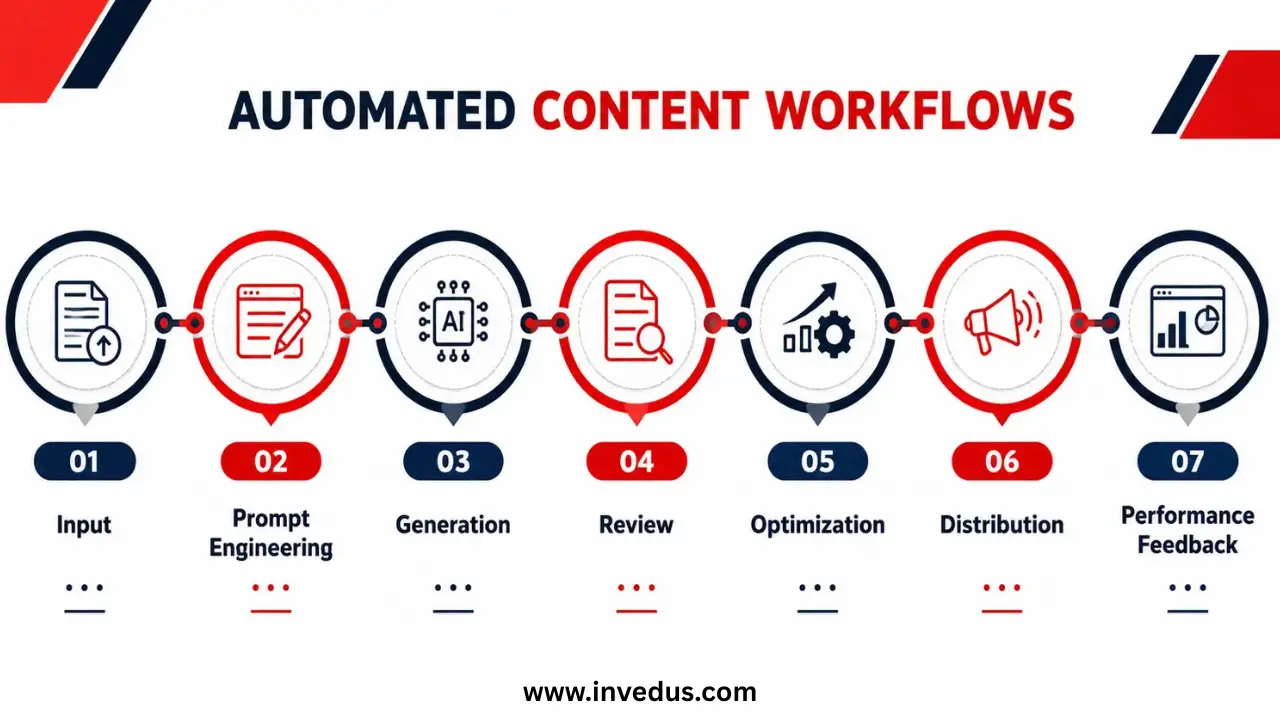
How the System Actually Works?
At the core of this transformation is an API-driven architecture. AI for content operations is no longer a standalone tool, rather:
- Content Management Systems (CMS): AI generates drafts directly inside platforms like headless CMS environments.
- SEO & Optimization Tools: Content is automatically analyzed for keyword intent, readability, and structure before publishing.
- Analytics Platforms: Performance data (CTR, engagement, bounce rate) feeds back into the system.
- Marketing Automation Tools: Content is distributed across channels (email, social, web) without manual intervention.
This is enabled through:
- REST APIs connecting AI models with tools
- Event-driven workflows (trigger-based publishing, updates)
- Data pipelines that continuously refine outputs
2. Feedback Loops & Continuous Improvement
What makes AI for content operations powerful is not automation alone, but closed-loop learning.
Once content is published, AI tracks user engagement signals (scroll depth, clicks, conversions). These signals are then fed back into optimization models. Lastly, future content is adjusted based on real performance data, not assumptions.
This creates a self-improving system, where each piece of content informs the next. Given that, here is how the content is created based on feedback loops in 2026:
- Creation is guided by data
- Optimization is automated
- Distribution is synchronized
- Improvement is ongoing
3. AI-Powered A/B Testing and Iteration
AI transforms A/B testing from slow, manual experiments into continuous, data-driven optimization. Instead of testing just 2–3 variations, AI tools for content creation generate multiple versions of headlines, CTAs, or layouts based on past performance patterns and user behavior.
Using machine learning and multi-armed bandit algorithms, traffic is dynamically shifted toward better-performing variants while still testing new ones.
The system learns from real-time signals like CTR, dwell time, and conversions, refining content automatically without waiting for test completion.
This approach reduces testing time from weeks to hours and can improve conversion rates by 10–30% through continuous iteration.
4. Detecting Errors, Misinformation, and Bias
AI for content operations goes beyond simple spell-checking by applying multi-layered language analysis and verification pipelines. At the surface level, models use syntactic parsing and token-level probability scoring to detect grammar issues.
For factual validation, more advanced systems integrate retrieval-augmented generation (RAG) and knowledge graph querying. Instead of relying only on training data, the model pulls structured or indexed external information (e.g., databases, APIs, or verified documents) and compares it against generated claims.
However, bias detection works differently. AI applies classification models trained on labeled datasets to identify sensitive attributes such as tone, sentiment polarity, and potentially harmful language. It evaluates whether content reflects skewed perspectives, exclusionary wording, or unintended bias patterns.
Some systems also use counterfactual analysis. Here, the content is re-evaluated under different demographic contexts to detect imbalance.
Note: these mechanisms are not foolproof. Language models can still produce hallucinations.
5. AI for Improving Grammar, Clarity, and Style
There are many benefits of AI in content creation, Agreed! And improving grammar is one of the core ones.
Modern systems improve writing by combining rule-based checks with probabilistic language modeling. Instead of only catching typos, they evaluate how well a sentence reads and whether it aligns with intent.
What gets evaluated?
- Readability & structure: AI compute scores (e.g., Flesch) and NLP metrics like sentence length variance, clause density, and cohesion. They flag overly complex constructions, passive overuse, and low information density.
- Grammar & syntax: A hybrid approach applies dependency parsing (subject-verb agreement, modifier attachment) and error classifiers trained on annotated corpora (e.g., GEC datasets) to catch agreement, tense, and punctuation issues.
- Clarity & concision: Systems detect redundancy, ambiguity, and filler phrases using semantic similarity and n-gram repetition checks, then propose tighter alternatives.
- Tone & style alignment: Classifiers infer tone (formal, conversational, persuasive) and compare it to a target profile, adjusting vocabulary, sentence rhythm, and voice.
6. Content Repurposing at Scale (Deep Dive)
AI tools for content creation use multi-format transformation by working on meaning rather than surface text. Instead of duplicating content, they restructure information to match the intent, format, and consumption behavior of each platform.
How the Mechanism Works?
- Semantic Chunking & Content Mapping
AI first breaks the original content into meaningful units using embedding models that understand context. It identifies themes like insights, steps, or examples. - Abstractive Summarization
Instead of copying text, AI rewrites content using abstractive techniques, generating new sentences while preserving meaning. - Format-Specific Structuring
AI applies predefined structural patterns based on the platform, such as hooks for social media or narrative flow for scripts. - Multimodal Transformation
AI converts text into formats suitable for visuals and audio by restructuring content into scripts, captions, or slide outlines. It adapts tone, pacing, and clarity accordingly.
7. Sentiment Analysis & Audience Insights (Deep Dive)
AI also analyses sentiments by labeling as positive, negative, or neutral. It operates on supervised machine learning models trained on annotated datasets. Here, the text is mapped to emotional categories such as satisfaction, frustration, urgency, or trust.
Modern AI tools for content creation use transformer-based NLP models (like BERT variants) to understand context, sarcasm, and domain-specific language.
How this actually works?
- Text Encoding & Context Understanding
Input text (reviews, comments, clicks, dwell time signals) is converted into vector embeddings. These embeddings capture semantic meaning for the model to differentiate between similar words used in different contexts. - Classification Layer
The system applies multi-class or multi-label classification models to assign sentiment scores (e.g., -1 to +1) or emotional tags. Advanced systems detect fine-grained sentiment such as “mild dissatisfaction” vs “strong negative intent.” - Behavioral Clustering
User interactions (clicks, scroll depth, time on page) are grouped using clustering algorithms (e.g., K-means, hierarchical clustering). This segment audiences into behavior-based cohorts, such as high-engagement readers or quick-bounce users. - Predictive Engagement Modeling
AI models (often regression or gradient-boosting systems) predict how different audience segments will respond to content variations.
8. Governance, Control & Consistency
AI brings structure and repeatability to content operations by enforcing:
- Pre-defined brand tone models aligned with guidelines
- Standardized templates for different content formats
- Rule-based generation systems to minimize deviations
AI systems rely on prompt engineering combined with system-level constraints to guide outputs. This includes defining tone, format, and content rules at the model level, ensuring every output follows a fixed structure.
Organizations that implement governance-driven AI content workflows see lower rework rates, faster turnaround, and higher content consistency across teams. The shift is from “create → review → fix” to “define → generate → deploy”.
9. Scalability Without Proportional Cost Increase
AI doesn’t just make teams faster; it allows one unit of effort to produce multiple outputs simultaneously across channels, formats, and audiences. This is called the multiplier effect. For businesses, this translates into faster scaling, lower marginal costs per output, and the ability to compete at a much larger scale without proportional investment.
Generative AI for content operations alone is projected to contribute between $2.6 trillion and $4.4 trillion annually in economic value.
This model doesn’t “think” like a human; it predicts the next most probable output token (word, pixel, or code unit) based on learned patterns. This prediction happens iteratively, generating coherent sentences, images, or responses step by step.
The system is further guided by fine-tuning and reinforcement learning (RLHF), making it one of the most scalable AI for content marketing and operations.
In regions like EMEA, AI adoption in marketing has reached 85%, with companies reporting improvements in personalization, efficiency, and cost reduction. Meanwhile, emerging markets such as India and Southeast Asia are leveraging AI for cost arbitrage + scale.
10. AI in Content Marketing
All the focus, mechanism, and learning now comes to AI in content marketing. According to Digital Applied, AI-powered campaigns have shown up to 12% higher click-through rates (CTR) due to faster testing and optimization of content variations.
Beyond visibility, AI is improving output and reach. 68% of businesses report improved ROI from AI-driven content strategies. This makes AI for content operations a key lever for scaling content without increasing resources. Companies that strategically implement AI in high-impact areas are seeing up to $3 ROI for every $1 invested.
Structured AI content workflows also directly impact engagement and conversions. AI-powered campaigns have demonstrated up to 30% improvement in conversion rates and significant efficiency gains, allowing teams to move from manual execution to data-driven optimization.
To Conclude
The real benefits of AI in content creation go beyond speed!
AI for content operations has become a system-driven, data-backed function where creation, optimization, and distribution are interconnected, measurable, and continuously improving.
What stands out is not just automation, but intelligence. With AI for content optimization, businesses are no longer guessing what works, they are aligning content with real user intent.
This improves engagement and drives measurable outcomes like higher CTRs and conversions. At the same time, structured workflows ensure consistency, scalability, and cost efficiency without compromising quality.
Best Recommendation?
Businesses should not treat AI as a standalone writing tool. Instead, adopt it as a complete content operating system.
Frequently Asked Questions
How do AI tools for content creation improve quality?
AI tools for content creation improve quality using NLP, semantic understanding, and readability scoring. They enhance grammar, clarity, tone alignment, and structure while ensuring content matches user intent, resulting in more engaging, accurate, and SEO-friendly outputs.
How does AI help in content optimization?
AI enables AI for content operations by applying semantic SEO, NLP-based readability checks, and predictive ranking models. It aligns content with search intent, improves structure, and enhances engagement, helping businesses achieve better rankings and performance outcomes.
Can Readers Actually Tell if Content Was Written by AI?
Not always. With advanced AI tools for content creation, content can closely match human writing. However, lack of originality, depth, or contextual nuance can still reveal AI-generated content, especially if proper editing and human refinement are missing.
Are AI-generated content workflows cost-effective?
Yes, AI content workflows reduce costs by 30–50% through automation of research, writing, and optimization. They allow teams to produce more content without increasing resources, making AI for content operations highly efficient and scalable.
Why does AI-generated content still need human review if it is so advanced?
AI can generate content, but may produce inaccuracies or bias. Human review ensures factual correctness, contextual relevance, and brand alignment. In AI for content operations, this validation step is essential to maintain trust and content quality.
Why Are AI-Powered Content Strategies Growing So Fast in 2026?
AI adoption is rising due to efficiency and performance gains. AI content workflows enable faster production, better personalization, and data-driven optimization, helping businesses scale content, improve engagement, and achieve higher ROI in competitive digital environments.




Last updated on: Jul 23, 2026