


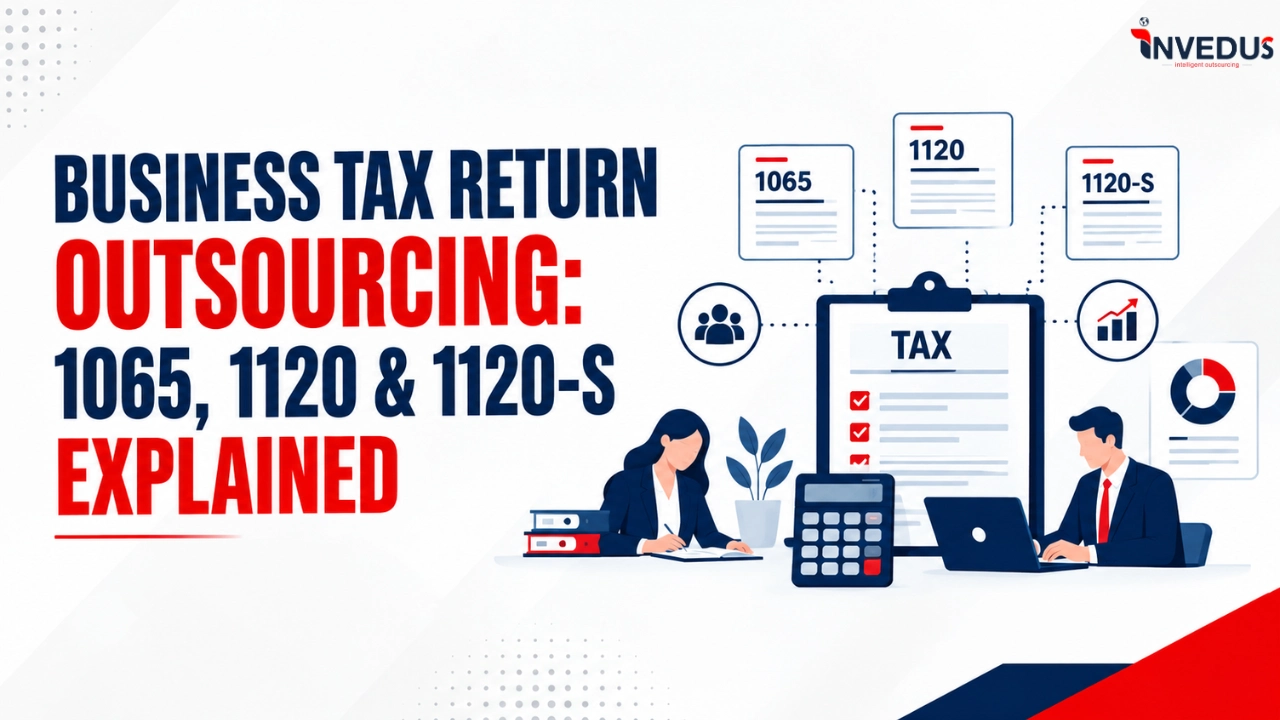
Business Tax Return Outsourcing: 1065, 1120 & 1120-S Explained

Authored By: Rifa Hussain
Rifa is a Senior Content Writer at Invedus. She focuses on creating content that aligns...

Fact-checked By: Pritpal Singh
UK accountant with 9+ years’ experience in taxation, audit, budgeting and management reporting.. He has...
Key Takeaways
- Business tax returns demand more than financial reporting, requiring ownership allocations, tax adjustments, supporting schedules, and detailed records.
- Forms 1065, 1120, and 1120-S differ significantly in taxation, ownership, deadlines, K-1 reporting, and their primary preparation challenges.
- Outsourcing can provide specialized tax preparation capacity during busy periods without expanding permanent in-house staffing or payroll costs.
- The right outsourcing partner should demonstrate tax expertise, quality controls, software compatibility, security, clear responsibilities, and reliable turnaround times.
- Tax data requires careful protection when outsourced, including access controls, encryption, MFA, secure file sharing, confidentiality, and compliance safeguards.
- A dedicated outsourcing model can support recurring preparation, amendments, extensions, tax planning, and specialized workloads while adapting to changing business needs.
Partnerships, C corporations, and S corporations can’t file a simple personal tax return, they have to file Form 1065, 1120, or 1120-S, and each is far more demanding than a standard 1040. These returns involve partner and shareholder allocations, K-1s, basis tracking, and book-to-tax adjustments, and a single mistake can lead to penalties or an IRS notice.
That complexity is exactly why accounting firms and in-house finance teams increasingly outsource business tax return preparation rather than stretching their own staff thin every filing season. The first challenge is simply knowing which form applies and what it demands: a partnership files one form, a C corp another, and an S corp a third, each with its own rules, deadlines, and schedules. Getting it wrong isn’t just inconvenient, it’s costly, in penalties and in rework.
Here’s how Forms 1065, 1120, and 1120-S differ, and how outsourcing their preparation can keep your firm on schedule without adding headcount.
What Is Business Tax Return Outsourcing?
Business tax return outsourcing is the practice of handing your entity tax returns, Forms 1065, 1120, and 1120-S, to an external team of qualified tax professionals instead of preparing them entirely in-house. Rather than hiring, training, and retaining seasonal staff, you delegate the preparation work to a specialized provider who handles the documentation, calculations, schedules, and workpapers, then returns a review-ready draft to your firm.
Outsourcing has grown very popular among US accounting firms and businesses, offering greater flexibility, streamlined operations, and reliable support for meeting deadlines without adding unnecessary workload.
Corporate tax returns and filings are also time-consuming and technically demanding, and the talent to prepare them is expensive and increasingly hard to hire.
Understanding the Three Core Business Tax Returns
Every business tax return maps to a specific type of entity, so the first step is simply knowing which one applies to you. Partnerships file one form, C corporations file another, and S corporations file a third, and while all three report income, deductions, and credits to the IRS, they follow very different rules. Here’s an overview of each, and why they’re more demanding to prepare than a personal return.
Form 1065: Partnership Tax Return
Form 1065 (the US Return of Partnership Income) is filed by partnerships and multi-member LLCs taxed as partnerships. The partnership itself doesn’t pay income tax; instead, it’s a pass-through entity, meaning profits and losses flow through to the partners, who report their share on their personal returns.
What makes Form 1065 complex is everything that happens around that pass-through: each partner receives a Schedule K-1 detailing their share of income and deductions, partner capital accounts must be tracked on a tax basis, and partnerships can make special allocations that split income differently from ownership percentages.
Getting these allocations and K-1s right, for every partner, is where the real work lies, which is why form 1065 preparation outsourcing is a common choice for firms handling multiple partnership clients.
Form 1120: C Corporation Tax Return
Form 1120 (the US Corporation Income Tax Return) is filed by C corporations, entities taxed separately from their owners. Unlike the pass-through forms, a C corp pays corporate income tax on its profits directly, and if those profits are later distributed as dividends, shareholders are taxed again on their personal returns, the well-known “double taxation.”
The complexity here is largely accounting-driven: preparers must reconcile the difference between book income and taxable income through Schedule M-1 or M-3, account for depreciation differences, and track items like net operating losses and credit carryforwards. Because of this technical depth, corporate tax return outsourcing 1120 appeals to firms that want specialists handling the book-to-tax reconciliations rather than tying up senior staff.
Form 1120-S: S Corporation Tax Return
Form 1120-S (the US Income Tax Return for an S Corporation) is filed by corporations and LLCs that have elected S corp status. It is a pass-through entity; income flows to shareholders via Schedule K-1 rather than being taxed at the corporate level, but the eligibility rules are stricter: only domestic corporations with 100 or fewer shareholders, each of whom must be an individual, certain trusts, or an estate, not a partnership, corporation, or nonresident alien qualify.
Some specific S corp require tracking each shareholder’s basis; the corporation must pay owners a “reasonable compensation” salary (an area the IRS scrutinizes closely), and accounts like the AAA (Accumulated Adjustments Account) must be maintained. These rules make the 1120-S deceptively tricky, even for a small business.
What is the difference between 1065 vs 1120 vs 1120-S?
Now that you know what each form is, here is the core difference between 1065, 1120, and 1120-S. This table focuses on the practical differences, who’s taxed, when it’s due, and what’s at stake, so you can quickly see where your business fits and why these returns demand careful preparation.
|
Factor |
Form 1065 (Partnership) | Form 1120 (C Corp) |
Form 1120-S (S Corp) |
| Entity type | Partnerships & multi-member LLCs | C corporations | S corporations & LLCs electing S-status |
| Taxation | Pass-through (no entity-level tax) | Double taxation (entity + dividends) | Pass-through (no entity-level tax) |
| Who pays the tax | Partners, on personal returns | The corporation, then shareholders on dividends | Shareholders, on personal returns |
| Schedule K-1? | Yes, one per partner | No | Yes, one per shareholder |
| Ownership limits | No limit on number/type of partners | No limit on shareholders | Max 100 shareholders; US citizens/residents only |
| 2026 filing deadline | March 16, 2026 | April 15, 2026 | March 16, 2026 |
| Extension (Form 7004) | 6 months → Sept 15 | 6 months → Oct 15 | 6 months → Sept 15 |
| Late-filing penalty | $255 per partner, per month | Based on unpaid tax | $255 per shareholder, per month |
| Main complexity driver | K-1 allocations, partner basis | Book-to-tax reconciliation | Basis, reasonable compensation, AAA |
Form 1065 Filing Requirements and Common Mistakes
For a partnership, preparing Form 1065 starts with having complete and organized business records. The IRS requires partnerships to report their income, deductions, credits, and other financial information, along with the information that flows to each partner.
Before handing the return to your accountant or choosing to outsource tax preparation services, make sure you have the following information ready:
| Information to have ready | What it supports |
| Profit & loss statement | Business income and deductible expenses |
| Balance sheet | Assets, liabilities, and equity |
| General ledger | Transaction-level support |
| Bank and credit-card statements | Revenue and expense verification |
| Fixed-asset records | Depreciation and asset reporting |
| Partner contributions | Partner capital information |
| Partner distributions | Capital and ownership reporting |
| Ownership changes | Correct partner allocations |
| Guaranteed payments | Partner-level tax reporting |
| Loan and liability records | Partnership liability reporting |
| Rental or investment records | Separate activity reporting |
| Foreign activity information | Potential K-2/K-3 requirements |
Common Mistakes
- Bad Partner Data: Incorrect names, addresses, or missing TINs on Schedule K-1 can cause reporting issues.
- Skipping Required Filings: Having little or no revenue does not automatically eliminate the filing requirement. A partnership should confirm whether Form 1065 is required before assuming it can be skipped.
- Misclassifying Items: Ordinary business income should be separated from items such as capital gains, charitable contributions, and other separately stated items.
- Balance Sheet Discrepancies: Schedules L, M-1, and M-2 should reconcile with the partnership’s books and capital-account information.
- Guaranteed Payment Errors: Payments to partners for services or use of capital must be reported correctly and should not be confused with ordinary distributions.
- Incorrect Partner Allocations: Changes in ownership or profit-sharing arrangements can result in incorrect allocations if not reflected properly.
- Missing K-1 Information: Incomplete or inaccurate Schedule K-1 information can create problems for both the partnership and its partners.
- Overlooking K-2/K-3 Requirements: Partnerships with applicable international tax information should determine whether Schedules K-2 and K-3 are required.
- Unreconciled Capital Accounts: Partner capital information should remain consistent across the return and applicable K-1s.
- Incomplete Returns: Missing required information or schedules can create filing issues even when the return is submitted by the deadline.
Form 1120 Filing Requirements and Common Mistakes
A C corporation filing Form 1120 needs a complete picture of its financial activity for the tax year. The return reports corporate income, deductions, tax liability, payments, and other applicable information, so the business should have its accounting and tax records organized before preparation begins.
The core records generally include:
- Profit and loss statement for revenue and operating expenses
- Balance sheet showing assets, liabilities, and equity
- General ledger supporting individual transactions
- Bank and credit-card statements
- Fixed-asset and depreciation records
- Payroll and employee compensation records
- Loan and interest records
- Dividend and investment information
- Capital gains or losses
- Charitable contributions
- Estimated tax payments
- Net operating loss information
- Tax credit documentation
The corporation should also review transactions that may require different treatment for financial reporting and tax purposes. Depreciation, certain deductions, income recognition, and other items can create differences between book income and taxable income. Keeping the underlying records organized makes those differences easier to identify and support.
What Can Affect Your Form 1120?
| Transaction | Why it needs attention |
| Asset purchases | Depreciation and basis |
| Property sales | Gain/loss calculation |
| Related-party transactions | Special reporting considerations |
| Foreign activity | Additional reporting requirements |
| Debt restructuring | Potential tax consequences |
Common Form 1120 mistakes to watch for
- Missing Deadlines: Calendar-year corporations generally file Form 1120 by the 15th day of the fourth month after year-end. If more time is needed, Form 7004 should be filed by the original deadline.
- Incorrect Corporate Details: Errors in the EIN, legal name, address, or tax year can create processing problems.
- Missing Signatures: Form 1120 must be signed and dated by an authorized corporate officer.
- Mixing Personal and Business Expenses: Personal expenses should not be treated as deductible corporate expenses.
- Incorrect Officer Compensation: Officer compensation should be reported accurately, and Form 1125-E should be completed when required.
- Skipping Book-to-Tax Reconciliation: Failing to properly reconcile book income with taxable income can create inconsistencies. Corporations with $10 million or more in total assets generally must use Schedule M-3 instead of Schedule M-1.
- Omitting Required Schedules: Activities such as capital gains, foreign operations, or specific ownership structures may require additional schedules.
- Inconsistent Figures: Amounts reported on Form 1120 should agree with the supporting schedules and underlying accounting records.
- Ignoring Foreign Reporting: Businesses with foreign subsidiaries, assets, or certain international activities may have additional reporting obligations.
- Incorrect Tax Payments: Businesses should reconcile estimated tax payments, credits, and any balance due with the final return.
Form 1120-S Filing Requirements and Common Mistakes
For an S corporation, the information required goes beyond the company’s income and expenses. The business also needs accurate shareholder information and records of transactions between the corporation and its owners.
The IRS requires Form 1120-S to report the corporation’s income, gains, losses, deductions, credits, and other information, while Schedule K-1 reports each shareholder’s separate share of applicable items.
Before filing, have these records available:
|
Information |
Why it matters |
| Profit & loss statement | Reports business income and deductions |
| Balance sheet | Supports assets, liabilities, and equity |
| General ledger | Provides transaction-level detail |
| Payroll records | Supports shareholder and employee compensation |
| Shareholder ownership records | Supports allocation of tax items |
| Contributions | Affects shareholder basis information |
| Distributions | Supports shareholder reporting |
| Shareholder loans | Relevant to stock and debt basis |
| Fixed assets | Supports depreciation |
| Investment transactions | Supports applicable gains and losses |
| Foreign activity | May trigger K-2/K-3 reporting |
The IRS requires reasonable compensation for shareholder-employees who provide services to the corporation. The business should therefore maintain payroll records and documentation supporting compensation paid during the year.
Businesses should also maintain records that help shareholders determine their stock and debt basis, particularly when there are significant losses, distributions, contributions, or shareholder loans. Form 7203 may be required for shareholders to calculate stock and debt basis.
Common Mistakes When Filing Form 1120-S
- No Reasonable Compensation: Shareholder-employees should receive reasonable compensation before taking non-wage distributions.
- Confusing Payroll With Distributions: Keep shareholder wages and distributions separately recorded to avoid reporting and payroll-tax issues.
- Mismatched Allocations: Ensure Schedule K-1 amounts match Form 1120-S and each shareholder’s ownership information.
- Ignoring Shareholder Basis: Failing to track stock and debt basis can lead to improper loss or deduction claims.
- Missing Deadlines: Calendar-year S corporations generally file by March 15, which shifts to March 16 in 2026 since March 15 falls on a Sunday. An extension moves the deadline to September 15, 2026.
- Incorrect Distributions: Report shareholder distributions correctly and consider their effect on stock basis.
- Incomplete K-1 Information: Provide accurate shareholder information and each shareholder’s share of applicable tax items.
- Overlooking K-2/K-3 Requirements: Check whether international activities require Schedules K-2 and K-3.
- Incorrect Shareholder Loan Reporting: Properly document shareholder loans, repayments, and related basis information.
- Incomplete Return: Missing required schedules, statements, or information can make the return incomplete.
Why Are Business Tax Returns Harder to Prepare Than Individual Returns?
Depending on the entity, the return may require separate schedules, allocation of income and deductions, balance-sheet reporting, shareholder or partner information, and additional tax forms.
The IRS estimates that Form 1120 and its associated forms take an average of 90 hours to complete, compared with 60 hours for Form 1065 and 60 hours for Form 1120-S and related attachments.
|
Area of complexity |
Individual return |
Business tax return |
| Financial information | Primarily focuses on the individual’s income, deductions, credits, and personal tax information. | Requires business income, expenses, assets, liabilities, and other entity-level financial information. |
| Multiple stakeholders | Usually reports information for one taxpayer or household. | May require reporting for multiple partners or shareholders and allocating tax items among them. |
| Pass-through reporting | Not applicable in the same way. | Partnerships and S corporations pass specific income, deductions, credits, and other items to owners through Schedule K-1. |
| Book-to-tax adjustments | Generally less extensive. | Business returns can require reconciliation between accounting records and taxable income, particularly for corporations. |
| Supporting schedules | Schedules are added based on the individual’s income and circumstances. | Business returns can involve numerous schedules and supporting forms based on the entity’s activities and transactions. |
| Owner-level reporting | Personal income is reported directly on the individual’s return. | Partnership and S corporation items may need to flow from the business return to each owner’s individual return. |
| Recordkeeping | Personal income and deduction records. | Business books, financial statements, fixed assets, liabilities, ownership records, and transaction-level documentation may all need to support the return. |
For accounting firms handling a growing client list, the challenge is not simply completing more forms. Each return can require a different combination of schedules, calculations, supporting records, and owner-level reporting.
Get dedicated, pre-vetted tax preparation talent from Invedus starting at $7.99/hour or $999/month. You can also build custom teams based on your firm’s workload, client volume, and specific tax preparation requirements, giving you the flexibility to scale support when you need it.
What Does It Cost to File 1065, 1120, 1120-S Tax Returns?
Professional tax preparation fees for business returns have continued to rise as these filings require more reconciliation, supporting schedules, and review. Professional preparation averages between $875 and $950 for a Form 1065, $1,050 and $1,150 for a Form 1120-S, and $1,075 and $1,175 for a Form 1120, several times the cost of a standard individual return.
| Tax Return | Entity | Average Preparation Fee |
| Form 1065 | Partnership | $875–$950 |
| Form 1120-S | S Corporation | $1,050–$1,150 |
| Form 1120 | C Corporation | $1,075–$1,175 |
For accounting firms preparing dozens or hundreds of business returns, paying several hundred dollars for every individual return can quickly become a significant seasonal expense. This is where business tax return outsourcing can offer a different cost structure.
Instead of paying a separate preparation fee for each return, firms can hire dedicated tax professionals through Invedus starting at $7.99/hour or $999/month. The full-time option provides a dedicated employee working exclusively for the business, while part-time support is available with a minimum of 10 hours per week.
Also Read: Tax Filing Costs in the US in 2026: What to Expect
Benefits of Outsourcing Business Tax Preparation
For businesses and accounting firms handling a growing volume of returns, tax preparation can consume significant time during periods when skilled staff is already stretched. Current industry research shows that firms are actively reallocating work to address capacity constraints, control costs, and free tax professionals for higher-value advisory work.
1. Add Capacity Without Expanding the Core Team
Business tax return outsourcing expands their team without requiring them to immediately add permanent employees. An outsourced team can support recurring workloads across 1065, 1120, and 1120-S tax returns, allowing internal professionals to handle review and client-facing responsibilities. This is particularly useful when return volumes increase faster than available staff capacity.
2. Manage Tax Season More Efficiently
Tax workloads are highly seasonal, making it difficult to maintain the right staffing level throughout the year. Outsourced tax preparation services can provide additional support when filing deadlines approach, without making every busy-season requirement dependent on permanent hiring. Thomson Reuters’ 2026 research found that 33% of firms reallocating tasks did so primarily because of busy-season capacity constraints.
3. Reduce the Cost of Hiring in-house
Hiring additional in-house professionals comes with salaries, benefits, recruitment, training, technology, and other employment costs. Outsourcing allows firms to access tax preparation resources without necessarily carrying the full cost structure of another permanent employee. The actual savings depend on workload, provider pricing, and the scope of work, but cost reduction remains one of the reasons firms consider task reallocation.
4. Access Specialized Tax Preparation Expertise
Businesses dealing with multiple entity types may need different technical knowledge for Form 1065, Form 1120, and Form 1120-S. Outsourcing can provide access to professionals who regularly work with these returns rather than requiring one internal employee to handle every type of preparation. This can be particularly useful when a firm’s existing team lacks capacity or specific experience.
5. Keep Internal Professionals Focused on Advisory Work
One of the strongest reasons for outsourcing is what it allows the internal team to do with the time saved. Thomson Reuters found that 39% of firms that had reallocated tasks cited freeing professionals for advisory work as the primary driver.
6. Scale Support Around Your Workload
Outsourcing does not have to mean transferring the entire tax function. Firms can assign selected preparation work, specific entity types, or a larger volume of returns during peak periods. This makes it possible to outsource 1065, 1120, and 1120-S tax returns according to actual workload while keeping review, client communication, and final oversight with the internal team.
Safety Considerations When Outsourcing 1065, 1120 & 1120-S Tax Returns
Outsourcing tax preparation involves sharing sensitive financial and taxpayer information, so security should be considered before you outsource tax preparation services. Businesses should establish clear confidentiality, access, data-transfer, and retention policies with the provider. The IRS also recommends written information security plans for tax professionals.
What IRS §7216 Requires
IRC §7216 restricts tax return preparers from knowingly or recklessly disclosing or using taxpayer information for purposes other than preparing or assisting with a tax return, unless an applicable exception applies.
When using an overseas provider for Form 1065 preparation outsourcing or corporate tax return outsourcing 1120, additional requirements may apply. Treasury Regulation §301.7216-2 generally requires taxpayer consent before disclosing certain tax return information to a preparer located outside the United States.
How to Vet a Provider’s Security
Before you outsource 1065, 1120, 1120-S tax returns, check how the provider protects client information. Key areas to verify include:
- Security certifications: Look for recognized standards such as ISO 27001 or SOC 2.
- Access controls: Confirm that employees only access information required for their work.
- Encryption: Tax information should be protected while stored and transferred.
- Multi-factor authentication: MFA adds protection beyond passwords.
- Secure file sharing: Avoid ordinary email attachments for sensitive documents.
- Employee confidentiality: Staff handling taxpayer data should have appropriate confidentiality obligations.
- Incident response: Ask how security incidents are detected, reported, and handled.
These controls are consistent with IRS recommendations around MFA, encryption, secure systems, and written security plans.
We use ISO 27001 certification, encryption, enterprise-grade firewalls, CCTV-monitored offices, and role-based access controls. Our employees handling sensitive information sign NDAs, and access is restricted to only authorized personnel.
This provides businesses outsourcing tax preparation with a security framework to evaluate alongside their own internal policies and compliance requirements.
Also Read: Offshore Accounting Data Security
Tax Outsourcing Partner Due Diligence Checklist
Before you hire a tax preparer or outsource tax preparation services, use this checklist to compare potential providers:
Business Tax Outsourcing Partner Checklist
- Tax expertise: Does the provider regularly handle Forms 1065, 1120, and 1120-S?
- Qualified professionals: Can you review the preparer’s experience and credentials before assigning work?
- Review process: Is there a defined review or quality-control process before work is returned?
- Software compatibility: Can the team work with your existing tax and accounting software?
- Data security: Does the provider use encryption, access controls, MFA, and appropriate confidentiality measures?
- Compliance: Does the provider understand applicable tax-preparation and taxpayer-information requirements?
- Turnaround time: Are deadlines, delivery timelines, and response times clearly agreed upon?
- Communication: Will you have a clear point of contact for questions, corrections, and follow-ups?
- Scalability: Can the provider increase or reduce support as your workload changes?
- Trial or pilot: Can you start with a small batch of returns before committing to a larger engagement?
- Clear responsibilities: Does the agreement specify who handles preparation, review, client communication, signatures, and final filing?
Invedus provides a dedicated staffing approach, with professionals working exclusively for our clients, while managing payroll, infrastructure, and supervision. Our dedicated team can work across CCH Axcess, GoSystem Tax RS, ProSeries, Drake Tax, and TurboTax, while supporting tax planning, amendments, extensions, upcoming tax cycles, and hybrid or specialized team requirements.
How to Outsource Tax Preparation Services with Invedus?
If you want to outsource 1065, 1120, 1120-S tax returns, Invedus follows a simple four-step hiring process that lets you define your requirements, review pre-vetted professionals, and select the talent that fits your firm’s workflow.
1. Brief Us
Start by sharing your requirements with Invedus. Tell the team what type of tax work you need, the experience level you’re looking for, working hours, return volume, software requirements, and any specific skills needed. The more detail you provide, the easier it is to match you with suitable tax professionals.
2. Review CVs
Invedus then shares shortlisted CVs based on your requirements. The candidates are pre-vetted for technical and communication skills, so you can focus on professionals who already meet your basic criteria instead of sorting through a large pool of applicants.
3. Select Your Tax Professional
You can interview the shortlisted candidates directly through video interviews and assess their experience, communication, and suitability for your workflow. This gives you control over who joins your team rather than assigning your tax work to an unknown resource.
4. Get Started
Once you select the candidate of your choice, you can hire and begin working with them. Invedus supports both dedicated full-time hiring and hourly arrangements, allowing firms to choose an engagement model based on their workload.
The Bottom Line
Successful business tax filing starts before the return is prepared. Clean books, complete ownership records, reconciled accounts, and properly documented transactions make the difference between a smooth filing and a return that requires repeated corrections or additional information.
Understand that 1065, 1120, and 1120-S cannot be managed with the same checklist. Each has different information requirements and risk areas, from partner allocations and K-1s to corporate book-to-tax adjustments and S corporation shareholder basis.
Businesses should organize financial records early, identify entity-specific issues, verify the return against the underlying books, and use additional preparation support when internal capacity becomes a constraint. This reduces last-minute pressure while keeping the business in control of its tax information and final review.

Frequently Asked Questions
Why Are Business Tax Returns Harder to Prepare Than Individual Returns?
Business returns require significantly more supporting information, including financial statements, ownership records, fixed assets, liabilities, schedules, allocations, and book-to-tax adjustments. Requirements also change according to the entity type, making business filings more involved than standard individual returns.
What Are the Most Common Mistakes When Filing Form 1065, 1120, or 1120-S?
Common mistakes include incorrect partner or shareholder information, mismatched allocations, missing schedules, unreconciled accounts, compensation errors, incorrect distributions, incomplete K-1s, and overlooked international reporting requirements. Reviewing supporting records against the final return can help catch these issues.
What Are the Filing Deadlines for 1065, 1120, and 1120-S and What If I Miss Them?
For 2026 filings, Forms 1065 and 1120-S are generally due March 16, while Form 1120 is due April 15. A six-month extension may be available through Form 7004. Missing the applicable deadline can result in filing penalties.
How Much Does It Cost to File Form 1065, 1120, or 1120-S?
Average 2026 preparation fees are approximately $875–$950 for Form 1065, $1,050–$1,150 for Form 1120-S, and $1,075–$1,175 for Form 1120. Actual preparation costs can vary depending on the return's complexity and supporting requirements.
Why Do Businesses and Accounting Firms Outsource Tax Return Preparation?
Outsourcing can provide additional preparation capacity, specialized expertise, and seasonal support without immediately expanding the internal team. It can also reduce workload pressure and allow internal professionals to spend more time on review, client service, and advisory work.
Is It Safe to Outsource Tax Preparation Services?
Yes, when appropriate safeguards are in place. Before sharing taxpayer information, verify that the provider uses encryption, access controls, MFA, secure file sharing, confidentiality measures, recognized security standards, employee safeguards, and documented procedures for responding to security incidents.
Are There Extra Rules for Outsourcing Tax Prep to an Overseas Provider?
Yes. IRC §7216 restricts certain disclosures and uses of taxpayer information. When information is disclosed to an overseas tax preparer, Treasury Regulation §301.7216-2 may require taxpayer consent, depending on the nature of the disclosure and applicable exception.
Can Invedus Help With Tax Planning, Amendments, and Extensions, Not Just Return Preparation?
Yes. Invedus can provide support beyond return preparation, including tax planning, amendments, extensions, upcoming tax cycles, and specialized or hybrid team requirements, allowing businesses and accounting firms to use dedicated support across different stages of their tax workload.
How Does Invedus Protect Sensitive Tax and Client Data?
Invedus uses ISO 27001 certification, encryption, enterprise-grade firewalls, CCTV-monitored offices, and role-based access controls. Employees handling sensitive information sign NDAs, while access to sensitive data is restricted to authorized personnel based on their work requirements.

Last updated on: Sep 10, 2026