


What is RFI? Meaning, Process, Template & Best Practices

Authored By: Rifa Hussain
Rifa is a Senior Content Writer at Invedus. She focuses on creating content that aligns...
Key Takeaways!
- An RFI is the first step in procurement, helping organizations research suppliers, compare capabilities, and refine requirements before issuing an RFP or RFQ.
- FAR Part 10 and FAR 15.201 recognize RFIs as a market research tool, and RFI responses are not legally binding offers.
- Five major RFI types are Vendor Sourcing, Construction, Government, Technology, and Strategic Planning, serving different procurement and project objectives.
- A complete RFI template follows 10 structured steps, from defining project objectives and supplier questions to response requirements and confidentiality clauses.
- An RFI Tracking Log should include 11 essential fields, such as RFI Number, Vendor Name, Response Deadline, Status, Evaluation Owner, and Next Action to monitor every supplier response efficiently.
- Avoid 6 common RFI mistakes, including vague questions, targeting the wrong vendors, inconsistent responses, and ignoring market feedback to improve procurement outcomes.
Before organizations invest time in evaluating vendors or requesting formal proposals, they need a clear understanding of what the market can offer!
Request for Information (RFI) provides information and insight about the supplier capabilities, available solutions, industry trends, and potential approaches before entering the formal procurement process.
In the United States, federal agencies are required to conduct market research before procurement activities, with the Federal Acquisition Regulation (FAR Part 10) identifying it as a critical step in acquisition planning and supplier evaluation.
Let us understand the RFI meaning, how the RFI process works, what a standard template includes, and how you can make informed procurement decisions.
What is an RFI?
A Request for Information (RFI) is a formal document that organizations use to gather details about supplier capabilities, available solutions, and market options before starting procurement. It is the research phase of the RFx process (focused on learning, not pricing) and typically precedes an RFP or RFQ once requirements are defined.
RFI helps buyers understand what solutions are available in the market and which suppliers may be capable of meeting their requirements.
The U.S. federal government officially recognizes RFIs as a market research tool. The GSA runs a Market Research As a Service (MRAS) program that uses FAR Part 10–compliant RFIs to collect industry responses, then delivers a consolidated market research report about supplier capabilities, pricing trends, delivery options, and market interest before issuing formal solicitations.
What Does an RFI Do?
At its core, an RFI helps buyers conduct structured market research. It performs the following functions:
1. Helps Organizations Understand the Market
One of the primary functions of an RFI is to provide visibility into the supplier landscape. Companies often know the problem they need to solve, but may not know which solutions are available.
By collecting responses from multiple vendors, organizations can know available products and services, learn about emerging technologies, understand industry best practices, or find different approaches to solving a business challenge.
2. Identifies Qualified Vendors
An RFI allows organizations to identify suppliers that have the expertise, resources, and capabilities needed for a project. Vendors typically provide information about:
- Company experience
- Industry specialization
- Technical expertise
- Certifications and compliance standards
- Customer support capabilities
- Previous project experience
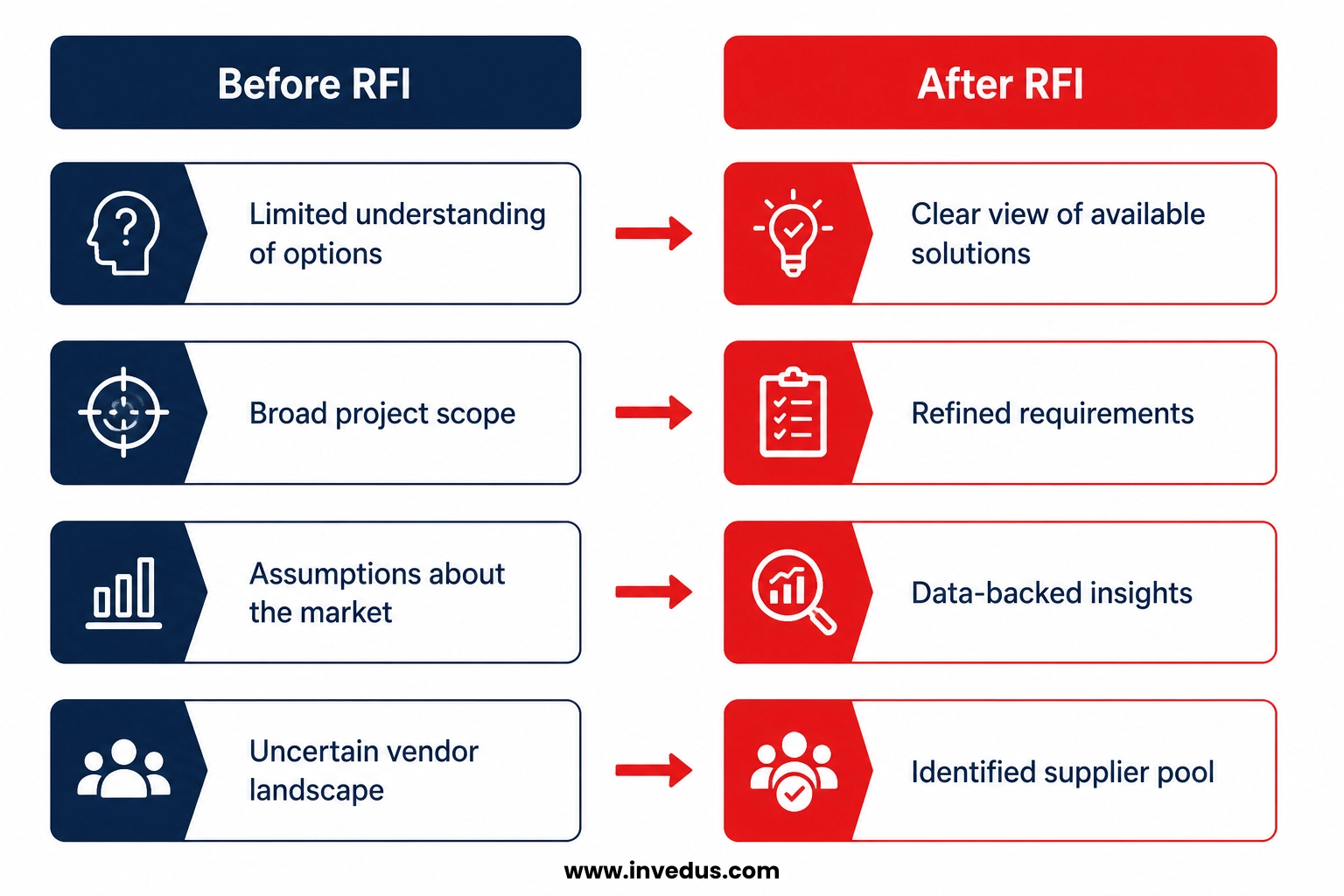
3. Refines Project Requirements
Many organizations issue an RFI because their requirements are not yet fully defined. Vendor responses often reveal new possibilities, features, or considerations that buyers may not have initially identified.
As a result, organizations can:
4. Supports Better Decision-Making
An RFI provides factual information directly from suppliers rather than relying on assumptions or limited market knowledge. Decision-makers can use the collected data to evaluate:
- Which solutions best fit their needs?
- How vendors differ in capabilities?
- What challenges may arise during implementation?
5. Reduces Procurement Risk
Request for information in procurement allows buyers to minimize the risk of supplier failure, budget overruns, implementation delays, and vendor mismatches. Buyers can assess vendor expertise, operational capacity, capabilities, etc.
6. Prepares for Future Procurement Stages
The information gathered helps organizations prepare for more detailed procurement documents, such as Requests for Proposal (RFPs) or Requests for Quotation (RFQs). The insights collected through an RFI make it easier to design an effective sourcing strategy and shortlist qualified vendors.
What are the Common Types of RFIs?
Understanding the different types of RFIs helps organizations choose the right approach and create a more effective RFI process.
1. Vendor Sourcing RFIs
Vendor sourcing RFIs helps organizations evaluate potential suppliers and build a shortlist for future RFPs or RFQs.
These RFIs help procurement teams understand vendor qualifications, product or service capabilities, industry certifications, and scalability.
2. Construction and Engineering RFIs
In the construction industry, an RFI serves a different purpose. It is a formal request used during an active project to clarify uncertainties in project documentation.
Contractors, architects, engineers, and project managers typically use construction RFIs to address design inconsistencies, missing specifications, unclear drawings, material requirements, or site condition concerns.
3. Government and Policy Consultation RFIs
Government agencies and public sector organizations issue RFIs to gather feedback before creating new policies, regulations, programs, or public procurement opportunities.
These RFIs help authorities understand industry capabilities, gather stakeholder feedback, evaluate technical options, assess the market, and identify challenges.
4. Technology and Software RFIs
Organizations often issue technology RFIs when evaluating software platforms, cloud solutions, cybersecurity tools, or digital transformation initiatives.
These RFIs focus on collecting information about system functionality, integration capabilities, security standards, deployment options, technical support models, etc.
5. Strategic Planning RFIs
Some organizations use RFIs during long-term planning initiatives when exploring new markets, business models, or operational improvements.
Instead of evaluating specific products, these RFIs gather broader insights related to industry trends, emerging technologies, market opportunities, future capabilities, etc.
| RFI Type | Primary Purpose | Typical Users |
| Vendor Sourcing | Evaluate supplier capabilities and offerings | Procurement teams |
| Construction & Engineering | Clarify project documents and specifications | Contractors, architects, engineers |
| Government & Policy Consultation | Gather feedback and assess options | Government agencies |
| Technology & Software | Research technical solutions and platforms | IT and procurement teams |
| Strategic Planning | Explore market trends and future opportunities | Business leaders and decision-makers |
RFI vs. Other Procurement Tools
The most common procurement tools include the Request for Information (RFI), Request for Proposal (RFP), and Request for Quotation (RFQ). While these documents may appear similar, they serve very different purposes within the procurement process.
| Criteria | Request for Information (RFI) | Request for Proposal (RFP) | Request for Quotation (RFQ) |
| Purpose | Gather market intelligence and supplier information | Evaluate detailed solutions and implementation approaches | Obtain pricing for a clearly defined requirement |
| Procurement Stage | Initial research phase | Vendor evaluation phase | Final purchasing phase |
| Focus | Information gathering | Problem-solving and strategy | Cost and pricing |
| Scope Definition | Often unclear or evolving | Clearly defined business objectives | Fully defined requirements |
| Pricing Requested | Usually No | Sometimes | Yes |
| Vendor Response | Capabilities, expertise, and available solutions | Detailed proposals, methodologies, timelines, and resources | Itemized pricing and commercial terms |
| Main Outcome | Better understanding of the market | Selection of the most suitable solution | Selection of the best-priced vendor |
Also Read: RFI vs RFP vs RFQ: Key Differences, Uses & Procurement Guide
When Should You Use Each Procurement Tool?
|
Situation |
Recommended Tool |
| You need to understand available solutions and market capabilities | RFI |
| You know the business problem but want vendors to propose solutions | RFP |
| You know exactly what you need and want competitive pricing | RFQ |
| Requirements are still being developed | RFI |
| Strategic evaluation of vendors is required | RFP |
| Price comparison is the primary objective |
RFQ |
How to Create an RFI Template?
Follow these steps to create an RFI template that delivers meaningful results.
Step 1: Purpose of the RFI
Before drafting questions, determine what information you need from vendors.
Ask yourself:
- What business problem are we trying to solve?
- What information is currently missing?
- Which supplier capabilities are important?
- What decisions will this RFI support?
Step 2: Add an Introduction and Project Overview
Start the RFI with a brief overview of your organization and the project. This section should explain the company background, business challenge or opportunity, project goals, and the purpose of the RFI.
Providing context helps vendors deliver more relevant and accurate responses.
Step 3: Request Company Information
Include a section that gathers basic information about each supplier. Common questions include:
| Information Required | Purpose |
| Company name | Vendor identification |
| Years in business | Assess experience |
| Industry expertise | Evaluate specialization |
| Office locations | Determine geographic presence |
| Team size | Understand operational capacity |
| Key clients | Assess market credibility |
Step 4: Ask About Products or Services
You can ask questions such as:
- What products or services do you provide?
- Which industries do you serve?
- What differentiates your solution?
- What key features or capabilities are available?
Keep questions open-ended to encourage detailed responses.
Step 5: Customize Questions Based on Industry Requirements
Below are examples of question sets that can be incorporated into a “Request for Information” based on different procurement categories.
IT and SaaS Procurement
- Which third-party systems and applications can your platform integrate with?
- What security certifications and compliance standards do you maintain?
- How do you handle data backup, disaster recovery, and business continuity?
Construction and Infrastructure Projects
- What experience do you have with projects of a similar size and complexity?
- How do you manage project delays and unexpected site conditions?
- What quality assurance and safety procedures do you follow?
- What certifications, licenses, or regulatory approvals do you maintain?
Professional Services
- What experience do you have within our industry?
- How do you typically structure project delivery and client engagement?
- What methodologies or frameworks do you use?
- Who would be assigned to our project, and what are their qualifications?
Note: These are just examples! Based on your industry, you can develop your own set of questions.
Step 6: Evaluate Technical and Operational Capabilities
If the project involves technology or specialized services, include questions about capabilities and infrastructure.
Examples include system integrations supported, security standards and certifications, compliance requirements, service delivery models, customer support processes, etc.
Step 7: Include Questions About Experience
Ask vendors to provide relevant case studies, industry-specific experience, similar projects completed, customer references, or any success stories. This section helps identify suppliers with proven expertise.
Step 8: Define Response Requirements
Clearly explain how vendors should submit their responses.
Include submission deadline, response format, contact information, file requirements, and question submission process.
Clear instructions improve response quality and consistency.
Step 9: Add Legal or Confidentiality Statements
Depending on the project, you may need to include confidentiality notices or disclaimers.
For example:
- Information provided does not guarantee future business.
- Participation is voluntary.
- Responses may be used for evaluation purposes only.
This helps manage expectations and protect sensitive information.
NOTE: Under FAR 15.201, responses to an RFI are not offers and cannot be used to form a binding contract.
Step 10: Review and Simplify
Before sending the RFI, review the document from a vendor’s perspective.
Ensure that all questions are easy to understand, technical jargon is minimized, there are no duplicate questions, and information requests are relevant to project goals.
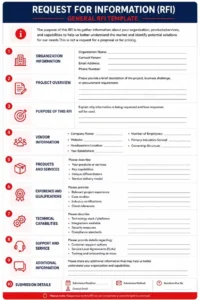
Here is an example of a successful RFI template:
How to Track and Manage RFI Responses?
Creating an RFI is only part of the procurement process. Once the document has been distributed, procurement teams need a structured way to monitor vendor participation, track deadlines, and evaluate responses. This is where an RFI tracking log becomes valuable.
What Is an RFI Tracking Log?
An RFI tracking log is a centralized document used to monitor the progress of every Request for Information issued during a procurement project.
It helps procurement teams track communication with suppliers, monitor response deadlines, prioritize evaluations, and maintain visibility across the entire RFI process.
Whether managed in a spreadsheet, procurement platform, or supplier management system, an RFI tracking log ensures that no vendor response is overlooked and that procurement activities remain organized.
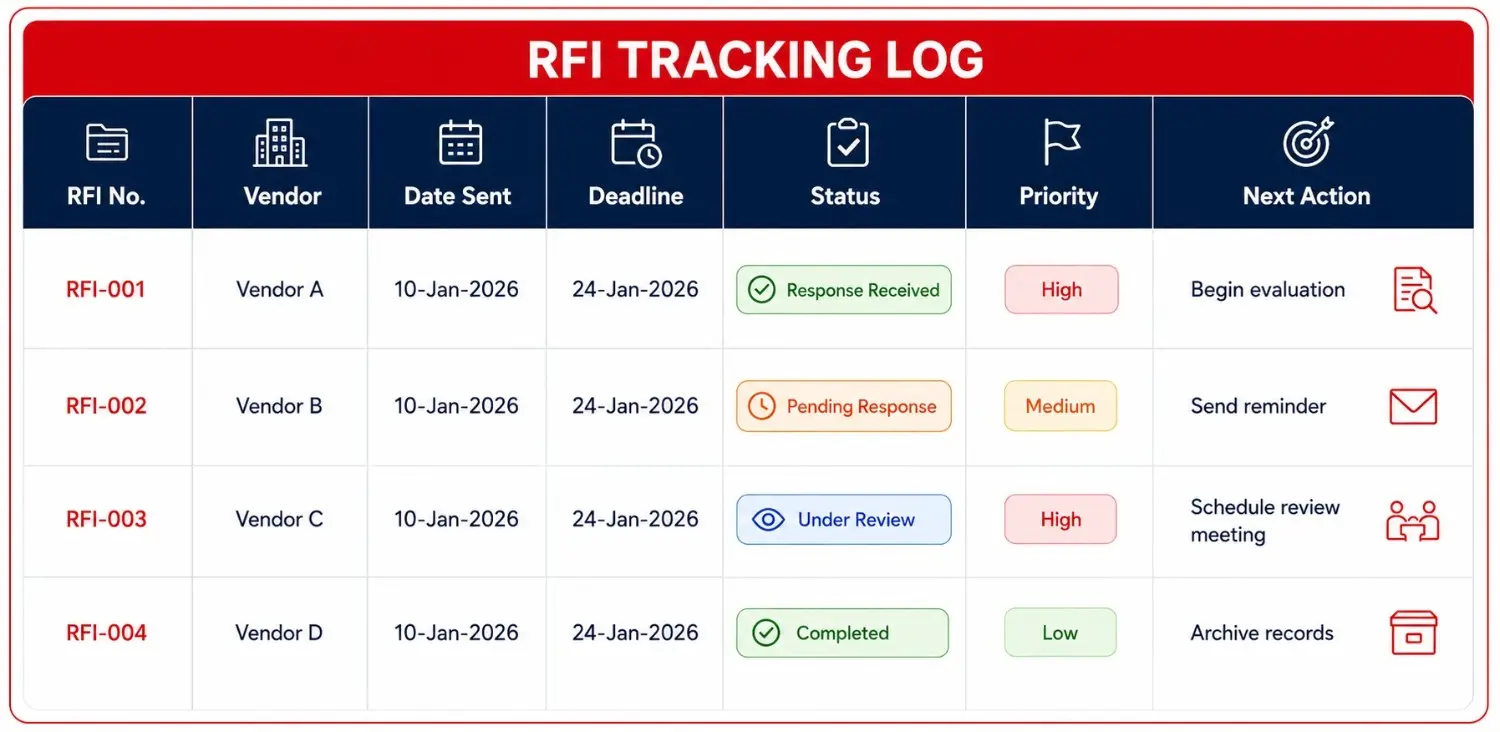
Key Information to Include in an RFI Tracking Log
| Field | Purpose |
| RFI Number | Unique identifier assigned to each RFI |
| Project Name | Associated procurement initiative |
| Vendor Name | Supplier receiving the RFI |
| Contact Person | Primary supplier representative |
| Date Sent | Date the RFI was issued |
| Response Deadline | Vendor submission deadline |
| Response Received | Indicates whether a response has been submitted |
| Status | Sent, In Review, Pending, Completed, Closed |
| Priority Level | High, Medium, or Low priority |
| Evaluation Owner | Internal reviewer responsible for assessment |
| Follow-Up Required | Tracks outstanding questions or clarifications |
| Next Action | Defines the next procurement step |
Sample of RFI Tracking Log
Why Procurement Teams Use RFI Tracking Logs?
As the number of vendors increases, managing responses manually becomes difficult. A tracking log provides a clear overview of supplier engagement and helps teams stay on schedule.
Benefits include:
- Improved visibility into vendor participation
- Easier deadline management
- Faster response evaluation
- Better stakeholder collaboration
- Reduced risk of missed follow-ups
- More organized supplier records
For organizations handling large-scale request for information procurement initiatives, a tracking log often becomes as important as the RFI template itself.
Common Challenges in RFI Creation and How to Overcome Them?
1. Asking Too Many Questions
Many organizations try to collect every possible detail during the information-gathering stage. While this may seem helpful, lengthy RFIs often overwhelm vendors and reduce response quality.
How to Overcome It
Focus only on information that is essential to the procurement decision. A well-designed RFI template should prioritize strategic questions and eliminate unnecessary requests.
2. Asking Vague or Ambiguous Questions
Poorly structured questions often result in inconsistent responses. When vendors interpret questions differently, procurement teams struggle to compare answers.
How to Overcome It
Use clear, specific language and avoid broad questions that can be interpreted in multiple ways. Organizing questions into logical sections and providing context where necessary can improve response consistency.
3. Targeting the Wrong Vendors
Even a well-crafted RFI can fail if it is sent to suppliers that lack the required expertise or capabilities. This challenge is particularly common in requests for information procurement, where organizations may rely on outdated supplier databases or limited market research.
How to Overcome It
Invest time in identifying relevant suppliers before distributing the RFI. Research vendor experience, industry specialization, certifications, and market reputation to identify qualified vendors.
4. Lack of Internal Stakeholder Alignment
Different departments often have different priorities during procurement. If procurement, IT, operations, finance, and legal teams are not aligned, important questions may be overlooked, leading to information gaps.
How to Overcome It
Involve key stakeholders early in the planning stage and gather their input before drafting the RFI. Establishing common objectives and evaluation criteria ensures the document captures all necessary information.
5. Inconsistent Vendor Responses
When suppliers submit information in different formats and levels of detail, comparing responses becomes difficult. Procurement teams may spend significant time organizing and standardizing information before they can properly evaluate it.
How to Overcome It
Provide a structured response format and clearly communicate submission requirements. Standardized questionnaires, response tables, and predefined sections help ensure vendors provide information in a consistent manner.
6. Ignoring Market Feedback
Some organizations treat an RFI as a routine procurement exercise rather than a valuable source of market intelligence. As a result, they fail to fully analyze supplier insights, industry trends, and recommendations.
How to Overcome It
Treat vendor responses as an opportunity to learn from the market. Review feedback carefully, identify recurring themes, and assess how supplier insights can influence project requirements.
The Bottom Line
An RFI is where smart procurement begins. Before committing budget or shortlisting vendors, it gives you a clear, evidence-based view of what the market can actually deliver. Used well, the RFI in procurement reduces risk, sharpens your requirements, and sets up stronger RFPs and RFQs down the line. The key is discipline: target the right suppliers, ask focused questions, and treat every response as market intelligence rather than paperwork. Get the research phase right, and every procurement decision that follows becomes faster, clearer, and far easier to defend.
Frequently Asked Questions
Are RFI responses legally binding?
No, under FAR 15.201, responses to an RFI are not offers and cannot be used to form a binding contract. RFIs are intended only for market research and supplier evaluation before formal procurement begins.
Should I include budget details in an RFI?
RFI focuses on gathering supplier capabilities and market information rather than pricing. Instead of budget details, it recommends including project background, business objectives, supplier questions, response requirements, and relevant legal or confidentiality statements.
Can I send multiple RFIs for the same project?
Yes. You can send multiple RFIs for the same project whenever new questions, design clarifications, or unforeseen site conditions arise. Each RFI should address a single issue, include supporting details, and be tracked separately to maintain clear communication and proper documentation.
How do I measure whether an RFI was successful?
A successful RFI provides meaningful supplier insights, identifies qualified vendors, refines project requirements, and supports better procurement decisions. You can also use an RFI tracking log to monitor vendor participation, response quality, deadlines, evaluations, and follow-up activities.
Can I outsource RFI creation and vendor response management?
Yes. Many businesses outsource RFI creation and vendor response management to experienced virtual assistants or engineering support teams. They can draft RFIs, coordinate with vendors, track responses, maintain documentation, and ensure communication stays organized, allowing project teams to focus on execution and decision-making.
How can Invedus Outsourcing help with the RFI process?
Invedus Outsourcing supports the RFI process by providing dedicated virtual professionals who draft RFIs, maintain RFI logs, coordinate with vendors and stakeholders, track responses, organize documentation, and monitor deadlines. This helps improve communication, reduce administrative workload, and keep construction projects moving efficiently.




Last updated on: Jul 17, 2026