


Bookkeeper vs Accountant: What’s the Real Difference in 2026?

Authored By: Rifa Hussain
Rifa is a Senior Content Writer at Invedus. She focuses on creating content that aligns...

Fact-checked By: Abhishek Sharma
10 years of experience in accounting, AP (P2P), invoice processing, and international payments across MNC...
Key Takeaways
- A bookkeeper records and organizes your financial transactions. An accountant interprets that data for tax planning, compliance, and business strategy.
- Accountants earn a US median of $81,680 per year, compared to $49,210 for bookkeepers (BLS, 2024).
- The two careers are heading in opposite directions: bookkeeping jobs are projected to decline 6% by 2034 as AI automates data entry, while accounting roles grow 5%.
- Only CPAs, Enrolled Agents, and attorneys can represent you before the IRS. Bookkeepers and non-credentialed accountants cannot.
Accountants typically charge $150 to $400 per hour. An in-house bookkeeper averages around $47,440 per year before payroll taxes, benefits, and software. - Most growing businesses need both roles, and outsourcing them can cut finance and accounting overhead by up to 70%.
When people compare a bookkeeper vs accountant, they often assume they’re choosing between two versions of the same role. But that is not true!
Think of it this way: a bookkeeper records and organizes your financial transactions, while an accountant interprets that information to help you make smarter business decisions. One focuses on keeping accurate financial records; the other focuses on turning those numbers into insights, strategies, and compliance.
The confusion is understandable. Both professionals work with financial data, both help maintain business finances, and in smaller companies, their responsibilities can sometimes overlap.
This blog will highlight the key differences between them, how their roles are evolving in the AI era, and how to determine which professional your business needs.
What is the Difference Between Bookkeeping and Accounting?
A bookkeeper records what happened in your business; an accountant interprets what it means and helps decide what to do next.
The core difference between bookkeeper vs accountant is how they contribute at different stages of the financial management process.
A bookkeeper focuses on maintaining accurate records. Their responsibilities typically include recording transactions, reconciling bank accounts, processing invoices, managing accounts payable and receivable, and keeping financial data organized.
An accountant builds on that foundation. Instead of primarily recording transactions, accountants analyze financial information to identify trends, prepare financial statements, support tax planning, ensure compliance, forecast cash flow, and provide strategic business advice.
Given that, here is a table of the differences between a bookkeeper vs accountant.
| Area | Bookkeeper | Accountant |
| Role | Records and organizes financial transactions. | Analyzes financial information and provides business insights. |
| Responsibilities | Recording transactions, invoicing, bank reconciliations, payroll, accounts payable, and receivable. | Financial reporting, budgeting, tax planning, compliance, forecasting, and financial analysis. |
| IRS Representation Rights | No automatic representation rights before the IRS | CPAs, Enrolled Agents (EAs), and attorneys can represent taxpayers before the IRS during audits, collections, and appeals |
| Financial Reporting | Generates basic reports. | Prepares and reviews formal financial statements. |
| Tax Responsibilities | May organize tax-related records. | Handles tax preparation, tax strategy, and compliance. |
| Cash Flow Analysis | Tracks cash movement. | Evaluates cash flow trends and recommends actions. |
| Compliance & Regulations | Ensures records are maintained accurately. | Ensures compliance with accounting standards, tax laws, and regulations. |
| Audit Support | Provides supporting documentation. | Conducts, manages, or supports audits. |
| Education Requirements | Often a high school diploma, certificate, or bookkeeping training. | Typically requires a bachelor’s degree in accounting or a related field. |
| Professional Certifications | Optional certifications such as Certified Bookkeeper (CB). | CPA, CMA, EA, and other professional credentials are common. |
| Software Usage | QuickBooks, Xero, Sage, spreadsheets, payroll systems. | Accounting software plus tax, audit, reporting, and analytics tools. |
| Business Advisory Role | Limited. | Core part of the role. |
| Salary (U.S. Median, 2024) | $49,210/year | $81,680/year |
| Job Outlook (2024–2034) | -6% decline due to automation of routine tasks. | +5% growth driven by demand for analysis, compliance, and advisory services. |
| Impact of AI & Automation | High impact; many transaction-entry tasks are increasingly automated. | Lower impact; analytical, advisory, and compliance work remains in demand. |
| Best For | Startups, sole proprietors, and businesses need organized financial records. | Growing businesses need tax planning, financial analysis, forecasting, and strategic guidance. |
What Does a Bookkeeper Actually Do?
The rise of AI has fundamentally changed bookkeeping, but it has not eliminated the need for bookkeepers. Instead, technology has automated much of the repetitive work, allowing bookkeepers to focus on the areas where human judgment still matters.
Tasks That Still Need to Be Done Manually
Bookkeepers are still responsible for reviewing exceptions and making judgment calls in situations such as:
- Vendor payment disputes
- Duplicate or missing transactions
- Misclassified expenses
- Customer billing discrepancies
- Unusual account activity
- Correcting AI-generated coding errors
For example, software may struggle to determine whether a property expense should be classified as a repair expense or a capital improvement. Similarly, distinguishing between a deductible client meal and a non-deductible commuting expense often requires contextual judgment.
A 2025 study published in PNAS Nexus found that large language models (LLMs) frequently diverge from human decision-making because they apply rules more rigidly and lack practical business context.
How AI is transforming Bookkeeping in 2026?
While judgment-based work remains human-led, many traditional bookkeeping functions are now heavily automated.
Modern accounting platforms can automatically perform transaction categorization, bank feed imports, bank reconciliation matching, OCR-based receipt processing, recurring accounts payable coding, invoice data extraction, expense tracking, and anomaly detection.
The speed of adoption has been remarkable. According to the Thomson Reuters Institute’s 2026 Future of Professionals Report, organization-wide AI adoption nearly doubled in a single year, increasing from 22% in 2025 to 40% in 2026. Within the tax profession, 44% of firms now report using generative AI daily.
The result is that bookkeepers spend significantly less time entering data and more time reviewing, validating, and managing financial information.
What Does an Accountant Do, and Why Is Demand Growing?
If bookkeepers focus on recording financial activity, accountants focus on understanding what that activity means.
According to the U.S. Bureau of Labor Statistics, accountants and auditors earn a median annual salary of approximately $81,680, compared to $49,210 for bookkeeping, accounting, and auditing clerks.
Their responsibilities often include:
- GAAP-compliant financial statements
- Federal tax return preparation
- Multi-state tax compliance
- Financial audits and reviews
- Regulatory reporting
- IRS correspondence and representation
Certain services are legally restricted to licensed professionals such as Certified Public Accountants (CPAs) and Enrolled Agents (EAs). These professionals can represent taxpayers before the IRS, sign certain reports, and provide specialized compliance services that bookkeepers typically cannot perform.
Role of AI in Transforming Accounting Tasks
AI is reshaping accounting by helping professionals analyze financial data, improve forecasting, strengthen audit procedures, enhance tax research, detect compliance risks, and deliver more strategic advisory services.
This shift toward higher-value work is reflected in the latest AICPA CAS Benchmark Survey. It found that Client Advisory Services (CAS) practices reported a median growth rate of 17% while median CAS fees per professional increased by 29%.
This makes businesses think whether they should hire a bookkeeper, an accountant, CPA or if an EA is enough.
Bookkeeper vs Accountant vs CPA vs EA
When it comes to tax preparation, a bookkeeper primarily organizes and maintains financial records that support accurate tax filing. An accountant uses those records to prepare returns, identify deductions, and ensure compliance with tax regulations.
A CPA provides advanced tax planning, handles complex tax situations, and can represent clients before the IRS. An Enrolled Agent (EA) specializes exclusively in taxation and IRS matters, making them highly qualified for tax preparation, audits, appeals, and tax resolution services.
| Factor | Bookkeeper | Accountant | CPA | Enrolled Agent (EA) |
| Primary Focus | Recording financial transactions | Financial reporting and analysis | Accounting, auditing, tax, advisory | Tax preparation and tax representation |
| License Required | No | Not always | Yes (state license) | Yes (federal IRS credential) |
| Maintains Books and Records | Yes | Sometimes | Sometimes | Rarely |
| Prepares Financial Statements | Limited | Yes | Yes | Limited |
| Performs Audits | No | No | Yes | No |
| Tax Preparation | Basic to moderate | Yes | Yes | Yes |
| Tax Planning | Limited | Moderate | Advanced | Advanced |
| Represents Clients Before IRS | Generally No | Not automatically | Yes | Yes |
| IRS Representation Rights | None or limited | Depends on credentials | Unlimited | Unlimited |
| Can Sign Tax Returns as Paid Preparer | Yes, if holding a valid PTIN | Yes, if holding a valid PTIN | Yes | Yes |
| Best For | Daily bookkeeping and transaction management | Financial reporting and compliance | Complex accounting, audits, business advisory, tax strategy | Tax resolution, audits, appeals, and tax-focused services |
How Much Does a Bookkeeper vs Accountant Cost in 2026?
According to QuickBooks, the average salary for an in-house bookkeeper in the United States is approximately $47,440 per year. This excludes additional employer costs such as payroll taxes, employee benefits, software subscriptions, equipment, training, and office overhead.
Actual costs vary depending on transaction volume, industry requirements, payroll complexity, and the level of experience required. Businesses with higher transaction volumes or more complex financial operations often incur higher bookkeeping costs than smaller organizations with straightforward accounting needs.
How Much Does an Accountant Cost in 2026?
Accounting services generally carry higher costs because they require greater financial expertise and analytical capabilities.
Accountants typically charge between $150 and $400 per hour. The rates can be influenced by factors such as credentials, specialization, geographic location, and the complexity of the engagement.
This difference is reflected in most bookkeeping vs accounting salary comparisons. While bookkeeping focuses on maintaining accurate financial records, accounting involves financial analysis, compliance oversight, tax planning, and strategic decision support, all of which require more advanced expertise.
Hiring a Bookkeeper: What Affects the Cost?
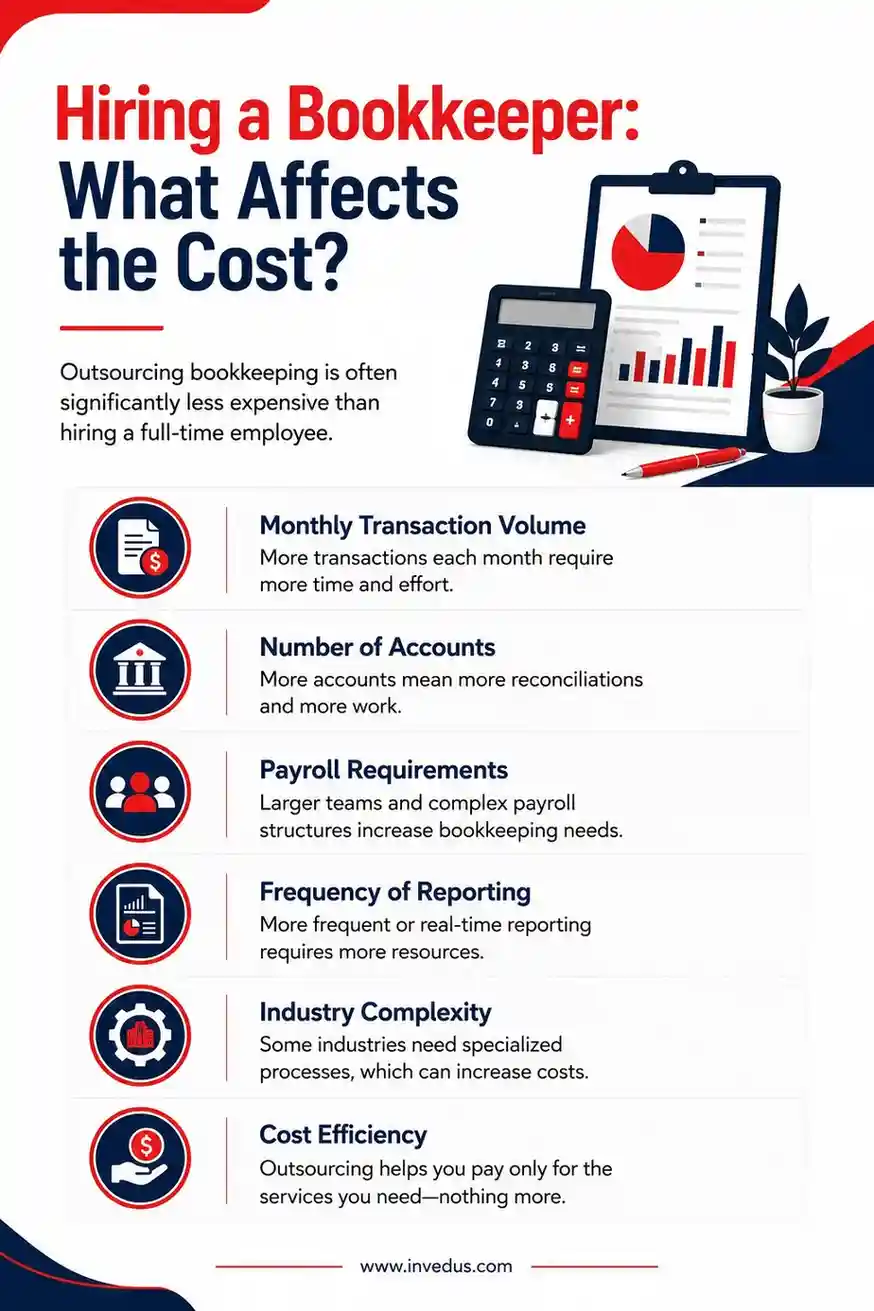
Outsourcing bookkeeping is often significantly less expensive than hiring a full-time employee because businesses only pay for the services they need.
However, outsourced bookkeeping costs can vary based on several factors:
Monthly Transaction Volume
The number of financial transactions processed each month directly impacts bookkeeping costs. A business with thousands of monthly transactions requires substantially more bookkeeping time than a company processing only a few dozen transactions.
Number of Accounts
Managing multiple bank accounts, credit cards, merchant processors, and loan accounts increases reconciliation requirements and the amount of work involved.
Payroll Requirements
Businesses with larger workforces, multiple pay schedules, or complex payroll structures typically require additional bookkeeping support, increasing overall costs.
Frequency of Reporting
Monthly reporting generally costs less than weekly reporting or real-time financial monitoring. More frequent reporting requires additional bookkeeping resources and oversight.
Industry Complexity
Industries such as construction, manufacturing, healthcare, and e-commerce often require specialized bookkeeping processes, which can increase service fees.
For many businesses, outsourcing bookkeeping eliminates the need to pay a full-time salary, benefits, payroll taxes, and software expenses while still maintaining accurate and up-to-date financial records.
Hiring an Accountant: What Affects the Cost?
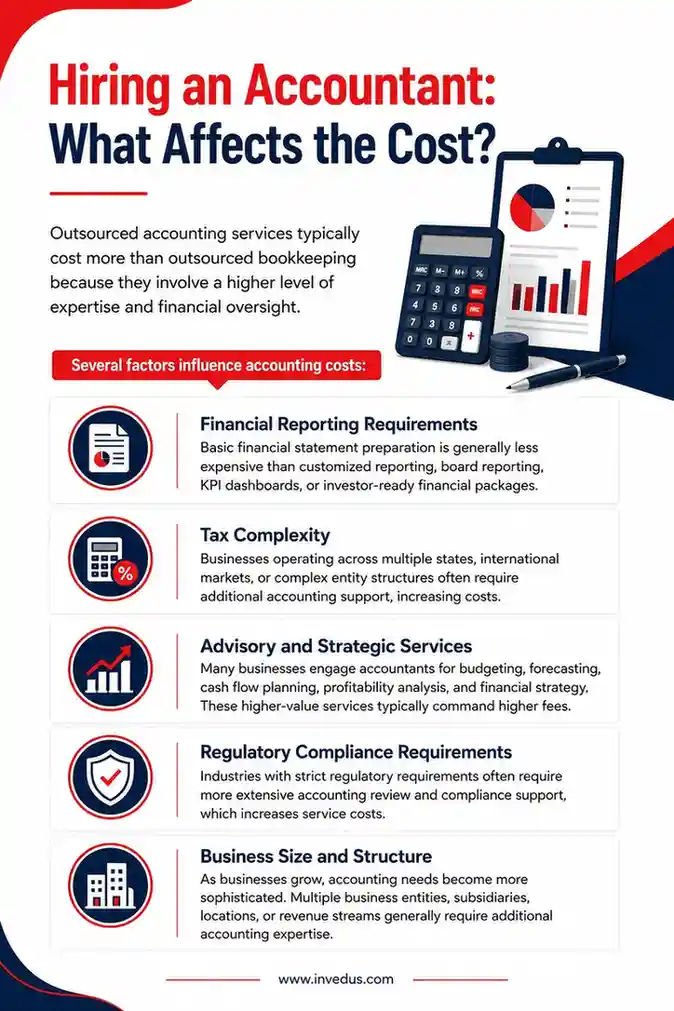
Outsourced accounting services typically cost more than outsourced bookkeeping because they involve a higher level of expertise and financial oversight.
Several factors influence accounting costs:
Financial Reporting Requirements
Basic financial statement preparation is generally less expensive than customized reporting, board reporting, KPI dashboards, or investor-ready financial packages.
Tax Complexity
Businesses operating across multiple states, international markets, or complex entity structures often require additional accounting support, increasing costs.
Advisory and Strategic Services
Many businesses engage accountants for budgeting, forecasting, cash flow planning, profitability analysis, and financial strategy. These higher-value services typically command higher fees.
Regulatory Compliance Requirements
Industries with strict regulatory requirements often require more extensive accounting review and compliance support, which increases service costs.
Business Size and Structure
As businesses grow, accounting needs become more sophisticated. Multiple business entities, subsidiaries, locations, or revenue streams generally require additional accounting expertise.
Also Read: Cost of an Accountant for a Small Business in 2026
Which One Should You Hire?
The right choice depends on your business’s financial requirements and growth stage.
Hire a Bookkeeper if you need:
- Accurate and organized financial records
- Regular account reconciliations
- Consistent financial data management
- Support for day-to-day financial operations
Hire an Accountant if you need:
- Financial reporting and analysis
- Tax planning and compliance support
- Budgeting and cash flow forecasting
- Strategic financial guidance for growth
Many businesses need both. Bookkeepers maintain accurate financial data, while accountants use that data to generate insights, support decision-making, and ensure compliance. As a business grows, these roles often become complementary rather than interchangeable.
For this reason, many companies choose to outsource bookkeeping, accounting, or both. Outsourcing provides access to experienced professionals without the costs associated with full-time hiring. Depending on the service model and business requirements, outsourcing can reduce finance and accounting overhead costs by up to 70% while providing greater flexibility and scalability.
Get Expert Bookkeeping and Accounting Support Without the Full-Time Cost
Whether you need a dedicated bookkeeper, an experienced accountant, or a combination of both, Invedus provides tailored finance and accounting support based on your business requirements. Our professionals can help manage financial operations, reporting, compliance, tax support, cash flow analysis, and other accounting functions while seamlessly integrating with your existing processes.
Depending on your needs, you can hire a dedicated virtual assistant, bookkeeper, or accountant and build a flexible support model that grows with your business.
Businesses can get started with Invedus at just $7.99 per hour or $999 per month, making it a cost-effective alternative to hiring full-time in-house finance professionals.

Frequently Asked Questions
What financial reports can a bookkeeper provide versus an accountant?
Bookkeepers typically generate basic financial reports such as income statements, balance sheets, and cash flow summaries. Accountants go further by preparing formal financial statements, conducting financial analysis, forecasting future performance, identifying trends, and providing strategic recommendations based on financial data.
What are the risks of relying solely on automated bookkeeping tools?
Automated bookkeeping tools can process transactions efficiently but often struggle with exceptions, unusual expenses, classification decisions, and contextual judgment. Errors in categorization, compliance issues, duplicate transactions, or misclassified expenses can occur without human review, potentially affecting financial accuracy and reporting.
What financial red flags can an accountant identify that a bookkeeper may miss?
An accountant can identify declining profit margins, cash flow issues, tax exposure, compliance risks, unusual spending patterns, financial inefficiencies, and long-term business risks. Their analytical expertise helps uncover trends and opportunities that may not be apparent from transactional records alone.
Why is bookkeeping considered the foundation of accounting?
Accounting relies on accurate financial records to produce meaningful insights and reports. Since bookkeepers maintain and organize transaction data, their work creates the foundation accountants use for financial analysis, forecasting, tax planning, compliance management, and strategic business decision-making.
Can businesses rely solely on AI for bookkeeping and accounting?
No. While AI can automate transaction processing, reporting, forecasting, and data analysis, it lacks human judgment and business context. Both bookkeeping and accounting still require professionals to review exceptions, interpret results, ensure compliance, and make strategic financial recommendations.
Can bookkeeping alone provide an accurate picture of business performance?
Bookkeeping provides accurate financial records but does not fully explain business performance. It shows what happened financially, while accounting helps interpret why it happened, identifies trends, evaluates profitability, and provides insights that support informed business decisions and future planning.
How do bookkeeping and accounting contribute to business sustainability?
Bookkeeping ensures financial records remain accurate and organized, while accounting transforms that information into actionable insights. Together, they support compliance, cash flow management, strategic planning, risk identification, and informed decision-making, all of which contribute to long-term business sustainability and growth.




Last updated on: Jul 13, 2026