


How to Find a Good Accountant and Choose for Business Needs

Authored By: Rifa Hussain
Rifa is a Senior Content Writer at Invedus. She focuses on creating content that aligns...

Fact-checked By: Abhishek Sharma
10 years of experience in accounting, AP (P2P), invoice processing, and international payments across MNC...
Key Takeaways
- According to the U.S. Bureau of Labor Statistics, demand for accountants and auditors is projected to grow 5% between 2024 and 2034.
- The IRS warns that reporting negligence or filing errors can trigger penalties worth 20% of underpaid tax amounts, showing why choosing the right accountant directly impacts business compliance and financial stability.
- Businesses should never hire accountants based only on pricing. Industry experience, software expertise, communication quality, and long-term scalability matter far more for operational success and financial decision-making.
- One of the smartest ways to find an accountant is by combining verified professional directories, referrals, credential checks, interviews, and technology evaluations instead of relying only on Google search results.
- Invedus helps businesses overcome rising accounting costs and talent shortages by providing experienced offshore accountants trained in U.S. accounting systems, bookkeeping workflows, payroll, tax support, and financial reporting.
One wrong hire can mean missed tax deadlines, cash flow confusion, compliance issues, or financial decisions made on incomplete numbers. That is exactly why so many business owners struggle finding a good accountant who truly understands their industry, growth stage, and long-term business goals.
According to the U.S. Bureau of Labor Statistics, the demand for accountants and auditors is expected to increase by 5% between 2024 and 2034, faster than the average for all occupations.
At the same time, the accounting industry is facing an ongoing talent shortage, making experienced accountants harder to find and retain.
To help you manage cash flow and avoid costly mistakes, learn how to find an accountant from this guide in 5 simple steps!
Why Does Finding A Good Accountant Matter?
A major reason businesses struggle financially is not always low revenue!
It is poor financial visibility, compliance mistakes, and weak cash flow management. That is why finding a good accountant matters far beyond tax season. A skilled accountant helps businesses maintain accurate records, manage cash flow, avoid penalties, and make informed financial decisions before problems become expensive.
The IRS continues to increase scrutiny around reporting accuracy, late filings, and compliance penalties. The IRS Accuracy-Related Penalty Guidance states that negligence or reporting errors can trigger penalties equal to 20% of underpaid tax amounts.
This makes accountants increasingly important for small businesses and growing companies navigating more complex regulations, payroll obligations, and tax requirements.
Whether businesses work locally or find an accountant online, the right accounting partner can reduce costly errors, improve financial planning, and provide long-term operational stability.
How To Find An Accountant?
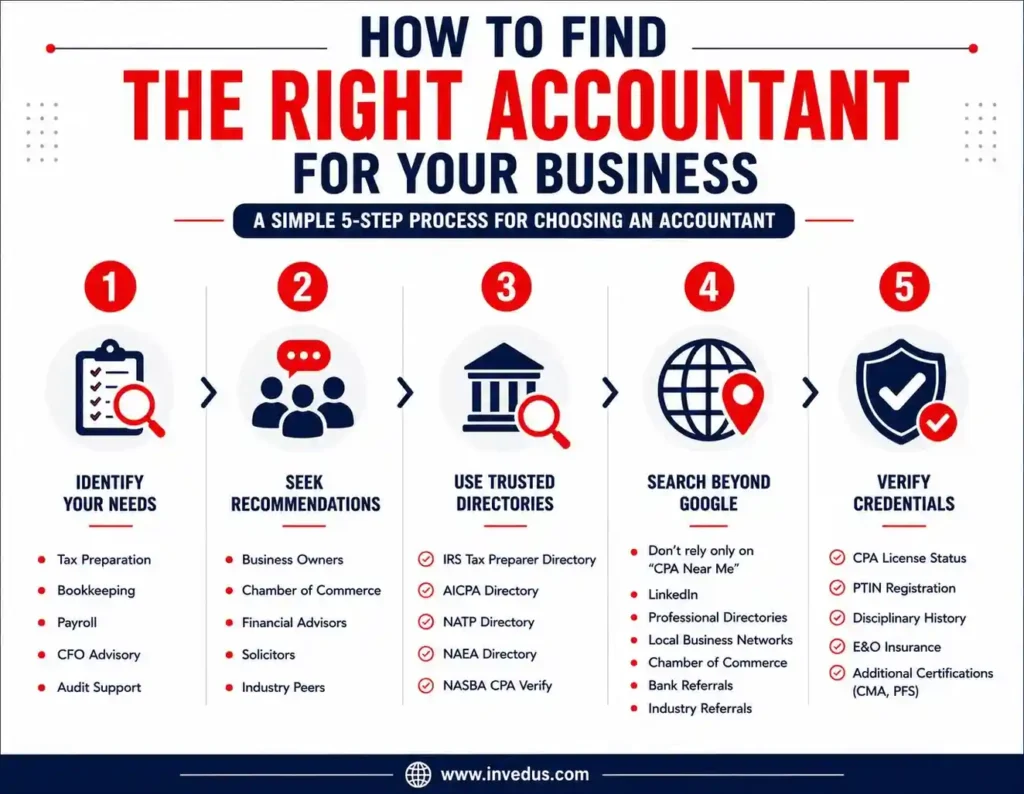
Finding the right accountant is not just about hiring someone to file taxes once a year. A good accountant becomes a long-term financial partner who helps you manage compliance, cash flow, business planning, reporting accuracy, payroll, and growth decisions.
The problem is that many businesses and individuals only realise they hired the wrong accountant after facing missed deadlines, IRS notices, reporting mistakes, or poor financial visibility.
That is why understanding how to find an accountant properly matters far more in 2026, especially as the accounting industry continues facing talent shortages and rising demand for experienced professionals.
Given that, here is how you can find an accountant for your business needs in 2026.
1. Start by Identifying What You Actually Need
Before choosing an accountant, first understand what type of accounting support you require. Ask yourself these questions before you start any search:
Is this a once-a-year need or an ongoing one?
If you only need someone to file your annual return, a freelance tax preparer or a seasonal CPA engagement may be perfectly sufficient. But if you’re generating invoices, managing expenses, paying employees, and trying to understand your cash position every month, you need ongoing support.
Are you a sole proprietor, LLC, S-Corp, or C-Corp?
Your business structure determines your filing obligations. A sole proprietor has far simpler requirements than an S-Corp, which demands separate payroll, distributions tracking, and its own set of compliance deadlines. Make sure whoever you hire has specific, hands-on experience with your entity type.
Do you have industry-specific complexity?
Certain industries carry accounting nuances that generalists often miss. Construction businesses deal with job costing and WIP reporting. eCommerce businesses navigate multi-state sales tax and inventory valuation. Real estate investors need depreciation schedules and cost segregation analysis. Medical practices have specific coding and reimbursement accounting requirements.
Are you planning to grow, raise funding, or exit in the next three to five years? If the answer is yes, your accounting needs are not what they are today. Investors and lenders expect clean, accrual-based financials, auditable records, and often GAAP-compliant reporting.
With those answers in hand, the common types of accounting support most small businesses need fall into one or more of the following:
- Tax preparation and IRS filings
- Small business bookkeeping
- Payroll management
- Financial forecasting and budgeting
- Audit support
- CFO-level advisory
- Industry-specific accounting
- International tax compliance
A freelancer handling personal taxes may be perfectly capable for a self-employed individual, but entirely unsuitable for a growing company needing full-scale business accounting services.
Equally, a startup needing tidy monthly books does not need the overhead of a full CPA firm charging enterprise-level retainers.
The clearer you are about what you need before you start comparing providers, the faster and cheaper the whole process becomes
2. Seek Recommendations
Word of mouth remains one of the most reliable ways of finding a good accountant. It is often the step people skip in favor of jumping straight to Google. That’s a mistake worth avoiding.
A recommendation from someone who runs a business similar to yours carries a very different weight than a five-star review on a directory listing.
Your local Chamber of Commerce is another underused resource here. Most chambers maintain member directories and can point you toward accountants who specialize in businesses of your size and sector.
Don’t overlook your solicitor or business advisor either. Professionals who work adjacent to accounting, such as lawyers handling business contracts, financial advisors, mortgage brokers who work with self-employed clients.
3. Use Trusted Professional Directories
The accounting and tax profession in the US is not uniformly regulated. Anyone can legally call themselves a “bookkeeper” or a “tax advisor” without formal qualifications, professional membership, or insurance.
The directories listed below solve that problem by only including practitioners who have met specific licensing, examination, or registration requirements:
- IRS Tax Preparer Directory: This is the most authoritative starting point for anyone looking for tax preparation help. The IRS maintains a searchable database of all credentialed tax preparers who hold a current “Preparer Tax Identification Number (PTIN)” and one of the three recognized credentials: CPA, Enrolled Agent, or Attorney.
You can search by location and filter by credential type. It also flags practitioners with limited representation rights versus full representation rights. This means you can immediately see whether the person you’re considering can represent you before the IRS in an audit or only prepare your return.
- American Institute of Certified Public Accountants: The AICPA allows you to search for licensed CPAs by name, location, and specialization. AICPA membership means the practitioner has agreed to the institute’s Code of Professional Conduct, stays current with mandatory continuing education, and operates under a peer review.
- National Association of Tax Professionals: NATP’s directory focuses specifically on tax professionals rather than accountants more broadly. It’s particularly useful if your primary need is tax planning and compliance rather than ongoing bookkeeping or financial management. Members are required to complete annual continuing education and members tend to be deeply current on code changes, credits, and filing requirements.
- NAEA — National Association of Enrolled Agents: An EA has passed a rigorous three-part IRS examination covering individual tax, business tax, and representation. They may have also worked directly for the IRS for at least five years. For small business owners who want serious tax expertise without necessarily paying CPA-level fees, an NAEA-listed Enrolled Agent is best option. The NAEA’s searchable directory at taxexperts.naea.org filters by location and specialization.
- NASBA CPA Verify Tool: This tool serves a specific and important function: licence verification. You can enter the CPA’s name and state into “CPA Verify” to confirm that their licence is current, in good standing, and free of disciplinary action. This takes approximately sixty seconds and removes any ambiguity.
*State CPA Societies
Beyond the national directories, every US state has its own CPA society with a searchable member directory. These state-level organizations are particularly valuable when choosing an accountant for location-specific needs. This includes multi-state sales tax compliance, state income tax planning, or navigating the specific filing requirements of your state’s revenue department.
A quick search for “[your state] CPA society member directory” will take you directly to the right resource.
4. Search Beyond Google Results
Typing “CPA near me” into Google feels like the logical first move. However, it just returns a mix of paid advertisements, directory listings optimized for search rather than quality, and large national firms with the budget to outrank smaller ones.
The most reliable approach is not to rely on any single channel but to triangulate across several. To find an accountant online or offline, combine:
- Professional directories
- LinkedIn Search
- Industry referrals
or
Local business networks: Business improvement districts, startup hubs, coworking communities, and local Facebook business groups are all places where candid, experience-based recommendations surface organically.
Chamber of Commerce: Most Chambers maintain curated member directories and can make warm introductions to accountants who’ve worked successfully with other members at your stage.
Financial advisor and solicitor referrals: Professionals who sit adjacent to accounting in their daily work develop strong, experience-based opinions on which accountants are competent and reliable.
Your bank’s small business team: Relationship managers at business-focused banks often have extensive referral networks and will typically recommend accountants they’ve seen deliver clean, bankable financial records.
5. Verify Credentials Carefully
When you find an accountant online, the directory listing, the professional-looking website, and the confident language on the homepage tell you very little about that person.
Doing a quick credential check before you sign anything is not overcautious; it’s essential.
Here is exactly what to verify, and how to verify it:
- The National Association of State Boards of Accountancy (NASBA) offers a free license check tool. You can find it at nasba.org. It lets you search for any CPA by name or license number. It also allows you to confirm if the license is active and in good standing. You can also check for any disciplinary action.
- Anyone who is paid to prepare or assist in preparing a federal tax return in the US is legally required to hold a valid Preparer Tax Identification Number (PTIN), issued by the IRS. You can verify this through the IRS’s free online Tax Preparer Directory at irs.gov.
- The NASBA verification tool and your state’s individual CPA licensing board allow you to view any formal disciplinary actions, sanctions, or complaints against a practitioner. For Enrolled Agents (federally licensed tax practitioners who are authorized to represent clients before the IRS), the IRS Office of Professional Responsibility maintains its own disciplinary database.
- Professional liability insurance (also called errors and omissions “E&O” insurance) means that if your accountant makes a significant reporting error, files an incorrect return, or misses a compliance deadline that results in financial penalties for your business, there is a mechanism for recovering those losses.
- Beyond the baseline CPA or EA credential, look for additional certifications that are relevant to your specific needs. A Certified Management Accountant (CMA) designation signals strength in financial planning and business analysis. A Personal Financial Specialist (PFS) designation indicates expertise in personal financial planning alongside tax.
What Unqualified Preparers Actually Cost You?
Errors made by an unqualified preparer on a business return, missed deductions, incorrect entity classification, unreported income, or mishandled payroll tax can result in IRS audits, penalty assessments, and back taxes that far exceed whatever you saved on fees.
Worse, if the preparer used fraudulent practices, IRS can hold the business owner responsible even if they had no knowledge of the wrongdoing.
How to Choose an Accountant Based on Your Business Needs?
Finding the right accountant is not about hiring the first CPA or bookkeeper you come across online. The right accountant should match your business model, financial complexity, industry requirements, growth stage, and long-term goals.
Many businesses make the mistake of hiring based only on pricing or convenience. But poor financial management often leads to cash flow problems, tax penalties, inaccurate reporting, compliance risks, and missed growth opportunities. The risk especially escalates with a small business accountant, where the company is still growing.
Choose the Right Type of Accounting Professional
Not every financial professional performs the same role.
Bookkeepers usually handle daily transaction recording, bank reconciliations, expense categorization, or invoice management.
Tax preparers usually focus on filing returns, basic tax compliance, or end-of-year documentation.
Accountants usually handle financial reporting, profit analysis, payroll oversight, compliance management, or budgeting.
CPAs can additionally provide IRS representation, audits, advanced tax planning, financial strategy, or regulatory advisory.
When learning how to find an accountant, understanding these distinctions helps avoid hiring someone without the expertise your business truly needs.
Also read: 6 Signs Your Startup Needs A Bookkeeper
Evaluate Experience Carefully
Experience is one of the most important factors when choosing an accountant. A technically qualified accountant may still struggle if they lack experience in your industry or business size.
For example:
- A restaurant accountant handles different tax and payroll structures than a SaaS accountant
- Real estate accounting differs heavily from eCommerce accounting
- Multi-state businesses require more complex compliance management
Industry-specific experience often improves:
- Tax efficiency
- Reporting accuracy
- Compliance handling
- Cash flow forecasting
- Financial planning
Conduct Interviews Before Hiring
Never hire an accountant based only on a website profile or referral.
Interviews help evaluate communication style, problem-solving ability, technical understanding, responsiveness, and strategic thinking.
During interviews, ask:
- What industries do you specialize in?
- What accounting software do you use?
- How do you handle tax planning?
- How quickly do you respond during busy seasons?
- Who will actually manage my account?
- Can you support business growth later?
Communication matters more than most businesses realize. A good accountant should simplify complex financial information instead of overwhelming you with jargon.
Verify Licenses, Certifications, and Credentials
One of the biggest mistakes businesses make when trying to find an accountant online is skipping credential verification.
Always verify:
- CPA licenses
- PTIN registration
- State board standing
- Certifications
- Disciplinary history
Credential checks help protect businesses from fraudulent preparers, unlicensed operators, or inexperienced contractors.
Check References and Reputation
Before finalizing your decision, request references from current or past clients.
Speaking with other business owners provides insights that websites and marketing pages rarely show.
Ask references about:
- Responsiveness
- Accuracy
- Deadline management
- Communication
- Problem handling
- Availability during tax season
You should also review Google reviews, LinkedIn recommendations, Better Business Bureau ratings, Reddit business discussions, or Clutch reviews.
*Patterns matter more than isolated complaints.
Review Their Technology and Software Capabilities
Modern business accounting services rely heavily on cloud accounting systems and automation. A strong accountant should be comfortable using:
- QuickBooks
- Xero
- NetSuite
- Sage
- Gusto
- Bill.com
- Stripe integrations
- Shopify integrations
Technology compatibility improves, reporting speed, financial visibility, collaboration, payroll processing, and automation efficiency.
Ask About Tax Strategy and Deductions
A good accountant should do more than simply “file taxes.”
They should actively help identify tax deductions, credits, entity optimization opportunities, expense categorization improvements, cash flow strategies, and risk reduction opportunities.
This becomes especially important for:
- Small businesses
- Freelancers
- Contractors
- eCommerce businesses
- Multi-state operations
Proactive tax planning is often one of the clearest signs of real expertise.
Understand the Fee Structure and Hidden Costs
Before signing any agreement, fully understand their pricing structure. Evaluate the method they are charging for, such as:
- Hourly pricing
- Monthly retainers
- Project fees
- Consultation costs
- Payroll charges
- Filing fees
- Additional service costs
Major red flag: Avoid accountants who charge based on refund size. The IRS specifically warns taxpayers against this practice.
Make Sure the Accountant Is Compatible & Long Term
Accounting relationships are usually ongoing. That means compatibility matters.
You should feel comfortable asking questions, discussing financial concerns, sharing sensitive information, or reviewing reports regularly.
Strong working relationships often lead to better financial planning and faster issue resolution. Trust and communication become especially important as businesses grow more complex.
Always Get a Written Agreement
Once you finalize your decision, formalize everything in writing.
Your agreement should clearly define:
- Scope of services
- Deliverables
- Reporting frequency
- Deadlines
- Pricing
- Responsibilities
- Communication expectations
Written agreements reduce confusion and create accountability for both sides.
Also Read: Offshore Tax Strategies for High Net-Worth Individuals
How to Find an Accountant in the USA Amid the Growing Shortage
The ongoing accountant shortage is making it harder to hire experienced financial professionals, especially for tax, audit, and advisory roles. Many firms are overloaded during peak seasons, which can affect response times, availability, and service quality.
When choosing an accountant, evaluate whether they have enough operational capacity to support your business consistently year-round. Ask about team size, turnaround times, workload management, and backup support during tax season. Businesses should also consider hybrid or outsourced accounting services if local hiring becomes too expensive or limited due to the growing shortage of accountants in the USA.
Also Read: Accountant Shortage in the USA – Invedus
On-Boarding Your Chosen Accountant
Finding and choosing the right accountant is only half the process. The real value begins during onboarding. Here, your accountant gains access to your financial systems, reporting structure, operational workflows, tax records, payroll setup, and business goals.
According to Reuters Reporting on the U.S. Accounting Talent Crunch, the U.S. accounting workforce declined significantly between 2019 and 2024 as retirements accelerated and fewer graduates entered the profession.
This shortage is directly increasing accounting costs. Many businesses now face:
- Higher CPA fees
- Longer onboarding timelines
- Reduced availability during tax season
- Increased turnover risk
- Overworked local accounting teams
That is why onboarding should not simply focus on transferring files. Businesses should look at all the affecting factors.
Outsourcing Accounting Services to India
Because of rising accounting salaries and the ongoing talent shortage, many businesses are now moving toward outsourced accounting services instead of relying entirely on expensive local hiring.
India has become one of the largest global hubs for accounting outsourcing because of:
- Large accounting talent pools
- U.S. GAAP familiarity
- CPA-trained professionals
- Lower operational costs
- Strong English communication
- Experience with U.S. accounting software
According to Reuters, major U.S. accounting firms are increasingly expanding operations in India to solve staffing shortages and capacity issues.
Industry reports also suggest that India now handles a significant share of global accounting outsourcing operations due to its scalability and trained finance workforce.
In a Nutshell
A good accountant communicates clearly, provides valuable advice, is responsive to your queries, and has a track record of accuracy and reliability. By following these steps, you ensure that you choose an accountant who can effectively manage your financial matters and provide valuable insights for informed financial decisions.
Need assistance with your accounting tasks? Consider exploring offshore accounting services!
If you’re in need of assistance in your search, Invedus can be your perfect partner. We connect you with experienced offshore accountants holding CPA credentials, providing tailored financial solutions. Achieve transparency, efficiency, and peace of mind in your financial management with Invedus.
Frequently Asked Questions
What should I look for when choosing an accountant?
Focus on industry expertise, software knowledge, communication quality, responsiveness, and long-term scalability. A qualified small business accountant should understand compliance, payroll, cash flow, and tax planning while simplifying complex financial information instead of overwhelming businesses with technical jargon.
What questions should I ask before hiring an accountant?
Before hiring an accountant, ask about their industry specialization, accounting software expertise, tax planning approach, response times, and who will manage your account. Businesses should also discuss pricing structures, scalability, and experience handling business accounting services for companies at similar growth stages.
Do small businesses need an accountant?
Yes, small businesses often need an accountant to manage bookkeeping, payroll, taxes, compliance, and financial reporting accurately. A skilled small business accountant helps reduce costly errors, improve cash flow visibility, support tax planning, and provide financial guidance that supports long-term business growth and stability.
How do I verify an accountant’s credentials?
Businesses can verify an accountant’s credentials through trusted sources like the IRS Tax Preparer Directory, NASBA CPA Verify Tool, state CPA boards, and professional associations. Always confirm active licenses, PTIN registration, disciplinary history, and professional liability insurance before hiring.
What are red flags to avoid when hiring an accountant?
Major red flags include accountants charging based on refund size, poor communication, missing credentials, unclear pricing, lack of written agreements, or limited industry experience. Also avoid professionals who cannot explain financial matters clearly or fail to provide references.
Why should businesses choose Invedus for outsourced accounting services?
Invedus helps businesses overcome accounting talent shortages and rising operational costs through outsourced accounting services. The company provides experienced offshore accountants trained in U.S. accounting systems, payroll management, bookkeeping, tax support, compliance, and financial reporting for growing businesses.

Last updated on: May 26, 2026