


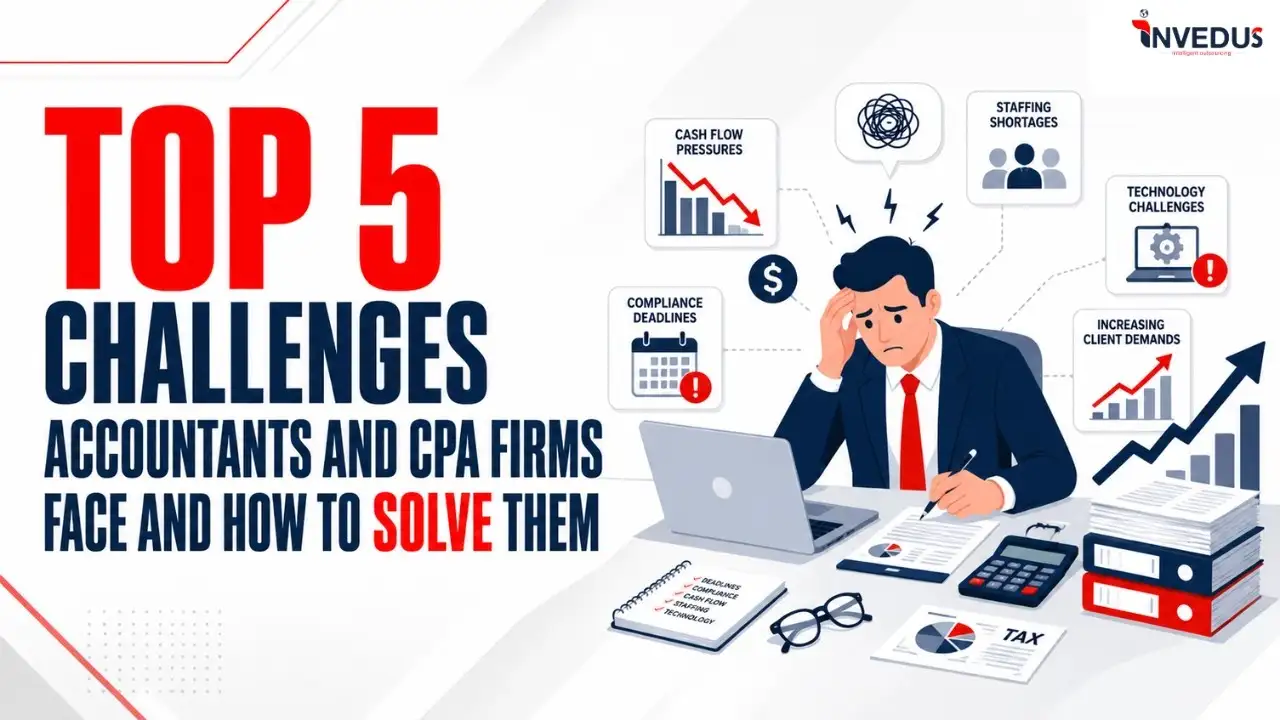
15 Biggest Accounting Firm Challenges in 2026 and Solutions

Authored By: Rifa Hussain
Rifa is a Senior Content Writer at Invedus. She focuses on creating content that aligns...

Fact-checked By: Abhishek Sharma
10 years of experience in accounting, AP (P2P), invoice processing, and international payments across MNC...
Key Takeaways
- Regulatory changes, cybersecurity risks, staffing shortages, pricing pressure, and rising client expectations are among the most significant accounting challenges facing CPA firms in 2026.
- The accounting talent pipeline remains constrained, with US accounting graduates falling 6.6% to 55,152, while employers are expected to face approximately 124,200 accountant and auditor openings annually.
- AI adoption is accelerating faster than firm readiness. Although 88% of finance professionals expect AI to be highly transformative, only 8% believe their organizations are very well prepared.
- Manual processes continue to create serious accounting problems in business. One study found that 18% of finance professionals make errors daily, while 59% make several errors each month.
- CPA firms should prioritize compliance and security risks first, followed by client-delivery bottlenecks, unprofitable work, technology integration, and longer-term growth initiatives.
- Automation and outsourced accounting services can expand capacity, reduce repetitive workloads, and support advisory growth, but firms must retain review responsibility, access controls, documented workflows, and clear performance standards.
With the introduction of AI and new accounting laws, accountants and firms have started to face many problems. Some are large, like expanding into advisory services, while others are smaller but persistent, like maintaining day-to-day accuracy. However, one thing is common for these accounting firm challenges: they can be hard to solve.
Even if you have the budget or time to invest to tackle such challenges, it can be a big task to get everything straight. While you may be willing to observe more such problems, we believe in helping accountants and firms acknowledge and solve their challenges head-on.
Drawing on current market and industry insights, as well as our experience working with accounting firms, we have identified some of the biggest challenges for CPA firms and suggested practical solutions. If you still have doubts, you can start by contacting Invedus to address accounting challenges.
The 15 Biggest Challenges Accountants and CPA Firms Face
The biggest challenges accounting firms currently face, include regulatory complexity, talent shortages, employee burnout, cybersecurity risks, technology integration, pricing pressure, and rising client expectations. CPA firms are also under pressure to improve efficiency, adopt AI responsibly, expand advisory services, and manage seasonal workloads without compromising quality. The following challenges reflect current market and industry research, along with our experience working with accounting firms as an outsourcing partner.
1. Keeping Up With Tax Laws and Regulatory Changes
Tax rules rarely remain static, requiring CPA firms to track frequent changes across federal, state, payroll, reporting, audit, and compliance requirements, including:
- The One Big Beautiful Bill Act under Public Law 119-21, which introduced or amended deductions relating to qualified tips, overtime pay, car-loan interest, seniors, withholding, and employer reporting.
- Internal Revenue Code Section 168(k), covering bonus depreciation and eligible business property.
- Internal Revenue Code Section 163(j), which limits business-interest expense deductions and contains revised adjusted taxable income calculations.
- The Fair Labor Standards Act, particularly its overtime rules, which affect eligibility and reporting for the qualified-overtime deduction.
- State and local tax requirements, including sales-tax nexus, payroll withholding, unemployment taxes, and pass-through entity taxes.
- FASB Accounting Standards Updates, which change GAAP recognition, measurement, presentation, and disclosure requirements.
Monitoring these changes requires extensive research, staff training, workflow updates, and additional review. The challenge is particularly difficult for smaller CPA firms with limited capacity, increasing the possibility of errors, penalties, rework, missed deadlines, and lost client trust.
2. Finding Qualified Accountants and Tax Professionals
The US accounting talent pipeline is struggling to keep pace with demand, leaving CPA firms competing for a limited pool of experienced tax, audit, payroll, bookkeeping, and advisory professionals. AICPA reported that accounting bachelor’s and master’s graduates fell to 55,152 in 2023–24, down 6.6% year over year, while BLS projects 124,200 accountant and auditor openings annually from 2024 to 2034.
This shortage increases competition for tax, audit, payroll, bookkeeping, and advisory professionals, especially those skilled in automation, cloud platforms, and data analytics. It is among the biggest challenges accountants face because long vacancies raise recruitment costs, delay client work, overload teams, and worsen other accounting problems in business.
AICPA also ranked hiring experienced staff as the leading concern for firms with 11 to 30 professionals. To address these challenges for CPA firms, practices can build graduate pipelines, use referrals and structured skills tests, define roles by outcomes, and use outsourced accounting services for functions.
3. Retaining Employees and Preventing Burnout
Tax-season pressure, repetitive administrative work, limited career progression, inflexible schedules, and uneven workload distribution can leave accounting professionals physically and mentally exhausted.
Other sources note that the talent problem now includes skills development, workload management, and burnout reduction. Gallup estimates that replacing a technical employee costs about 80% of annual salary, while replacing a manager can cost around 200%.
SHRM found that only 14% of organizations considered their compensation budgets adequate, with a typical organization needing an 8% to 10% increase to address turnover. This suggests many growing firms may struggle to absorb retention costs without reducing margins.
These challenges accountants face can cause errors, resignations, delays, and wider accounting-related problems. To address these challenges, practices should track workloads, automate repetitive tasks, provide promotion paths, offer flexibility, delegate routine work, and use outsourced accounting services or offshore capacity before peak periods.
4. Managing Seasonal Workloads and Capacity Constraints
Managing seasonal workloads is one of the most disruptive accounting challenges because tax deadlines concentrate returns, reconciliations, reports, and client queries into a short period.
Capacity should be measured against forecasted hours, a five-accountant team capped at 45 hours each provides 225 gross hours weekly, so a 300-hour workload creates a 75-hour gap before review time or absences.
Thomson Reuters recommends calculating busy-season hours and filling shortfalls through interns, outsourcing, or moving nonurgent work to quieter periods. These challenges can force unsustainable overtime, rushed reviews, delayed communication, rejected work, and wider accounting problems in business.
Journal of Accountancy also warns that exhaustion and deadline pressure increase professional-liability risk. Firms can reduce these challenges by forecasting from prior-year data, documenting workflows, cross-training staff, automating document requests, and using outsourced accounting services for bookkeeping, reconciliations, AP, AR, payroll support, workpapers, data organization, and tax administration.
5. Adopting AI Without Creating New Risks
Adopting AI is one of the fastest-growing accounting challenges because firms are testing public tools without rules for data use, verification, and accountability. AICPA’s 2026 survey ranked technology and AI change management as the profession’s leading five-year concern.
Another AICPA-CIMA study found that 88% of finance professionals expect AI to be the most transformative technology trend, yet only 8% say their organization is very well prepared. These challenges accountants face create long-term issues by exposing data, generating fabricated answers, weakening judgment, and creating uncertainty about jobs and return on investment.
CPA firms should:
- Approve tools and low-risk use cases.
- Prohibit client data on unapproved platforms.
- Require human review.
- Train staff to verify sources and detect errors.
- Measure time saved, accuracy, and rework.
- Use outsourced accounting services for routine work while retaining oversight.
These controls reduce accounting barriers without abandoning automation.
6. Integrating New Technology With Legacy Systems
Integrating new technology with legacy systems is a persistent accounting challenge because firms often add tax, payroll, CRM, document, and workflow tools without connecting them. A common example occurs when a client changes address: staff update the CRM but must re-enter it in tax and payroll software, creating duplicate records, inconsistent files, and errors.
Sources like Thomson Reuters state that disconnected systems cause manual re-entry, duplicated effort, and wasted time switching platforms, while AICPA warns that automating broken processes can simply “digitize dysfunction.”
These problems slow client delivery, increase training demands, and turn software spending into another accounting problem in business. To address these challenges, leaders should audit the technology stack, map data flows, remove overlapping tools, prioritize APIs, assign ownership, and pilot changes with one team.
Outsourced accounting services can support data cleanup, migration, testing, and workflow documentation, but purchasing software alone does not create efficiency.
7. Protecting Client Data From Cybersecurity Threats
Protecting client data is one of the most serious accounting challenges because CPA firms hold tax IDs, bank details, payroll files, and financial records that criminals can exploit. The IRS warned in 2026 that tax professionals remain targets of spear-phishing and malicious “new client” emails designed to steal credentials and client information.
AICPA also placed data security among the top five challenges for CPA firms with up to ten professionals. Weak passwords, personal devices, shared accounts, ransomware, and poorly controlled remote or offshore access can cause downtime, regulatory exposure, reputational damage, and wider accounting problems in business.
Firms should:
- Require multifactor authentication, individual accounts, password managers, and least-privilege access.
- Protect endpoints, encrypt backups, train staff, and maintain a written incident-response and information-security plan.
- Remove access immediately during offboarding and apply identical controls to outsourced accounting services.
These measures address the challenges accountants face without restricting secure collaboration.
8. Meeting Faster and More Proactive Client Expectations
Meeting faster and more proactive client expectations has become one of the most important accounting challenges because clients now expect immediate responses, secure digital access, regular updates, and advice tailored to their business.
Accurate tax returns and financial statements are no longer enough. Many clients also want cash-flow forecasting, budgeting support, tax planning, and early warnings about financial risks. These challenges accountants face can increase workloads, create communication gaps, and lead to dissatisfaction even when the technical work is correct.
Poor response times may also cause clients to question the firm’s reliability and look elsewhere. To address these problems, practices should establish clear response-time standards, automate routine status updates, segment clients by service needs, schedule proactive review meetings, and use dashboards or reporting templates.
Assigning clear ownership for each client also improves accountability. Outsourced accounting services can handle routine business accounting problems, giving internal teams more time for communication, planning, and higher-value advisory support.
9. Collecting Documents and Encouraging Portal Adoption
Collecting documents and encouraging portal adoption is a recurring accounting challenge because clients often submit incomplete files, send sensitive information through email, or delay uploading records they do not understand.
Confusing portal layouts and unclear instructions can make the process worse, leading to repeated follow-ups, missed deadlines, disorganized files, and staff spending hours sorting documents instead of completing client work.
These slow tax preparation, reconciliations, audits, and financial reporting while increasing the risk of using outdated or missing information. To reduce these challenges for CPA firms, practices should provide simple document request checklists, short portal guides or videos, automated reminders, and consistent file-naming rules.
One team member should be responsible for follow-ups, while limited onboarding support can help clients become comfortable with the system. Outsourced accounting services can also organize incoming records and handle routine accounting problems in business, allowing accountants to focus on review, compliance, and advisory work.
10. Reducing Manual Errors and Maintaining Audit Trails
Reducing manual errors and maintaining complete audit trails is a persistent accounting challenge because heavy workloads and fragmented processes lead to duplicate entries, incorrect classifications, missing documents, and unrecorded approvals.
Gartner’s survey of 497 controllership professionals found that 18% made financial errors at least daily and 59% made several each month. These create rework, inaccurate reports, delayed closes, compliance exposure, and wider accounting problems in business.
CPA firms should:
- Standardize recurring workflows and workpaper templates.
- Use OCR and automated data capture.
- Route approvals digitally and retain supporting documents.
- Add review checkpoints and record who prepared and approved each task.
- Apply the same controls to outsourced accounting services.
Gartner also found that organizations with strong technology acceptance achieved a 75% reduction in financial errors, showing that software works only when employees consistently use it. These measures address key challenges for CPA firms while creating a searchable audit trail.
11. Protecting Profitability During Pricing Pressure
Protecting profitability during pricing pressure is an accounting challenge because salaries, software, cybersecurity, and training costs are rising while clients resist fee increases.
Sources report that 71% of firms expect pricing and competitive pressure to affect them. A 2025 MAP Survey found median firm revenue grew 6.7%, while starting salaries rose 11% for bachelor’s graduates and nearly 17% for master’s graduates over two years.
These worsen when fixed-fee engagements are underpriced, scope expands without extra charges, and partners spend time on low-value work.
To address these challenges for CPA firms:
- Measure profitability by client and service.
- Define scope, exclusions, and additional fees.
- Review prices annually and offer tiered or value-based packages.
- Delegate work and remove persistently unprofitable engagements.
- Use outsourced accounting services to control delivery costs.
These steps reduce accounting issues and help firms protect margins without compromising quality.
12. Moving From Compliance Work to Advisory Services
Moving from compliance work to advisory services is an accounting challenge because automation is making routine tax preparation, bookkeeping, and reporting harder to differentiate, while clients increasingly expect cash-flow guidance, forecasting, and business insight.
These challenges accountants face limit growth when senior staff remain occupied with processing, managers lack consultative skills, or firms cannot package advice into repeatable offerings.
CPA firms should:
- Analyze client data to identify recurring needs.
- Package cash-flow forecasting, budgeting, management reporting, controller support, virtual CFO, valuation, and financial planning services.
- Train managers to lead advisory conversations and use standard reporting templates.
- Delegate routine work through automation or outsourced accounting services.
These steps address challenges for CPA firms, reduce accounting problems, and strengthen client relationships.
13. Winning New Clients and Differentiating the Firm
Winning new clients and differentiating the firm is one of the most persistent accounting challenges because many CPA practices still depend heavily on referrals and describe their services in nearly identical terms.
When every firm promotes tax preparation, bookkeeping, payroll, and advisory support without explaining a clear specialization or outcome, prospects struggle to see why one provider is better than another. These are intensified by strong online competition, weak follow-up, and generic websites that fail to convert visitors into inquiries. As a result, firms may experience slow growth, inconsistent lead flow, and wider accounting problems in business.
To address these challenges for CPA firms, practices should specialize by industry or client type, publish authoritative content, create service-specific landing pages, collect genuine client reviews, and use a CRM to track leads and conversion rates. Outsourced accounting services can also free internal teams from routine delivery work, allowing partners to focus on relationship building, sales follow-up, and communicating the firm’s value.
14. Developing Future Partners and Planning for Succession
Developing future partners and planning for succession is an accounting challenge because many firms depend on aging partners who control major client relationships, technical knowledge, and key decisions. AICPA’s 2026 survey ranked finding the next generation of leadership as the leading issue for firms with 31 to 100 professionals.
Without a prepared pipeline, these can create client uncertainty, delayed ownership transitions, lost institutional knowledge, and wider accounting problems in business. Strong technical performers may also lack the management, commercial, and relationship-building skills needed for partnership.
To address these challenges for CPA firms, practices should identify potential leaders early, rotate responsibility for major accounts, document client histories and internal processes, and provide leadership and business-development training. Clear promotion criteria and a multi-year transition plan are essential. Outsourced accounting services can shift routine work away from future leaders, giving them more time to develop client, team, and strategic responsibilities.
15. Scaling Through Outsourcing Without Losing Control
Scaling through outsourcing without losing control is one of the most misunderstood accounting challenges. Problems arise when CPA firms transfer poorly documented work, use shared logins, grant excessive access, or treat offshore professionals as disconnected task workers.
Time-zone gaps, unclear accountability, inconsistent reviews, and weak escalation procedures can create delays, quality issues, security exposure, and wider accounting problems in business.
To address these challenges for CPA firms, begin with repeatable processes, define each role’s scope, and set accuracy, turnaround, and escalation metrics. Require NDAs, individual accounts, least-privilege access, documented handovers, and onshore review. Integrating offshore employees into team meetings and training also improves ownership.
Properly managed outsourced accounting services can expand capacity without sacrificing control, helping solve the challenges accountants face during growth and peak seasons.
Which Accounting Firm Challenges Should You Solve First?
CPA firms rarely have the time, budget, or internal capacity to solve every operational issue at once. The best approach is to rank accounting challenges according to risk, client impact, financial cost, and growth potential.
Prioritize Compliance and Security Risks
Begin with challenges for CPA firms that could cause penalties, legal exposure, or loss of client trust. These include missed regulatory deadlines, incomplete audit trails, weak cybersecurity controls, unauthorized access, unsecured document sharing, unreviewed AI-generated work, and inconsistent quality checks. These accounting problems in business should be addressed before expansion because one serious breach or compliance failure can create lasting financial and reputational damage.
Remove Client-Delivery Bottlenecks
Next, fix the challenges accountants face that delay returns, reports, reconciliations, and communication. Track turnaround times, overdue tasks, employee utilization, rework, document collection delays, approval bottlenecks, and peak-season capacity gaps.
Correct Profitability Problems
Review unprofitable clients, scope creep, underpriced engagements, overtime, duplicate software, excessive partner involvement, and senior employees handling low-value tasks. Solutions may include repricing, process redesign, automation, delegation, or outsourced accounting services.
Invest in Growth After Stabilizing Operations
Once risk, delivery, and profitability are controlled, firms can invest in advisory services, technology, client acquisition, leadership development, succession planning, and industry specialization. CPA firms should fix the problems creating the greatest risk and financial impact before pursuing wider transformation.
How Invedus Helps CPA Firms Solve Challenges?
Invedus helps CPA firms build dedicated offshore accounting capacity from $7.99 per hour, compared with the $81,680 median annual wage for US accountants and auditors.
With Invedus, firms receive:
- Handpicked candidates, CV reviews, and video interviews before selection.
- Support for bookkeeping, reconciliations, AP, AR, payroll, reporting, and tax-season administration.
- NDA-based engagements, individual accounts, role-based permissions, and managed office support.
- Flexibility to begin with one professional and scale without immediate in-house overhead.
Invedus reports 95% client satisfaction across 31+ countries. CPA firms retain professional judgment, client responsibility, review, and compliance oversight. Collaborate with Invedus to save on in-house overheads!
|
Comparison point |
In-house scaling |
Scaling with Invedus |
| Monthly staffing cost | The median US accountant salary equals about $6,807 per month, before benefits, recruitment, equipment, and other overheads. | Full-time virtual employee plans start at $999 per month, although accounting costs vary by experience and responsibilities. |
| Setup requirements | Requires recruitment, onboarding, payroll administration, equipment, and workplace or remote-work infrastructure. | Invedus states there are no recruitment, HR, tax, or setup costs for clients. |
| Scaling flexibility | Adding capacity usually requires another permanent or temporary hiring cycle. | Monthly rolling contracts allow firms to scale their offshore team up or down as workloads change. |
| Oversight and security | The firm directly manages access, performance, reviews, and employee development. | The firm should retain onshore review while using NDAs, individual access, defined metrics, and scheduled overlap hours. |
Contact Invedus to build your dedicated offshore accounting team.
Conclusion
Accounting challenges rarely exist in isolation. Staffing shortages increase burnout, weak workflows delay client work, outdated systems create errors, and pricing pressure reduces room for growth.
The challenges accountants face are therefore best solved through a mix of stronger processes, technology, delegation, and scalable staffing. Invedus helps CPA firms address accounting problems in business by providing handpicked offshore professionals for bookkeeping, reconciliations, AP, AR, payroll, reporting, and tax-season support.
Our outsourced accounting services start at $7.99 per hour and include CV review, video interviews, NDA-based engagement, managed support, and role-based access. For challenges for CPA firms that require flexible capacity, Invedus offers a way to scale without adding in-house overhead.

Frequently Asked Questions
What accounting work should stay in-house vs. be outsourced?
Strategic judgment, client relationships, final reviews, audit decisions, and regulatory accountability should remain in-house. Repetitive, process-driven work such as bookkeeping, reconciliations, AP, AR, payroll support, workpaper preparation, and document organization can suit outsourced accounting services.
How is AI changing the challenges accounting firms face?
AI is reducing manual work and accelerating research, reporting, and data analysis, but it also creates accounting technology challenges involving privacy, fabricated outputs, weak governance, staff anxiety, and the need for consistent human review.
Why are accounting firms struggling to hire in 2026?
Accounting firms are struggling to hire because fewer graduates are entering the profession while demand remains high for experienced tax, audit, payroll, bookkeeping, advisory, cloud, automation, and analytics skills. This intensifies the US accounting talent shortage.
What challenges do small and mid-sized CPA firms face that large firms don't?
Small and mid-sized firms often face tighter budgets, owner dependence, limited specialist capacity, weaker succession pipelines, seasonal overload, and greater difficulty absorbing technology or compliance costs. Large firms usually have deeper resources but greater integration and governance complexity.
What are the most common compliance risks for accounting firms in 2026?
The most common accounting compliance risks include missed tax deadlines, outdated regulatory interpretations, incomplete audit trails, insecure document sharing, unauthorized access, weak review controls, incorrect classifications, and unverified AI-generated work that reaches clients or financial records.
Which accounting firm challenges should you solve first?
CPA firms should first solve problems creating compliance, cybersecurity, or client-data risk. Next, they should address delivery bottlenecks and unprofitable work before investing in advisory services, technology expansion, leadership development, or new-client growth.
Why should CPA firms choose Invedus for outsourced accounting?
Invedus gives CPA firms access to handpicked offshore accounting professionals from $7.99 per hour, with CV reviews, video interviews, NDAs, managed office support, role-based access, and scalable assistance for bookkeeping, reconciliations, payroll, reporting, and tax-season administration.




Last updated on: Aug 7, 2026