



Authored By: Rifa Hussain
Rifa is a Senior Content Writer at Invedus. She focuses on creating content that aligns...
Key Takeaways!
- Administrative responsibilities in a healthcare workday take attention away from patients and contribute to staff burnout and turnover.
- Hiring an in-house medical assistant can cost $45,690 a year in median wages, before adding benefits, payroll taxes, equipment, leave, and other employment expenses.
- Hire a medical virtual assistant for routine administrative work, including appointment scheduling, patient communication, insurance verification, billing support, referrals, EHR updates, etc.
- Outsourcing provides a more flexible staffing model, allowing practices to start with limited support and increase hours as patient volume and administrative needs grow.
- Invedus offers pre-vetted medical virtual assistants starting at $7.99/hour, with full-time support starting at $999/month and customized staffing options.
- HIPAA compliance and data security must remain a priority, with appropriate agreements, access controls, secure systems, and training required when virtual assistants handle protected health information.
Running a healthcare practice means managing far more than patient care. Between scheduling, insurance verification, billing, and endless paperwork, your team spends more time on admin than they should. This is exactly why more US healthcare providers are turning to a virtual medical assistant for help.
Administrative work in the health industry takes up a large share of every clinical day, pulls staff away from patient care, and fuels burnout and turnover. At the same time, the healthcare staffing shortage makes hiring qualified admin support locally slower and costlier.
For hospitals and healthcare providers, the real question isn’t whether to delegate, it’s how: what a virtual medical assistant can and can’t do, how to stay compliant, what it costs, and how to hire one who truly understands healthcare.
Here’s everything you need to make that decision with confidence.
Who is a Medical Virtual Assistant?
A virtual medical assistant is a trained healthcare support professional who handles a practice’s administrative and non-clinical work remotely, rather than from a desk inside your office.
They’re fluent in medical terminology, healthcare workflows, EHR systems, and HIPAA (the federal rules governing protected health information). They can step into the day-to-day running of a medical practice without a long learning curve.
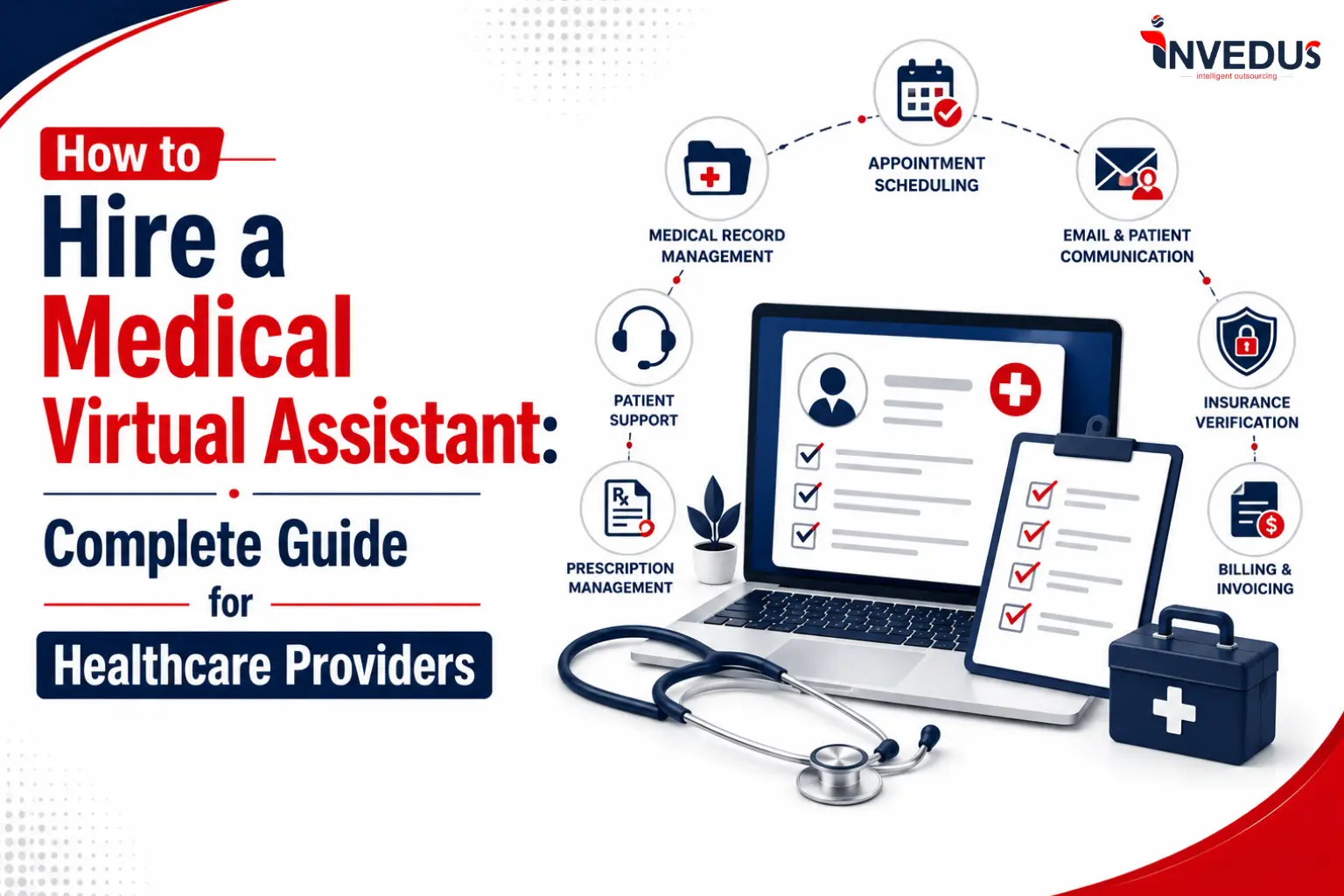
In practice, that means a virtual medical assistant can manage appointment scheduling and reminders, verify insurance and handle prior authorizations, process new-patient intake, update electronic health records, support billing and claims, and manage patient communication by phone, email, and portal.
The key distinction? They support non-clinical functions. Anything requiring physical presence, like taking vitals or administering treatment, stays in the office. Everything else that eats your team’s day can be delegated.
Done right, the work is seamless enough that patients rarely notice the support is remote. It looks like it came from your own front desk.
When you hire a virtual medical assistant for your practice through Invedus, you don’t get handed a random assistant off a roster.
You can interview and shortlist candidates yourself and choose the person who best fits your practice. Since you pick the match, your assistant integrates as a genuine extension of your team in your time zone, learning your workflows, your EHR, and your patient-communication style, rather than acting as a stopgap.
We save you from the rigid subscription tier as well; you get a custom pricing model built around what your practice actually needs, whether that’s full-time front-desk coverage or a few hours of billing support each week
Full-time support starting at $999/month, or part-time help from $7.99/hour. No bloated packages, no paying for hours you won’t use. See full pricing to find the model that works for your practice.
What Does a Medical Virtual Assistant Do?
A medical virtual assistant takes on the wide range of non-clinical work that keeps a practice running. The scope is broad: a well-trained assistant can handle 30–50 different tasks across front-office, revenue-cycle, and records work, all remotely and inside your existing systems.
Here’s what that looks like in practice.
- Booking, rescheduling, and confirming appointments, and sending reminders to cut no-shows
- Answering phone lines, portal messages, and patient inquiries
- Managing new-patient intake and pre-visit information
- Handling insurance verification, authorizations, and claims follow-up
- Supporting CPT/ICD-10 coding and billing workflows
- Preparing and maintaining medical documentation and EHR records
- Processing prescription refills and coordinating referrals
- Setting up and troubleshooting telehealth visits
- Managing patient communication, follow-ups, and reminders
- Generating operational reports (no-shows, unpaid claims, outstanding authorizations)
A busy front desk leans on scheduling and communication, while a billing-heavy operation puts more weight on authorizations and claims. What stays constant is the boundary: a virtual medical assistant handles the administrative and documentation load, while all clinical decisions and patient care remain with your providers.
When you hire a healthcare virtual assistant through Invedus, you get someone already trained on EHRs, billing, and HIPAA workflows.
Our VAs pick up these tasks quickly instead of learning on your time. You interview and choose your own assistant, match them to the work your practice needs most, and scale hours up or down as demand shifts.
What Is the Difference Between a Clinical Assistant and a Medical Virtual Assistant?
Let’s clear up the question that trips up most practices before they hire: where exactly does a virtual medical assistant’s work end and your clinical team’s begin?
The honest answer is a clean line.
A virtual medical assistant owns the administrative and non-clinical side of your practice while anything that needs a physical presence or independent medical judgment stays with your licensed, on-site staff. That’s not a limitation to work around; it’s the boundary that keeps your practice compliant.
Hiring the wrong kind of support doesn’t just waste money; it creates real risk. The moment an assistant strays into clinical territory (triaging symptoms, adjusting medications, advising a patient on treatment), you’re exposed to scope-of-practice and liability problems that no amount of cost savings makes up for.
Here’s how the two sides actually split:
| Administrative (a Virtual Medical Assistant handles this) | Clinical (stays with licensed on-site staff) | |
| Core nature | Process-driven, non-clinical support | Hands-on care and clinical judgment |
| Typical tasks | Scheduling, patient intake, insurance verification, prior authorizations, billing support, EHR updates, records, patient communication | Taking vitals, drawing blood, injections, procedures, physical exams |
| Decision-making | Follows defined workflows and scripts | Requires independent medical judgment |
| Patient contact | Non-clinical (reminders, follow-ups, coordination) | Direct, in-person clinical care |
| Judgment calls | Routes clinical questions to licensed staff | Makes diagnostic and treatment decisions |
| Where it happens | Remotely, inside your secure systems | On-site, by necessity |
| Requires a license? | No, trained in workflows, terminology, and HIPAA | Yes, credentialed clinical staff |
Why Should You Hire Medical Virtual Assistants?
Hiring a medical virtual assistant isn’t really about convenience; it’s about three pressures bearing down on US practices at once. This includes a shrinking workforce, a mounting administrative load, and the burnout those two create.
Delegating the non-clinical work isn’t a nice-to-have anymore; for many practices it’s how they stay staffed, solvent, and sane.
Here’s what the numbers show:
The Staffing Shortage and Administrative Burden
The supply side of healthcare is tightening. The Association of American Medical Colleges projects the US could face a shortage of up to 86,000 physicians by 2036.
Fewer providers are absorbing more demand, and support roles are just as hard to fill: front-desk and administrative positions are among the toughest to keep staffed, with turnover a constant drain on practice managers.
Now layer on the paperwork. Physicians spend close to 2 hours on documentation and desk work for every hour of direct patient care, and prior authorizations alone eat roughly 13 hours of physician and staff time each week, according to the American Medical Association. That’s an entire clinical day, every week, lost to a single administrative process.
An Invedus medical VA can take over insurance verification, payer-portal navigation, and claims coordination (the exact revenue-cycle work that consumes those hours) using the systems your practice already runs on.
Cost Pressure and Burnout
The financial and human costs are two sides of the same coin. On the money side, revenue leaks through the administrative cracks: denial rates on first-submission claims now hover near 11.8%, and disciplined verification, authorization, and accounts-receivable follow-up are what stand between a practice and permanent revenue loss. Meanwhile, an in-house administrative hire carries not just a salary but benefits, payroll taxes, office space, and recruiting overhead.
According to the American Medical Association’s 2025 National Physician Comparison Report, 41.9% of physicians reported at least one symptom of burnout, with administrative burden among the leading drivers, alongside ineffective EHR systems and inadequate staffing. Even as that figure has edged down for four straight years, the structural causes haven’t gone away, and roughly 3 in 10 physicians still report intent to leave their organization within two years.
What Services Can You Delegate to a Medical Virtual Assistant?
Tell Invedus what your practice needs, and we’ll help you find the right virtual assistant for medical clinic operations. You can interview and choose your preferred candidate, then delegate specialized non-clinical services such as documentation, billing, patient communication, and telehealth support.
Administrative Support and Scheduling
A healthcare virtual assistant can take care of the administrative coordination that keeps your practice moving throughout the day. They can manage appointments, follow up with patients, coordinate referrals, and support reception workflows while working with platforms such as AthenaHealth and Epic.
Medical Documentation & Record Management
Accurate documentation is essential for both continuity of care and efficient practice operations. A medical VA can assist with HIPAA-compliant documentation, EHR management through systems such as Kareo and AdvancedMD, case notes, discharge summaries, and maintaining organized medical records.
Billing, Coding, and Insurance Coordination
Revenue-cycle work can quickly become overwhelming for an internal team. A medical virtual assistant can support CPT/ICD-10 coding workflows, insurance verification, claims processing, payer-portal communication, and discrepancy follow-ups using platforms such as AdvancedMD and DrChrono.
Telehealth and Remote Patient Monitoring Support
Virtual care creates its own administrative workload. Your virtual assistant for medical clinic can support telehealth platforms such as Doxy.me, Teladoc, and HRS by coordinating virtual check-ins, monitoring assigned data workflows, and troubleshooting routine technical issues that could otherwise interrupt appointments.
Patient Engagement and Communication
Consistent communication can be difficult when staff are already managing a busy practice. A healthcare virtual assistant can handle non-clinical patient queries, reminders, approved educational communications, and feedback collection through platforms such as OhMD and Spruce Health while following privacy and communication protocols.
Workflow Optimization and Practice Scalability
As patient volume changes, your administrative workload changes with it. A medical VA can help organize multi-location workflows, support periods of higher patient volume, maintain data organization, and handle recurring administrative processes so your practice can adjust its support capacity without rebuilding its internal team.
Provider Credentialing & Enrollment Support
Credentialing can involve extensive documentation, follow-ups, and deadline tracking. A medical virtual assistant can help organize provider credentialing files, maintain enrollment records, track outstanding requirements, and coordinate administrative follow-ups with the appropriate organizations. This allows practice managers to spend less time chasing paperwork while retaining oversight of the credentialing process.
Why Does Generic Hiring Fail for Medical Practices?
Most practices don’t set out to make a bad hire. They post a job ad, find a promising résumé, ask “Are you HIPAA-trained?” in the interview, and bring someone on at an attractive rate.
For a few weeks it looks like relief finally arrived. Then the cracks show! A missed portal message, a billing error, a patient who could tell within one phone call that the person on the line didn’t understand them, a HIPAA gray area the provider has to clean up personally.
This is the DIY trap, and it fails for one reason: a medical practice isn’t a typical business, so generic hiring doesn’t work here.
A general assistant can manage a calendar and answer email, but a virtual assistant for a medical practice deals with protected health information every single day, navigates insurance systems and payer portals, and works inside regulated EHR workflows where a small mistake carries real consequences.
The “cheap hire” math rarely holds. The lower hourly rate looks like a saving until you add the real costs: the weeks spent training someone on medical terminology and your EHR, the denied claims from coding they didn’t understand, the revenue that stalls while they learn on your time.
The compliance risk is the part most practices underestimate. When you hire a virtual assistant for healthcare, your practice stays liable for how that person handles PHI.
FYI: Healthcare has been the costliest industry for data breaches for 14 straight years, with an average breach now running $6.6 million in 2025, and the HHS Office for Civil Rights closed 21 enforcement actions in 2025 (second-highest annual total).
Most tellingly for anyone hiring remote help: measured by patient records exposed rather than breach count, HIPAA Journal’s analysis of the federal breach portal found the share tied to a business associate or vendor climbed from just 5% in 2015 to roughly 65% in 2025. Asking ‘are you HIPAA-trained?’ in an interview is not a compliance process. Real protection requires verified training, a signed Business Associate Agreement, and secure systems before a single patient record is touched.
With Invedus, you hire differently. Instead of gambling on a generalist who learns on your dime, you get a pre-vetted, healthcare-trained medical VA (HIPAA-aware and fluent in EHR and billing workflows) matched to your practice, in four simple steps:
- Share your requirements
- Review handpicked CVs
- Interview and select
- Get started
Because hiring a medical virtual assistant should fit your practice, not a rigid template, Invedus builds a custom package around what you actually need. Whether that’s a single dedicated medical VA or a small team scaled to your patient volume. You interview and pick your own hire, so your assistant works as a genuine extension of your practice from day one, and you can scale up or down as demand shifts.
Comparing Different Hiring Models: In-House vs. Freelance vs. US Agency vs. Offshore
There are several ways to add medical support to your practice, and the right model depends on your workload, budget, level of control, and the type of support you need. Invedus brings these needs together by giving you access to dedicated professionals, flexible engagement options, and a hiring process built around your specific requirements.
Here is the transparent comparison between In house, freelancer, USA agency, and offshore hiring models:
|
Hiring Model |
Why Choose It? | Typical Cost | Best For |
Main Trade-off |
| In-House | Gives you direct control over schedules, training, supervision, and day-to-day work. | $46,120/year average ($22.17/hour) for U.S. medical assistants — BLS median is $45,690/year ($21.97/hour) | Practices needing an on-site employee for regular administrative and clinical support | Highest employment commitment and additional costs for benefits, payroll taxes, equipment, and office space |
| Freelancer | Provides flexibility to hire an individual for specific hours, tasks, or temporary workload. | $15–$25/hour in recent medical VA listings | Small practices, short-term projects, or variable workloads | You handle screening, training, supervision, and finding a replacement |
| U.S. Agency | Gives you access to remote talent while the agency handles sourcing and some administrative management. | $15–$25/hour for non-nurse virtual medical support; specialized services can cost more | Practices wanting U.S.-based or U.S.-led remote support without recruiting independently | Higher rates than many offshore options and agency availability may vary |
| Offshore | Provides access to a larger global talent pool and can reduce staffing costs while offering dedicated remote support. | Variable/custom based on role, experience, hours, and scope | Practices looking for dedicated, scalable support at a lower operating cost | Requires secure workflows, clear communication, and appropriate oversight |
In-House Medical Assistant
An in-house hire makes sense when you need someone physically present and want maximum day-to-day control.The latest BLS wage data puts the average U.S. medical assistant wage at $46,120 annually ($22.17/hour) in May 2025 (the median is $45,690, or $21.97/hour). This is the employee’s wage, not the employer’s complete cost, so benefits, payroll taxes, leave, equipment, and other employment expenses come on top.
Freelance Medical Virtual Assistant
Freelancing works well when you don’t need a full-time resource or want to test support before committing to a larger arrangement. Recent medical VA listings show rates around $15–$25/hour, while platforms such as Freelancer allow hourly contracts with negotiated rates. The trade-off is that hiring medical virtual assistant talent yourself means handling vetting, onboarding, performance management, and replacement.
U.S. Agency
A U.S.-based agency can be useful when you want remote assistance but don’t want to manage the entire recruitment process yourself. Current virtual medical support pricing from providers shows approximately $15–$25/hour for non-nurse virtual services, with higher rates for specialized or credentialed support. You’re paying not only for the assistant’s time but also for the agency’s sourcing and service infrastructure.
Offshore Medical Virtual Assistant
Offshore hiring can make sense when your priority is dedicated support, scalability, and cost control without limiting your search to local candidates. Pricing is highly dependent on the assistant’s experience, specialty, working hours, and responsibilities, so a custom quote is more meaningful than a generic market rate.
Calculating the Cost to Hire a Medical Virtual Assistant
For calculating the cost to hire a medical virtual assistant, the first step is to define what you actually need! This could be a few hours of administrative support, a dedicated full-time professional, or specialized help with billing, documentation, or patient communication.
From there, you can compare hourly, monthly, and full-time cost estimates across different talent markets. Here are some factors that contribute to the cost of hiring a virtual medical assistant for clinics and healthcare practices:
Experience and specialization: A general administrative VA will typically cost less than someone experienced in medical billing, coding, EHR management, insurance verification, or other specialized healthcare workflows.
Working hours: Part-time support costs less overall, while a dedicated full-time assistant requires a larger monthly commitment. Some providers also charge different rates for patient-facing work, after-hours coverage, or specialized support.
Recruitment and management: Hiring independently may appear cheaper, but you may also need to account for sourcing, screening, background checks, onboarding, training, software, and replacement costs. Managed services can bundle some of these responsibilities into the service fee.
Healthcare and compliance requirements: A healthcare virtual assistant handling sensitive patient information may require HIPAA training, secure systems, controlled access, and appropriate privacy agreements. These requirements can affect the provider’s overall pricing.
Location: The region or country you hire a virtual assistant for healthcare facility makes a big impact on the end cost. India generally offers lower labor costs than the U.S. Its large pool of English-speaking professionals also makes it possible to access skilled remote talent at more competitive rates.
Why Is India a Good Choice for Medical VA Support?
India combines a large English-speaking professional workforce with established outsourcing infrastructure and experience supporting U.S. businesses.
For healthcare practices, the bigger advantage is not simply a lower hourly rate. You can access professionals familiar with healthcare administration, EHR workflows, billing processes, and U.S.-focused support requirements without limiting your search to the local talent pool.
That makes India particularly useful when you need dedicated support that can scale with your practice.
With Invedus, you can hire a medical virtual assistant through a customized engagement model based on the role, experience, hours, and responsibilities your practice requires. Save up to 70% on staffing costs, including infrastructure and overheads. Check our Medical Virtual Assistant Services
Get started with part-time support from $7.99/hour or a full-time dedicated employee from $999/month, while custom teams are priced according to requirements. We also provide pre-vetted candidates and let you review CVs and interview shortlisted professionals.
How to Hire a Medical Virtual Assistant From Invedus?
Hiring the right medical virtual assistant doesn’t have to involve endless screening or guesswork. With Invedus, choose the professional who fits your practice in 4 simple steps.
Step 1: Define Your Practice’s Needs
Don’t start by looking at candidates. Start with the workload. Decide which tasks you want to delegate, how many hours you need, which systems the assistant must know, and whether the role involves patient interaction. This gives Invedus a clear profile to match against its talent pool.
Step 2: Vet for Healthcare Experience and Compliance
A healthcare VA needs more than general administrative experience. Look for familiarity with medical terminology, EHR systems, healthcare workflows, and patient-data privacy requirements. Invedus can help you find professionals with relevant healthcare experience, so you aren’t spending your time filtering candidates who aren’t suited to a virtual assistant for medical practice role.
Step 3: Interview the Company and the Assistant
You should know exactly who will be handling your practice’s work. Invedus lets you review shortlisted candidates and interview them before making a commitment. Use this stage to assess their communication, healthcare experience, software knowledge, availability, and whether they understand the responsibilities you’ve defined.
Step 4: Onboard and Integrate
Give your healthcare virtual assistant clear responsibilities, system access, communication guidelines, and examples of how your practice handles routine work. Invedus provides ongoing support through its Client Success Partners, helping make the transition into your existing workflow smoother.
Why Choose Invedus for Hiring a Medical Virtual Assistant?
- Invedus keeps the hiring process flexible, so you can assess your staffing needs before committing to a long-term arrangement.
- Once you find a suitable candidate, you can delegate with greater confidence knowing that Invedus follows data-protection practices aligned with HIPAA, GDPR, and applicable US state privacy laws.
- With more than a decade in the industry, Invedus brings established outsourcing expertise to the hiring process and helps match professionals to your specific requirements.
- You define the skills, experience, responsibilities, and working requirements you need. Invedus then presents suitable pre-vetted candidates for you to review and interview before making your choice.
- Whether you need limited assistance or a dedicated professional, you can structure the engagement around your practice’s requirements instead of adjusting your workflow to fit a fixed staffing model.
Healthcare Tools & Software Used by Invedus Virtual Assistants
Your healthcare virtual assistant can work with the medical, communication, scheduling, documentation, and collaboration tools already used by your practice. Invedus professionals are experienced with commonly used healthcare platforms as well as everyday productivity software.
- Epic: Used for electronic health records, clinical documentation, patient information, and practice workflows. Invedus medical VAs can support administrative tasks within established Epic workflows.
- Athenahealth: Combines EHR, practice management, billing, and patient engagement capabilities. A trained VA can assist with the administrative processes your practice manages through the platform.
- Kareo / Tebra: Used by medical practices for EHR, billing, and practice management. VAs can support documentation, administrative, and revenue-cycle workflows within these systems.
- AdvancedMD: Supports EHR, scheduling, billing, and broader practice management. Invedus VAs can assist with routine administrative work across these connected workflows.
- DrChrono: Provides EHR, medical billing, scheduling, and practice-management functionality. A VA can help manage the administrative tasks assigned to them within the platform.
- eClinicalWorks: Used for EHR and practice management across healthcare organizations. Invedus VAs can support routine documentation, administrative, and patient-management workflows.
- Doxy.me: A telehealth platform used for virtual patient consultations. VAs can assist with appointment coordination, virtual check-in processes, and other non-clinical telehealth administration.
- Teladoc: Supports virtual healthcare delivery and related patient services. Healthcare VAs can provide administrative assistance around established telehealth workflows without taking on clinical decision-making.
- HRS: Used for remote health monitoring and connected-care workflows. VAs can assist with assigned administrative monitoring and organization of remote-care information.
- OhMD: Supports patient communication and engagement. A VA can manage approved non-clinical messages, reminders, and other patient communication workflows.
- Spruce Health: Provides secure communication tools for healthcare practices. Invedus VAs can use it for approved messaging, coordination, and patient-support activities.
Communication & Productivity Tools
For a virtual assistant for medical practice, healthcare software is only one part of the workflow. Our medical virtual assistants also work with widely used collaboration and productivity platforms to keep communication, tasks, files, and schedules organized.
Slack, Microsoft Teams, Notion, Trello, Asana, Calendly, Dropbox, Evernote, Microsoft Outlook, Sprout Social, LastPass
Our healthcare virtual assistant can work directly within the software and platforms already used by the practice. Whether the workflow relies on an EHR, billing system, scheduling platform, communication tool, or project-management software, no additional software subscription is required solely for the VA’s work.
Benefits of Hiring a Medical Virtual Assistant
Beyond the day-to-day tasks a medical VA handles, here is what a practice can expect to gain after hiring an Invedus medical virtual assistant.
- Reduced after-hours workload for providers. Documentation, charting, and follow-ups are completed during the assistant’s working hours, allowing clinicians to complete their work within the day rather than carrying it into evenings and weekends.
- Improved patient retention. Reliable scheduling and prompt communication reduce the small frustrations that lead patients to switch providers. A Tebra survey found that 42% of patients would consider changing providers after being rescheduled just twice.
- Greater patient accessibility. Calls and portal messages are attended to during lunch hours, after hours, and peak periods, reducing missed inquiries and the loss of prospective patients before they book.
- Stronger support for diverse patient populations. For practices in markets such as New York, bilingual assistants can manage intake, scheduling, and patient communication in the patient’s preferred language, improving the accuracy of information collected and strengthening patient trust.
- Lower risk of front-desk burnout and turnover. Redistributing routine administrative overflow to a virtual assistant relieves pressure on in-house staff, supporting morale and helping practices retain the team they have already trained.
- A more predictable revenue cycle. Insurance verification, coding support, and claims follow-up reduce denials and delayed reimbursements, keeping cash flow steady and minimizing revenue lost to administrative error.
- Scalable capacity without added payroll. Support can be scaled up during periods of high patient volume and reduced when demand settles, giving practices flexibility without the cost of permanent hires.
- Assured compliance. Working with a HIPAA-trained, pre-vetted assistant ensures administrative support strengthens the practice’s compliance position rather than introducing new risk.
Also Read: Benefits of Hiring a Medical Virtual Assistant
Ready to Add the Right Support to Your Practice?
Running a healthcare practice in the U.S. can mean finishing a patient consultation and immediately moving into documentation, referrals, insurance forms, or scheduling issues. The workload doesn’t necessarily end when the last patient leaves.
In fact, AMA data found that physicians worked an average of 57.8 hours a week, but only 27.2 hours were spent on direct patient care. Another 13 hours went toward indirect patient care and 7.3 hours toward administrative work.
That makes the value of a medical virtual assistant easier to understand. The goal isn’t simply to find another person to complete a checklist. It’s about creating enough breathing room for the people inside the practice to spend more of their working day doing work that actually requires them.
With Invedus, that support can be shaped around the practice’s workload, systems, hours, and priorities. If the administrative side of healthcare is taking more from the team than it should, it may be time to put the right support behind it.
Ready to find the right medical virtual assistant? Get Started with Invedus



Last updated on: Sep 4, 2026