


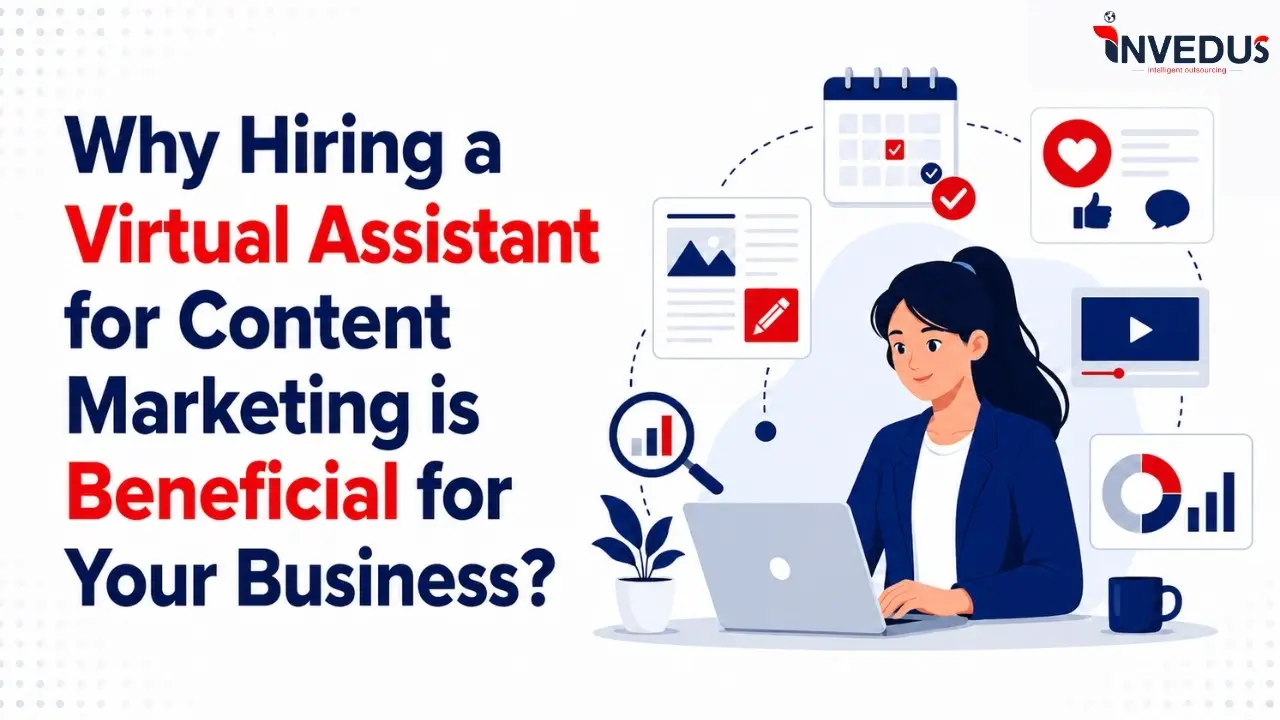
Why Hiring a Virtual Assistant for Content Marketing is Beneficial for Your Business?

Authored By: Rifa Hussain
Rifa is a Senior Content Writer at Invedus. She focuses on creating content that aligns...

Fact-checked By: Juhi
Juhi is an experienced content creator with a deep understanding of audience engagement and brand...
Key Takeaways!
- 87% of marketers say content marketing generates demand and leads, making consistent execution more important than ever.
- Companies using content marketing achieve 6× higher conversion rates, highlighting the value of a structured content strategy.
- 83% of marketers believe content quality outperforms quantity, making skilled content management a competitive advantage.
- Hiring a content marketing virtual assistant can reduce outsourcing costs by 50–70% compared to hiring U.S.-based specialists.
- A virtual assistant can manage 10+ content marketing functions, from SEO writing and publishing to reporting and optimization.
- Flexible hiring models let businesses scale content operations part-time, full-time, or hourly without long-term hiring commitments.
Hiring a virtual assistant for content marketing can be the difference between publishing content and running a consistent strategy that drives real business growth!
Understand this:
Creating valuable content is only one part of content marketing. Planning campaigns, optimizing for search engines, distributing across channels, updating existing assets, and tracking performance all require time and ongoing attention. That is why many businesses are delegating these tasks to marketing VAs.
According to Ahrefs, 87% of marketers say content marketing generates demand and leads, up 11 percentage points since 2023. These results show that content marketing has become a long-term growth strategy rather than just a branding activity.
Why Hire a Virtual Assistant for Content Marketing?
A virtual assistant for content marketing brings consistency and operational efficiency to a process that often suffers from delays, scattered workflows, and limited internal bandwidth.
Many businesses don’t fail at content marketing because they lack expertise, they fail because they lack consistency. Publishing irregularly, leaving content unoptimized, or neglecting distribution can limit the impact of even the best strategies.
As content marketing becomes increasingly complex and performance-driven, businesses need dedicated operational support to maintain momentum.
According to a Content marketing institute report, companies that use content marketing have a sixfold higher conversion rate.
Given that, here is what hiring a content marketing virtual assistant can do for your business:
- 74% of marketers report that content marketing helps nurture audiences and customers, keeping prospects engaged throughout the buying journey.
- More than half (52%) of marketers say content marketing strengthens customer loyalty, proving that long-term engagement extends beyond acquiring new customers.
- Websites, blogs, and SEO rank among the highest ROI marketing channels, outperforming many paid strategies when content is published and optimized consistently.
- 83% of marketers believe focusing on content quality over quantity delivers better results, highlighting the importance of maintaining high publishing standards instead of simply producing more content.
- 64% of marketers reported higher conversion rates after incorporating original research into their content strategy, while 61% saw improvements in SEO rankings and organic traffic.
Source: Ahrefs
Also Read: Why You Should Outsource Content Writing Services
What Are The Benefits of Hiring a Virtual Assistant For Content Marketing?
1. Reduce Hiring and Operating Costs
Hiring a full-time content marketing employee involves salaries, employee benefits, office space, software subscriptions, equipment, and ongoing training costs.
A virtual assistant eliminates many of these overheads, allowing businesses to access experienced marketing support while paying only for the hours or services they actually need.
2. Scale Marketing Efforts as Your Business Grows
Content requirements rarely remain constant. Product launches, seasonal campaigns, website expansions, or new marketing initiatives often require additional support.
A virtual assistant gives businesses the flexibility to increase or reduce marketing resources without lengthy recruitment cycles, making it easier to adapt to changing workloads.
3. Access Specialized Marketing Talent
Virtual hiring removes geographical limitations, allowing businesses to work with professionals who specialize in SEO, content strategy, social media, email marketing, analytics, or other niche marketing disciplines.
4. Increase Productivity Across Internal Teams
Marketing teams often spend significant time on routine coordination and operational work that takes attention away from planning and business growth. By delegating ongoing marketing activities to a virtual assistant, internal teams can focus on strategic initiatives, campaign development, customer engagement, and revenue-generating opportunities.
5. Flexible Engagement Models
Whether you require support for a few hours each week, a part-time resource, or a dedicated full-time professional, virtual assistants offer flexible engagement models that can be adjusted as priorities change.
6. Faster Onboarding and Business Continuity
Recruiting and training an in-house employee can take weeks or even months. Virtual assistants can often be onboarded much faster, helping businesses maintain marketing momentum during busy periods, employee absences, or unexpected workload increases.
7. Focus on Business Growth Instead of Administrative Management
Managing an in-house workforce requires time for recruitment, onboarding, payroll, performance management, and administrative oversight. Hiring a virtual assistant reduces much of this operational burden, allowing business owners and marketing leaders to spend more time on innovation, customer acquisition, and long-term growth.
What Tasks Can A Virtual Content Marketer Do For You?
1. Strategy & Editorial Planning
Successful content marketing starts long before the first article is written. A content marketing virtual assistant develops editorial calendars, plans campaigns, identifies content pillars, researches audience interests, and organizes publishing schedules. This structured approach ensures every piece of content supports your marketing objectives while maintaining consistency across channels.
2. Competitor & Keyword Research
Understanding what your competitors publish helps uncover opportunities to create more valuable content. A virtual content assistant analyzes competitor content, identifies high-performing topics, studies audience preferences, researches industry trends, and recommends content ideas that help your brand stay relevant and competitive.
3. SEO Content Writing & Copy Creation
Producing valuable content creation assets is essential for attracting, educating, and converting potential customers. A virtual content marketer develops SEO-friendly blogs, website copy, landing pages, product descriptions, case studies, whitepapers, newsletters, and other marketing materials that align with your brand voice and business goals.
4. Social Media Content Creation
Every social platform requires content tailored to its audience and format. A virtual content creator develops platform-specific posts, captions, campaign creatives, short-form copy, and publishing schedules for LinkedIn, Facebook, Instagram, X, and other channels to maintain a consistent and engaging brand presence.
5. Graphic Content Creation
Visual content improves engagement and makes marketing messages easier to understand. A content marketing professional creates branded graphics, blog banners, infographics, presentation slides, social media creatives, carousels, featured images, and other visual assets using tools such as Canva or Adobe Express to support your overall marketing strategy.
6. Publishing & CMS Management
Publishing content requires much more than clicking the “Publish” button. A content marketing virtual assistant formats articles, uploads content to WordPress or other CMS platforms, optimizes images, adds metadata, creates internal links, schedules publication, and ensures every page is presented professionally across desktop and mobile devices.
7. Email Marketing Content
Email remains one of the highest-performing content marketing channels for nurturing prospects and retaining customers. A virtual marketer creates newsletters, promotional emails, welcome sequences, product announcements, lead nurturing campaigns, and customer engagement emails that encourage readers to take meaningful action.
8. Content Distribution
Publishing content is only the beginning. A virtual content assistant distributes content across websites, newsletters, social media platforms, and other digital channels to maximize visibility, reach the intended audience, and increase the return on every piece of content you create.
9. Content Refresh & Optimization
High-performing content requires continuous improvement to remain competitive. A virtual marketing professional updates outdated information, refreshes statistics, improves readability, strengthens calls-to-action, optimizes internal links, and enhances existing pages to maintain relevance and support long-term search visibility.
10. Content Performance Reporting
Measuring performance helps determine what content delivers business value. A virtual content creator monitors traffic, audience engagement, conversions, and campaign performance through analytics tools, preparing actionable reports that help businesses refine their content strategy and make more informed marketing decisions.
How to Hire a Virtual Assistant for Content Marketing?
Hiring a virtual assistant for content marketing helps businesses quickly integrate experienced marketing professionals into their existing workflow. Given that, here’s how it works:
1. Define Your Content Marketing Requirements
Start by identifying the tasks you want to delegate, such as blog writing, social media content, graphic design, email marketing, content publishing, or performance reporting. A well-defined scope helps match your business with the right content marketing virtual assistant.
2. Evaluate Skills and Experience
Review portfolios, writing samples, marketing experience, industry knowledge, and proficiency with tools like WordPress, Canva, Google Workspace, HubSpot, Mailchimp, Google Analytics, and project management platforms.
3. Interview and Finalize the Right Candidate
Conduct a short interview to assess communication skills, creativity, problem-solving ability, and understanding of your brand voice. Discuss your marketing objectives, preferred workflows, reporting expectations, and turnaround times before finalizing the engagement.
4. Onboard Your Virtual Content Assistant
Provide brand guidelines, content calendars, access to required tools, standard operating procedures (SOPs), and approval workflows. Your virtual content assistant collaborates with your team through platforms like Slack, Microsoft Teams, Asana, Trello, or ClickUp, ensuring every task moves through planning, creation, review, publishing, and reporting efficiently.
5. Delegate, Collaborate, and Scale
Once onboarding is complete, your assistant independently manages recurring marketing activities while keeping you informed through regular updates and performance reports. Whether you want to outsource content creation, publish content consistently, or support multiple campaigns simultaneously, your virtual assistant works as an extension of your internal marketing team.
What skills to look for in a content marketing specialist?
Here are some skills that you should look for while hiring a content marketing virtual assistant:
| Skill | Why It Matters |
| Strategy Building | A good content marketer understands business goals, audience needs, and customer journeys. They create content that supports measurable marketing objectives instead of publishing for the sake of consistency. |
| Excellent Writing & Editing | Strong writing, editing, and storytelling skills are essential for producing clear, engaging, and persuasive content while maintaining a consistent brand voice across every marketing channel. |
| Research Skills | The ability to conduct audience research, analyze competitors, verify facts, identify trends, and gather credible information helps create authoritative, trustworthy, and valuable content. |
| Communication & Collaboration | Content marketers regularly coordinate with designers, SEO specialists, developers, sales teams, and stakeholders. Strong communication ensures projects move smoothly from planning to publication. |
| Analytical Thinking | A content marketer should interpret traffic, engagement, conversions, and audience behavior to understand what works and where improvements are needed instead of relying on assumptions. |
| SEO Awareness | While they don’t replace SEO specialists, content marketers should understand search intent, on-page SEO fundamentals, metadata, and content optimization so their work performs well in search results. |
| Organization & Time Management | Managing editorial calendars, deadlines, approvals, and multiple campaigns requires excellent planning and organizational skills to maintain publishing consistency. |
| Adaptability | Search algorithms, AI tools, content formats, and consumer behavior evolve constantly. The ability to learn new platforms, embrace emerging technologies, and adapt strategies is now a core professional skill. |
| AI & Technology Proficiency | Modern content marketers are expected to use AI responsibly for ideation, research, editing, and workflow automation while applying human judgment, creativity, and strategic thinking to produce high-quality content. |
How Much Does it Cost to Outsource Content Marketing to a VA?
The cost of outsourcing content marketing depends on the expertise required, project complexity, and engagement model.
In the United States, businesses typically pay premium hourly rates for specialized content marketing services, including writing, graphic design, email marketing, and campaign planning.
However, by working with experienced remote professionals from India, companies can often reduce these costs by 50–70% while maintaining access to skilled English-speaking marketing talent.
Given that, here is a cost comparison:
| Services Covered | Typical U.S. Cost (Hiring Individual Specialists) | Virtual Content Marketing VA (India) |
| Strategy & Editorial Planning | Marketing strategist or content strategist: $50–$100+/hr | Included in VA engagement |
| Competitor & Content Research | Content researcher / SEO content researcher: $30–$75/hr | Included |
| SEO Content Writing & Copy Creation | Professional content writer: $50–$175 per blog or $40–$100/hr (Upwork) | Included |
| Social Media Content Creation | Social content creator: $30–$80/hr | Included |
| Graphic Content Creation | Graphic designer: $35–$90/hr | Included |
| Publishing & CMS Management | Content coordinator / CMS specialist: $25–$60/hr | Included |
| Email Marketing Content | Email copywriter: $100–$500 per email or $40–$100/hr (The Content Writing Craft) | Included |
| Content Distribution | Marketing coordinator: $30–$70/hr | Included |
| Content Refresh & Optimization | SEO content editor: $40–$100/hr (The Editorial Freelancers Association) | Included |
| Content Performance Reporting | Marketing analyst: $35–$85/hr | Included |
What Mistakes Should You Avoid When Hiring a Content Marketing Virtual Assistant?
Hiring the right virtual assistant for content marketing can significantly improve your marketing efforts, but choosing the wrong candidate can lead to inconsistent content, missed deadlines, and wasted resources. Given that, here are some common mistakes businesses should avoid:
1. Hiring for Strategy Instead of Execution
A content marketing virtual assistant is primarily responsible for executing your content strategy, not replacing a senior marketing strategist. While they should understand content marketing principles, advanced SEO planning, brand positioning, and overall campaign strategy should remain with your internal marketing team or marketing leadership.
2. Writing Vague Job Descriptions
Unclear expectations often result in poor outcomes. Define specific responsibilities, deliverables, preferred tools, turnaround times, content formats, and performance expectations before hiring. A detailed job description helps both you and the candidate understand exactly what success looks like.
3. Choosing Price Over Capability
Selecting the lowest-cost candidate may seem economical initially, but poor-quality content often requires extensive revisions and additional management time. Evaluate writing quality, portfolio, communication skills, industry knowledge, and problem-solving ability before making a hiring decision.
4. Skipping a Paid Trial Project
Resumes and portfolios only tell part of the story. Assigning a small paid project allows you to evaluate the candidate’s writing quality, creativity, attention to detail, ability to follow instructions, and communication style before committing to a long-term engagement.
5. Overlooking Time Zone Compatibility
If your marketing campaigns require quick approvals or regular collaboration, discuss working hours before onboarding. Establish overlapping availability, communication schedules, and asynchronous workflows using collaboration tools to avoid unnecessary delays.
6. Neglecting Proper Onboarding
Even the most experienced virtual content assistant cannot understand your business overnight. Share brand guidelines, target audience information, content calendars, standard operating procedures (SOPs), approval workflows, and examples of successful content. Regular feedback during the first few weeks helps maintain consistency and accelerates productivity.
Wrapping up!
Hiring a virtual assistant for content marketing is the new way to scale your content efforts, boost productivity, and keep up with constant quality.
Virtual assistants offer businesses a powerful solution to some important challenges firms face in content marketing, reducing overhead costs, accessing specialized talent, enhancing scalability, and streamlining tasks.
Invedus Outsourcing provides verified virtual assistants with expertise in handling social media and content marketing effortlessly. At a fraction of the cost of in-house hiring, we help businesses tap into the global talent and scale up their content game with the right talent always assisting them.
Ready to elevate your content marketing efforts? Contact us to outsource your project today or hire a dedicated virtual assistant that can help you grow your social media presence and bring effective results.

Frequently Asked Questions
Can I hire a content marketing VA part-time or for a few hours a week?
Absolutely. Most businesses hire content marketing VAs based on their workload. Whether you need support for a few hours weekly, part-time assistance, or a dedicated full-time professional, flexible engagement models let you scale resources as your marketing needs evolve.
Is it cheaper to hire a content marketing VA or a marketing agency?
Hiring a content marketing VA is often more cost-effective than working with a marketing agency, especially for ongoing execution. You avoid agency overheads while gaining dedicated support for writing, publishing, SEO, and content management at a lower overall cost.
What's the difference between a content marketing VA and a freelance writer?
A freelance writer primarily creates content, while a content marketing VA handles a broader range of responsibilities. Besides writing, they can manage content planning, SEO optimization, publishing, CMS updates, email marketing, content distribution, reporting, and day-to-day marketing operations.
Is it safe to give a VA access to my CMS and marketing tools?
Yes, provided you follow proper security practices. Give role-based permissions, use secure password managers, enable two-factor authentication, and sign confidentiality agreements when needed. Reputable virtual assistants work professionally while protecting your business data and marketing assets.
Will a content marketing virtual assistant understand my brand voice?
Yes. With proper onboarding, brand guidelines, examples, and regular feedback, a content marketing VA can quickly learn your tone, messaging, and audience preferences. Over time, they create consistent content that aligns closely with your brand identity across every channel.
Is there a minimum contract to hire a content marketing VA?
In most cases, no. Many providers offer flexible hiring options without long-term commitments. You can start with a short-term project, part-time support, or a dedicated monthly engagement, depending on your business goals and content requirements.
Where can I hire a reliable content marketing VA?
You can hire content marketing VAs through specialized outsourcing companies, virtual assistant providers, freelance platforms, or staffing agencies. Choosing a provider that pre-screens candidates, verifies skills, and offers ongoing support helps ensure a reliable long-term partnership.
How quickly can I onboard a content marketing VA with Invedus?
Invedus helps businesses onboard experienced content marketing virtual assistants much faster than traditional hiring. Once your requirements are finalized, the onboarding process is streamlined so your VA can quickly integrate with your team and begin supporting ongoing marketing activities.

Last updated on: Jul 15, 2026