


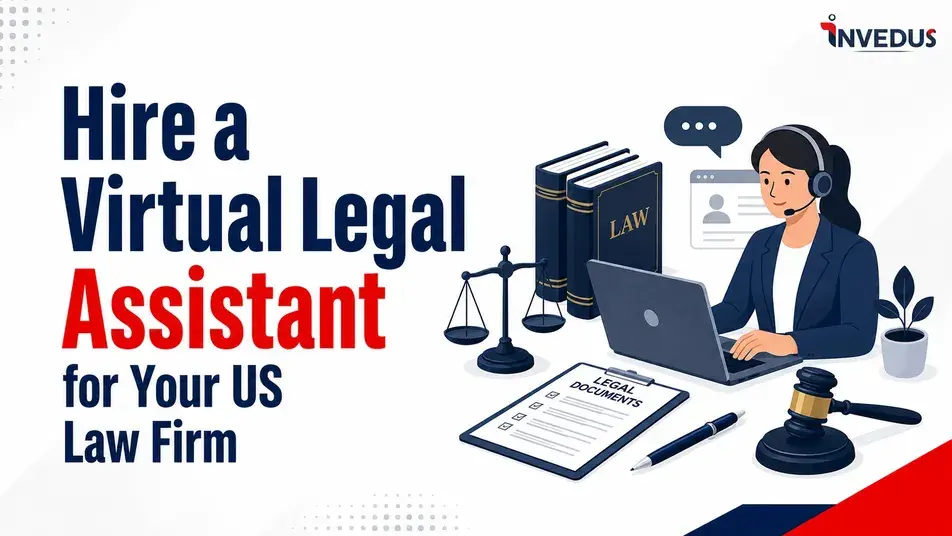
Hire a Virtual Legal Assistant for Your US Law Firm

Authored By: Rifa Hussain
Rifa is a Senior Content Writer at Invedus. She focuses on creating content that aligns...
Key Takeaways
- Virtual legal assistants handle administrative, case-management, billing, client-support, and research tasks that take time away from higher-value legal work.
- The right assistant needs legal experience, software proficiency, strong communication, attention to detail, and familiarity with US legal procedures.
- Invedus lets you define your requirements, review pre-vetted candidates, interview them yourself, and select the assistant who fits your workflow.
- Paralegals and legal assistants earn a median of $61,010 annually, while virtual legal assistants average $48,215, according to cited US salary data.
- Invedus offers virtual legal assistant support starting at $7.99/hour part-time or $999/month full-time, depending on your workload.
Remote legal support requires proper supervision, confidentiality, and security, with Invedus using NDAs, background checks, access controls, and data-protection measures.
You sit down to focus on a case, but before you can get into the work, you’re chasing signatures, updating the calendar, formatting documents, and following up on unpaid invoices. The day keeps slipping away, and the legal work that actually needs your attention is still waiting. Soon, those unfinished tasks spill into your evenings, your weekends, and the time you should have to yourself.
Hiring another full-time employee feels like the obvious fix, but it’s slow, expensive, and a lot to commit to. Thankfully, you can hire virtual legal assistants from Invedus to reclaim those hours.
Legal VAs take on the intake, scheduling, document prep, and billing that eat your day, working remotely as an extension of your team so you can get your hours back without adding to payroll.
Here’s what hiring one can save you, the compliance rules to keep in mind, and how to find the right fit.
What Is a Virtual Legal Assistant?
A virtual legal assistant is a trained legal support professional who works for your firm remotely, rather than from a desk in your office. They operate as a dedicated member of your team, using your tools, following your processes, and working to your standards, just from a different location.
Unlike a freelancer or a one-off contractor, they’re not there for a single task; they work with your firm on an ongoing basis, like any other member of staff.
Because the assistant becomes an ongoing part of your firm, finding the right professional matters. You want someone whose skills, experience, and working style match your requirements, not simply whoever happens to be available.
When you hire a virtual legal assistant through us, you don’t get handed a random assistant off a roster.
You interview the shortlisted candidates yourself and choose the person who best fits your firm. It is the same way you’d hire in-house. Because you pick the match, your assistant integrates as a genuine extension of your team, not a stopgap.
What Does a Virtual Legal Assistant Do? Roles and Responsibilities
A virtual legal assistant can take on far more than most firms expect. They handle everything from front-desk responsibilities that interrupt your day to case-support tasks that quietly pile up.
When you hire a virtual assistant for lawyers from Invedus, you’re not filling one narrow role; you’re adding a trained professional who can cover the full range of work.
15+ Tasks You Can Outsource with a Virtual Legal Assistant
Administrative Tasks
The day-to-day work that keeps your office running and keeps interrupting your billable hours:
- Answer phone calls and live chats so no client inquiry or new lead goes unanswered
- Sort and reply to emails, flagging what’s urgent and clearing the noise from your inbox
- Manage calendars and book meetings, coordinating court dates, consultations, and internal deadlines
- Handle travel arrangements for hearings, depositions, and client meetings
Document and Case Management
The organizational backbone of every matter, handled so nothing slips through the cracks:
- Organize digital files and cloud storage so every document is where it should be when you need it
- Format and proofread legal pleadings or contracts for clean, error-free, court-ready output
- Draft routine correspondence from templates, freeing you from repetitive writing
- Enter data into case management software like Clio, MyCase, or PracticePanther, keeping every matter current
Client Support and Billing
The client-facing and revenue tasks that directly affect cash flow and retention:
- Conduct client intake and onboarding, capturing case details and following up with new leads promptly
- Send retainer agreements and engagement letters so clients are formally onboarded without delay
- Track billable hours and create invoices accurately, so no billable time is lost
- Follow up on accounts receivable and payments, chasing outstanding balances so you don’t have to
Research Support
Preliminary legal legwork that saves your attorneys hours of prep:
- Perform basic statute checks to support case preparation
- Summarize case law into digestible briefs for faster review
- Gather records for settlement packages, compiling the documentation your matters depend on
Skills and Qualifications to Look for When You Hire Virtual Legal Assistants
Not every assistant is the same, and the difference between one who adds real value and one who adds more work comes down to skills. Before you hire virtual legal assistants, it’s worth knowing exactly what to screen for.
Hard Skills
These are the teachable, testable abilities the role runs on:
- Legal research using platforms like Westlaw, LexisNexis, and PACER to pull statutes, check case law, and prepare memos.
- Document drafting and proofreading to produce clean, court-ready pleadings, contracts, and correspondence with precise formatting.
According to the 2024 American Bar Association Legal Technology Survey, 73% of law firms now use cloud-based legal technology, making proficiency in legal practice management software an essential skill for legal professionals.
- Case management software proficiency in tools such as Clio, MyCase, and PracticePanther.
- Legal billing and time tracking, including invoicing and accounts-receivable follow-up.
- Strong typing speed and computer literacy across everyday tools like Microsoft Office and Google Workspace.
Every Invedus virtual legal assistant is selected for hands-on command of these tools, so they integrate into your existing tech stack from day one and not after weeks of ramp-up.
Soft Skills
In a remote setup, these matter as much as technical ability:
- Clear, proactive communication to keep you updated without needing to be chased.
- Time management and organization for juggling deadlines, calendars, and multiple matters without dropping any.
- Paying attention to detail because a single formatting or data error can cost a case.
- Discretion and professionalism when handling sensitive client information.
- Adaptability to pick up your workflows, tools, and preferences quickly
These qualities are exactly what make a virtual assistant for law firms effective rather than just extra hands. Because you interview candidates yourself, you can assess them firsthand and choose the person who genuinely fits your firm.
Qualifications and Certifications
While a virtual legal assistant doesn’t always need a formal law degree, the right credentials signal reliability and cut down training time:
- Prior law-firm or legal-support experience is the single strongest indicator of readiness.
- A paralegal or legal-studies certificate or associate degree, where the role calls for deeper legal work.
- Software certifications that confirm platform fluency.
- Knowledge of legal terminology and procedures as a baseline requirement.
US Legal Familiarity
For a US practice, an assistant has to understand the environment they’re working in:
- Familiarity with US court procedures, filing systems, and deadlines
- Understanding of US legal documentation from intake forms to retainer agreements and pleadings.
- Awareness of confidentiality and compliance expectations under US legal ethics rules.
- Strong English proficiency with bilingual (especially Spanish) support available for firms serving diverse client bases.
CTA: Skip the Hiring Gamble, Interview Your VLA First
With Invedus, you don’t get assigned an assistant. You interview pre-vetted, US-workflow-trained candidates and pick the one who fits your firm so your first hire is the right one. Contact Now.
Note: According to the U.S. Bureau of Labor Statistics, the median wage for paralegals and legal assistants was $61,010 a year (about $29.33 an hour) as of May 2024. And that’s before payroll taxes, benefits, and office space, which typically add another 20–30%. It also projects little to no employment growth through 2034, with roughly 39,300 openings a year, most just backfilling people who leave the field.
What is the Cost to Hire a Virtual Legal Assistant?
The cost of hiring a virtual legal assistant varies considerably depending on experience, location, and the scope of work. According to ZipRecruiter’s US salary data, the average annual salary is $48,215, equivalent to about $23.18/hour or $4,017/month.
Most virtual legal assistants fall between $38,000 and $55,000 per year, representing the 25th to 75th percentile. At the higher end, the 90th percentile reaches around $66,500 annually, while salaries can range from approximately $27,000 to $74,500 depending on the role and candidate.
Location can also affect compensation. Some higher-paying markets exceed the national average, with Portola Valley, California, reaching approximately $67,203 per year ($32.31/hour).
The national average gives you a useful starting point, but the actual cost can vary significantly from one virtual legal assistant to another. Along with location, other factors also drive the cost of hiring a virtual assistant.
With Invedus, you can choose the level of support that matches your workload instead of committing to the cost of a full-time US hire. Full-time virtual legal assistant support starts at $999/month, while part-time support starts at $7.99/hour.
You can scale the support around what you actually need, whether that’s consistent day-to-day assistance or help during busier periods.
See full pricing to compare the options and find the model that fits your needs.
What Drives the Cost of Hiring a Virtual Legal Assistant?
Beyond the model itself, a handful of factors move the hourly number up or down. Knowing them helps you budget for the workload you actually have, not a blanket average.
Task complexity: Rate scales with the difficulty and risk of the work. General admin sits at the low end; intake, document prep, and research support command more, because legal accuracy and confidentiality raise the stakes.
Legal expertise and software fluency: An assistant already fluent in legal software and familiar with US legal procedures costs more per hour but eliminates weeks of ramp-up, so the higher rate often pays for itself.
Onshore vs. offshore: Location is the single biggest lever on the hourly rate. US-based support sits at the higher end of the range, while offshore talent delivering comparable administrative work costs substantially less for the same core tasks.
Full-time vs. part-time: How much support you actually need shapes the spend. A busy litigation practice may want full-time coverage; a solo firm might only need part-time help, and paying a fixed full-time salary you don’t fully use is exactly where in-house hiring turns inefficient.
Overhead you don’t see: Payroll taxes, benefits, PTO, office space, equipment, and the productivity dip during onboarding never appear on an offer letter, but they’re what push an in-house hire’s real cost well above its hourly wage, and what the outsourced model removes entirely.
Legal Software and AI Tools Our Virtual Legal Assistants Use
When you hire virtual legal assistants from Invedus, you get professionals who are efficient in the software that matters, pre-trained on the five core platform categories below, so they slot into your existing tech stack and start contributing from day one.
Here are the tools and software Legal VAs at Invedus are equipped to work in, what each one does, and the tasks they handle inside it.
Clio
The industry-standard, cloud-based legal practice management platform, used by more than 150,000 legal professionals worldwide. It brings matter management, billing, and client intake together in one system.
Core tasks your assistant handles in Clio:
- Create and update client and matter files
- Track billable hours and generate draft invoices
- Manage the client intake pipeline and schedule consultations
- Set deadline reminders and court-date alerts
- Run matter reports for caseload and productivity review
MyCase
An all-in-one practice management solution built for small-to-midsize firms, pairing case management with a secure client portal. It keeps client communication and documents in one protected place.
Core tasks your assistant handles in MyCase:
- Upload and organize case documents in the client portal
- Send invoices and track payment status
- Log client calls, emails, and messages against the right matter
- Manage tasks and deadlines across the caseload
- Keep clients updated through the secure portal
PracticePanther
A billing- and automation-focused platform known for document assembly and native trust accounting. It streamlines repetitive work and keeps client trust ledgers compliant.
Core tasks your assistant handles in PracticePanther:
- Build documents from templates using document assembly
- Prepare and send client invoices
- Maintain trust (IOLTA) ledgers and reconciliations
- Set up automated task workflows
- Manage secure client messaging
Westlaw
Thomson Reuters’ primary legal research database, covering case law, statutes, regulations, and secondary sources. It’s a core tool for case preparation and citation checking. Core tasks your assistant handles in Westlaw:
- Research case law relevant to active matters
- Locate current statutes and track amendments
- Pull secondary sources like practice guides and treatises
- Verify citations with KeyCite
- Summarize findings into briefs for attorney review
LexisNexis
A comprehensive research platform pairing legal research with litigation analytics. It helps firms research faster and validate that cited cases remain good law.
Core tasks your assistant handles in LexisNexis:
- Conduct case law and statutory research
- Check citations with Shepard’s Citations
- Review court filing and procedural requirements
- Compile litigation analytics on judges and opposing counsel
- Organize research into usable case-prep summaries
Other Tools Invedus Virtual Legal Assistants Use
Beyond the core five platforms, your assistant is equally comfortable in the everyday tools that surround legal work, so the handoff into your workflow is seamless:
Asana, Calendly, Buffer, Clockify (clock), Doodle, Evernote, Dropbox, Hootsuite, Microsoft Teams, LastPass, Notes/OneNote, Outlook, Notion, Slack, Sprout Social, Trello, Zoom.
Legal Virtual Assistant Services Invedus Offers
When you hire virtual legal assistants from Invedus, you get support across every operational layer of your practice. We provide VAs for case files and research, to client communication and compliance. Here’s what our Legal VAs can take off your plate.
Case & Client Management
Keep your practice organized without the scramble. Our assistants manage case files, coordinate client intake, handle legal correspondence, and track court dates so deadlines are met and cases stay on course.
Legal Research & Documentation
Hand off the time-consuming legal legwork. Assistants support case law analysis, statute summaries, contract formatting, drafting of pleadings and motions, and proofreading for consistency and correct citations, freeing attorneys for higher-value work.
Administrative Support
Clear the everyday admin that eats your day. Delegate email and calendar management, billing, invoicing, retainer tracking, and document organization to keep your practice running accurately and on time.
Client & Lead Engagement
Struggling to keep up with client relationships and new leads? A virtual assistant for lawyers can handle lead qualification, appointment scheduling, case updates, follow-ups, and ongoing client communication, keeping clients engaged while you focus on core work.
Paralegal Support
Get help with the substantive work, under your direction. Our virtual paralegals assist with legal research, drafting motions, discovery preparation, deposition summaries, and contract reviews under attorney supervision.
Legal Transcription & Compliance
Stay accurate and audit-ready. Assistants handle legal transcription, document and data management, compliance support, and regulatory tracking, helping your firm meet court, state, and bar requirements while reducing administrative risk.
How to Hire a Virtual Legal Assistant with Invedus
Hiring the right virtual legal assistant is about finding someone who fits your practice, understands your workflow, and can be trusted with sensitive client data. At Invedus, we follow a transparent process built to remove the guesswork at every stage, so you make a confident hire without the weeks-long recruiting cycle a local hire demands.
Here’s how it works, step by step.
Step 1: Define Your Requirements
Start by mapping out exactly what you want to delegate (intake, document drafting, billing, research support) along with the software your assistant should know and the experience level and practice-area familiarity that matter to you.
The clearer this brief, the better the match: a well-defined scope is what separates a hire who contributes from day one from one who needs constant direction. You share these requirements with Invedus, and we source candidates matched specifically to your practice.
Step 2: Choose a Hiring Model That Fits
Decide how you want to engage. Full-time for a busy practice, or part-time if your caseload fluctuates. This is where the Invedus model works in your favor: instead of a rigid subscription tier, you get a custom arrangement built around your actual workload, so you’re never paying for hours you won’t use. And because the process carries no upfront obligation, choosing to explore a hire costs you nothing until you’re ready to commit.
Step 3: Review Pre-Vetted CVs
Every candidate is background-checked and assessed for legal-support skills and experience before they reach you. We then shortlist the best-fit professionals and share their CVs. This is where an established provider saves you the most time: the screening, reference checks, and skills assessments are already done.
Step 4: Interview and Select Your Assistant
You interview the shortlisted candidates over a video call and choose the one who fits your firm best. It is like the same control you’d have over an in-house hire. Use this step to test fit, not just credentials: ask candidates to walk through how they’d handle a new client intake, manage a missed filing deadline, or organize a case file, and you’ll quickly see who works the way your firm does.
Step 5: Lock In Confidentiality
Before any work begins, put data protection in writing. Every Invedus virtual legal assistant signs a non-disclosure agreement before accessing client information and works under strict confidentiality controls aligned with GDPR and established data-protection standards.
Step 6: Onboard and Integrate
Once you’ve chosen your assistant, share your workflows, grant access to your tools and communication channels, and set clear expectations for the first few weeks. Your assistant integrates into your existing systems and starts contributing quickly. This makes no disruption to your active cases, and no long ramp-up before real work gets done.
Step 7: Get Ongoing Support
The relationship doesn’t end at onboarding. A dedicated support contact stays on hand to help you delegate effectively, resolve any issues, and keep performance on track and if a match ever falls short of expectations.
Worried About Making the Wrong Hire?
Committing to a remote hire you haven’t worked with before feels like a risk. Here’s why, with Invedus, it isn’t.
You hire only when you’re sure: The entire process is free and carries no obligation. You sign the contract only after you’ve interviewed the pre-vetted candidate and found the right fit no upfront commitment, no pressure. If the match isn’t right, you simply don’t proceed.
You’re backed by years of experience. With over 11 years in outsourcing, Invedus has developed deep insight into how firms actually work and what makes a placement succeed.
- 95+ VAs outsourced
- 18+ industries served
- 95% returning clients
- 67% average cost savings
Put simply, the risk sits with us, not you: you interview first, you decide, and you’re never locked in before you’re confident. Learn more
Are Virtual Legal Assistants at Invedus Confidential and Secure?
Delegating legal support means giving another professional access to information that may be highly sensitive. The important question is not whether the assistant works remotely, but whether appropriate supervision, confidentiality, and security controls are in place.
ABA Model Rule 5.3: Supervising Non-Lawyer Assistants
ABA Model Rule 5.3 places responsibility on lawyers for properly supervising non-lawyer assistants. That means setting clear instructions, protecting client information, and reviewing work where appropriate. Remote support does not change those professional responsibilities.
Avoiding the Unauthorized Practice of Law (UPL)
A virtual legal assistant can provide administrative and legal-support work, but the supervising attorney remains responsible for legal judgment and advice. Tasks should therefore be clearly defined and performed under appropriate attorney direction. Legal virtual assistants at Invedus support case management, client intake, legal research, document drafting, administration, and compliance, rather than replacing the attorney-client relationship.
State Bar Considerations
ABA Model Rules provide a general framework, but individual states can have additional professional-conduct requirements. Before delegating legal work, review the applicable state bar rules and determine which tasks can appropriately be assigned to a non-lawyer assistant.
Data Security and Client Confidentiality
When client information is involved, confidentiality needs to be addressed before the assistant receives access. Virtual legal assistants sign NDAs, and the legal staffing services follow data-protection requirements including GDPR and the American Data Privacy and Protection Act. Legal process outsourcing work is handled through ISO 27001-certified processes, strict access controls, and secure office environments, with NDAs at both company and employee levels.
All the candidates at Invedus undergo background checks as part of its vetting process. The staffing model includes ISO, ICO, and GDPR protections, along with mandatory NDAs and confidentiality agreements.
CTA: Hire Virtual Legal Assistant Now
The Bottom Line
Running a law firm was never meant to mean spending your evenings on invoices and filing deadlines. Yet for most practices, the administrative load is exactly what crowds out the billable, high-value work attorneys are there to do. A virtual legal assistant changes that equation, taking on the intake, research, documentation, and day-to-day admin remotely, so your team gets its hours back without the cost or commitment of another in-house hire.
The key is hiring someone who genuinely fits your practice, works within US ethics rules, and can be trusted with client data. Get that right, and remote legal support is every bit as reliable as in-house staff, at a fraction of the cost.
If you’re ready to make that move, Invedus lets you interview and choose your own virtual legal assistant, with flexible plans starting at just $7.99/hour. Share your requirements to get started.

Frequently Asked Questions
Can a virtual legal assistant use my existing case management software?
Yes. Virtual legal assistants are experienced with leading legal practice management platforms, including Clio, MyCase, and PracticePanther. They integrate into your existing systems from day one, helping manage case files, billing, client communication, and deadlines without disrupting your established workflow.
What should I look for before hiring a virtual legal assistant?
Look for legal support experience, strong communication, attention to detail, proficiency in legal software, familiarity with US legal procedures, and professionalism when handling confidential information. Choosing someone who matches your firm's workflows and practice area can significantly reduce onboarding time and improve productivity.
How quickly can I hire a virtual legal assistant through Invedus?
The hiring process is designed to be fast and straightforward. After you share your requirements, Invedus shortlists suitable candidates, schedules interviews, and lets you select the best fit. Once you've made your choice, onboarding begins immediately so your assistant can start contributing quickly.
What's the biggest mistake law firms make when hiring a virtual legal assistant?
One of the biggest mistakes is hiring based only on availability or cost instead of assessing legal experience, software proficiency, communication skills, and cultural fit. Clearly defining responsibilities and interviewing candidates helps ensure your assistant supports your practice effectively from the start.
Is it difficult to manage a remote legal assistant?
Not when expectations and workflows are clearly established. A dedicated virtual legal assistant works within your existing tools, communication channels, and processes while providing regular updates. With proper onboarding and ongoing support, remote collaboration can be as seamless as managing an in-house team.
What software should a virtual legal assistant know?
A qualified virtual legal assistant should be comfortable using everyday working tools such as Microsoft Office, Google Workspace, and collaboration tools, along with legal research platforms such as Westlaw and LexisNexis and practice management systems like Clio, MyCase, and PracticePanther.
How does Invedus protect confidential legal information?
Invedus safeguards confidential legal information through signed non-disclosure agreements, background-verified professionals, secure encrypted platforms, controlled access to client data, and confidentiality practices aligned with GDPR. Assistants also work under attorney supervision to help firms remain compliant with applicable legal ethics requirements.
Why should I hire a virtual legal assistant from Invedus instead of hiring independently?
Unlike independent hiring, Invedus sources, vets, and shortlists candidates based on your exact requirements. You interview every shortlisted professional, choose the best fit, and receive ongoing support, flexible pricing, and replacement assistance, saving time while reducing hiring risk and administrative overhead.

Last updated on: Aug 27, 2026