


Step-by-Step Guide to Outsource SEO Services in 2026

Authored By: Rifa Hussain
Rifa is a Senior Content Writer at Invedus. She focuses on creating content that aligns...

Fact-checked By: Ankit
Passionate about researching and writing on marketing, advertising, e-commerce, and developing high-energy, highly skilled, and...
Key Takeaways!
- The global SEO market may cross $83 billion in 2026, making it crucial to strategically outsource SEO services for sustainable growth.
- Nearly 58% of searches now end without clicks, forcing businesses to prioritize AI SEO, GEO, and search intent optimization.
- SEO outsource services help businesses gain access to technical SEO, AI optimization, backlink building, reporting systems, and scalable expertise.
- Google AI Overviews and AI-powered search engines are reshaping SEO by prioritizing topical authority, structured data, E-E-A-T signals, and conversational search optimization.
- Invedus helps businesses outsource SEO services through dedicated specialists, custom marketing teams, cost-efficient support, and scalable long-term SEO strategies.
Have you ever experienced?
“One month, traffic goes up. The next month, rankings disappear after a Google update, and the entire SEO strategy feels uncertain.”
Most businesses don’t struggle with SEO because they ignore it. They struggle because they outsource SEO services from the wrong agency, rely on outdated strategies, or expect rankings without understanding how search engines work in 2026.
According to Mordor Intelligence, the global SEO services market may cross $83 billion this year. This is driven by increasing dependence on organic visibility and the growing complexity of AI-driven search.
This makes the stakes even higher and the need to outsource SEO services at the best price even more important. Learn how to outsource SEO at the lowest possible cost and reshape your visibility on SERPs.
What is SEO Outsourcing?
SEO outsourcing is the process of hiring external experts or agencies to manage search engine optimization activities instead of handling them in-house. Businesses often outsource SEO services to improve rankings, increase website traffic, and save time while accessing specialized expertise. This may include keyword research, content optimization, technical SEO, link building, and performance tracking.
Understanding how to outsource SEO helps businesses choose the right strategy, tools, and partners. It also helps companies reduce operational costs, improve campaign efficiency, and focus more on core business growth.
Why Outsourcing SEO in 2026 Is Different?
Artificial Intelligence is fundamentally transforming SEO in 2026. AI-driven search optimization is replacing traditional keyword-focused optimization, as search engines now prioritize context, intent, authority, and user experience over keyword matching.
Google AI Overviews, ChatGPT Search, Gemini, Perplexity, and other AI-powered answer engines have completely transformed SEO.
According to HubSpot SEO Trends 2026, users are increasingly discovering information through AI tools instead of traditional search engines alone.
This has created a broader optimization approach called:
- AEO (Answer Engine Optimization)
- GEO (Generative Engine Optimization)
- AI SEO
- Structured data implementation
- Semantic content mapping
Given that, here is how user behavior has changed SEO practices:
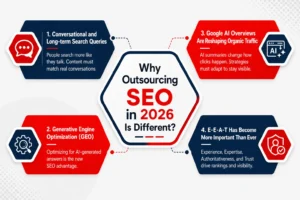
1. Conversational and long-form Search Queries
Users are no longer typing short keyword phrases like “best CRM software”. Instead, they ask detailed questions such as:
“What’s the best CRM for a 50-person agency under $150 monthly?”
According to Semrush AI Search Trends Report, AI search engines are increasing the use of longer, more specific queries because users expect direct and personalized answers.
This shift has forced SEO professionals to optimize content around:
- Search intent
- Contextual relevance
- Topical depth
- Conversational phrasing
- Entity-based optimization
2. Generative Engine Optimization (GEO)
GEO focuses on optimizing websites for AI-generated answers rather than only traditional search rankings.
GEO strategies include:
- Structured data optimization
- Semantic content mapping
- FAQ-rich content
- Entity recognition
- Citation-friendly formatting
- Source credibility enhancement
3. Google AI Overviews Are Reshaping Organic Traffic
Instead of showing only blue links, Google now generates summarized AI answers directly on search results pages.
This has created major changes in SEO performance metrics:
- Impressions are increasing
- Organic click-through rates are declining
- Brand citations are becoming more valuable than clicks
- Visibility inside AI answers matters more than ranking #1 alone
According to Ahrefs , AI Overviews can reduce click-through rates on top-ranking pages by an average of 58%.
4. E-E-A-T Has Become More Important Than Ever
Google’s E-E-A-T framework (Experience, Expertise, Authoritativeness, and Trustworthiness) is now central to SEO success in AI search environments.
AI systems increasingly favor content that demonstrates real expertise, original insights, first-hand experience, credible sourcing, and author transparency.
Why the Old “Publish and Rank” Formula No Longer Works Alone?
For years, businesses could scale traffic simply by publishing high volumes of keyword-targeted content. The traditional “publish and rank” SEO model focused heavily on keyword density, publishing frequency, exact-match search targeting, and basic backlink acquisition.
According to TechRadar, modern AI search increasingly favors “algorithmic trust” rather than simple ranking metrics.
Another major change is the rise of zero-click search behavior. AI-generated answers now satisfy many informational queries directly on search interfaces, reducing website clicks significantly.
That is why knowing SEO key metrics and opting for the best modern practices is important in 2026 to maintain a competitive edge.
Ways to Handle SEO: Which One Makes Sense for You?
Organic search has become far more operational than it was a few years ago. Because of this, businesses now face a critical decision: should SEO stay internal, be built as a dedicated team, or be handled by specialists?
Each model comes with different trade-offs in cost, speed, scalability, expertise, and operational control.
Doing It Yourself
DIY SEO works best when SEO is not your primary acquisition channel yet. It is practical for early-stage startups, creators, niche blogs, or local businesses with limited competition.
The advantage is control. You understand your customers, industry language, and conversion journey better than anyone else.
DIY SEO usually makes sense when:
- Budget is extremely limited
- Website size is small
- SEO competition is manageable
- Content publishing frequency is low
But it won’t work in today’s competitive market, where SEO has fundamentally advanced.
Building an In-House Team
An in-house SEO team gives businesses direct control over workflows, priorities, approvals, and brand messaging. This model is common among SaaS companies, marketplaces, publishers, and enterprise brands where SEO impacts multiple departments.
The biggest advantage is operational alignment. Internal SEO teams can collaborate directly with:
- Developers
- Product teams
- Content writers
- CRO specialists
- Marketing leadership
This becomes extremely valuable when technical SEO changes affect product architecture or user experience.
However, the challenge is specialization. Hiring one “SEO manager” rarely covers all these areas effectively. In-house SEO makes sense when SEO is a core revenue channel or when the website infrastructure is complex.
Outsourcing to a Specialist
Businesses that outsource SEO gain immediate access to specialized expertise without building internal infrastructure from scratch.
Most businesses outsource SEO because agencies already have SEO systems, reporting frameworks, technical specialists, link-building operations, AI SEO workflows, or content production processes.
However, understanding when your business needs or doesn’t need SEO is important to keep you from getting burned.
What Outsourcing SEO is NOT: Expectations vs Reality
Most businesses that waste money on outsourced SEO don’t pick the wrong agency. They go in with the wrong expectations. By the time the mismatch becomes obvious, three to six months and thousands of dollars are already gone.
Three Expectations That Will Cost You Time and Money
“The agency handles everything , I just wait for results”
This is the most expensive misconception in outsourced SEO. Agencies only bring results on your guidance. Without context, they optimize for traffic that looks good in a report but doesn’t connect to anything you actually care about. The businesses that get strong ROI from outsourced SEO treat it as a collaboration, not a delegation.
“SEO will fix our lead or revenue problem”
SEO brings the right people to your website. What happens after they arrive is entirely down to you. If your current traffic doesn’t convert well, more organic traffic won’t change that. Before outsourcing SEO, make sure your landing pages, offers, and conversion paths are already working at a basic level. SEO accelerates what’s already functioning. It doesn’t repair what isn’t.
“We should see results within the first 60 days”
Unlike paid advertising, SEO compounds over months, not days. Domains build authority gradually, content earns ranking signals over time, and Google takes a measured approach to rewarding newer optimizations. For most businesses in competitive US and UK markets, meaningful traffic movement appears at the four to six month mark. Revenue impact becomes visible at six to twelve months.
Any agency promising faster outcomes in a competitive space is either targeting low-value keywords nobody searches for or overpromising to close the contract.
|
Expectation |
Reality |
Business Impact |
|
Agency runs everything independently |
Requires consistent input from your side |
Misaligned content, wrong keyword priorities, wasted budget |
|
SEO fixes conversion and revenue problems |
SEO drives traffic — conversion is your responsibility |
High traffic, low ROI, frustration with the agency |
|
Results visible within 60 days |
Meaningful results take 4–12 months in competitive markets |
Pulling out too early, losing compounding progress already built |
When Is the Right Time to Outsource SEO?
As a business owner, you should outsource SEO services when:
Your Traffic Has Plateaued Despite Consistent Effort
If publishing frequency has increased, but organic growth remains flat. Here, the issue is usually structural rather than content volume. Weak topical clustering, poor crawl prioritization, low entity relevance, or declining SERP visibility inside AI-generated results often require advanced analysis that pushes businesses to outsource SEO services.
Your Team Is Handling SEO Alongside Everything Else
SEO breaks down when marketing teams manage optimization alongside campaigns, operations, and content production. Technical debt accumulates quickly through indexing issues, duplicate content, orphan pages, and inconsistent optimization. SEO outsourcing services introduce dedicated workflows, auditing systems, and specialized expertise.
You Were Hit by a Google Update and Don’t Know Why
Core update volatility usually exposes weaknesses in content quality, authority signals, semantic relevance, or backlink profiles. Without log analysis, SERP volatility tracking, and intent recalibration, recovery becomes difficult. Many companies outsource SEO after algorithm hits to isolate ranking loss causes and stabilize visibility faster.
You Are Scaling Content or Entering a New Market
Scaling SEO across new geographies or verticals requires far more than content production. It involves search intent localization, multilingual architecture, topical segmentation, and scalable internal linking systems.
Your Current SEO Results Are Not Connecting to Revenue
Traffic growth without revenue usually indicates poor commercial intent targeting or weak conversion alignment. High rankings alone no longer guarantee business performance. SEO outsource services connect organic visibility with lead quality, attribution modeling, and revenue-driven search strategies.
But beyond this, partnering with a reliable source is important as SEO results are not something you can achieve overnight. It requires consistency! And to build that consistency, one must know which outsourcing model fits your business.
Which Outsourcing Model Fits Your Business?
SEO today includes technical audits, AI search optimization, and semantic content creation. It also covers core web vitals, entity mapping, and link building, along with analytics, CRO, and GEO optimization.
Case Study:
A UK-based pottery manufacturer operating across 35 countries struggled with slow website performance, mobile responsiveness issues, indexing problems, and declining SEO efficiency due to its outdated Oracle Commerce Cloud Classic (OCC) platform.
After partnering with Invedus for the OCC to OSF migration and technical SEO optimization, the business achieved measurable global growth:
- 23.17% increase in worldwide traffic (2.2M+ visitors)
- 87.04% YoY traffic growth in the US
- 27.97% YoY traffic growth in the UK
- Site load time reduced from 8 seconds to 2 seconds
- 900+ pages migrated within two months
The biggest improvements came from technical SEO fixes, schema implementation, mobile optimization, URL restructuring, sitemap refinement, and crawl/indexation improvements.
Plus, they saved almost 60-70% of costs on overheads by outsourcing SEO services.
Here is a table to help you understand the differences and benefits of different SEO outsourcing models.
|
SEO Outsourcing Model |
Freelancer |
Full-Service SEO Agency |
Dedicated Offshore SEO Team |
|
Ideal Business Type |
Startups, niche businesses, founder-led brands with limited SEO scope |
Mid-size to enterprise businesses requiring multi-disciplinary SEO execution |
Companies needing long-term scalable SEO operations without building in-house teams |
|
Typical Monthly Cost |
$500–$3,500/month depending on expertise and workload (Cloudswitched) |
$1,500–$10,000+/month for full-stack SEO delivery (Hubspot) |
$3,000–$7,000/month for a dedicated offshore SEO team with multiple specialists (Ahrefs) |
|
Team Structure |
Single SEO specialist handling multiple disciplines |
Separate teams for technical SEO, content, outreach, analytics, and project management |
Dedicated remote SEO professionals integrated directly into business workflows |
|
Scalability |
Limited by freelancer bandwidth and working hours |
High scalability through internal resource allocation |
Highly scalable through offshore hiring and dedicated resource expansion |
|
Turnaround Speed |
Fast for small tasks, slower for enterprise execution |
Structured but sometimes slowed by approval layers |
Faster operational delivery due to dedicated workflows and extended time-zone coverage |
|
SEO Tools Access |
Often limited or partially included |
Enterprise-grade SEO stack usually included |
Shared enterprise tools across dedicated offshore operations |
|
Reporting & Analytics |
Simplified reporting dashboards |
Advanced reporting with forecasting, attribution, and KPI tracking |
Custom reporting aligned with internal business objectives |
|
Operational Risk |
High single-point dependency if freelancer becomes unavailable |
Lower risk due to distributed teams and process documentation |
Moderate risk depending on offshore management quality and documentation systems |
|
Best Use Cases |
Local SEO, audits, consulting, niche technical SEO |
Enterprise SEO, international SEO, digital PR, large content operations |
Continuous SEO execution, link building, content production, technical optimization |
|
AI SEO / GEO Readiness |
Depends entirely on freelancer’s skillset |
More likely to include AI SEO, entity optimization, and GEO workflows |
Increasingly used for AI-driven content operations and scalable SEO production |
|
Long-Term Cost Efficiency |
Cost-effective for small projects |
Higher operational cost but broader expertise coverage |
Often reduces operational SEO costs by 40–60% |
|
Hiring & Onboarding Overhead |
Minimal onboarding complexity |
Moderate onboarding and contract structuring |
Requires process alignment but avoids internal recruitment costs |
|
Best Choice If You Want To Outsource SEO |
Small-scale specialized SEO support |
Full-stack strategic SEO management |
Long-term scalable SEO production and operational efficiency |
Disclaimer – This table is only for a general idea, and the SEO outsourcing model depends on business requirements and budget.
How to Outsource SEO Services in 2026?
In 2026, businesses outsource to gain access to technical expertise, AI-driven optimization, content scalability, and faster execution without building expensive in-house teams. However, the challenge? Outsourcing SEO services without a process often leads to poor communication, low-quality backlinks, inconsistent reporting, and wasted budgets.
To avoid this, here is how to outsource SEO like a pro in 2026:
1. Define Clear SEO Goals Before Hiring Anyone
Most businesses fail to outsource SEO services because they don’t define their goals and get confused midway. Structuring your needs on paper can help you find SEO outsource service companies that match your requirements.
Ask yourself the following:
- Do you want more organic traffic?
- Higher local visibility?
- Better lead generation?
- Technical SEO improvements?
- Search visibility and GEO optimization?
Based on the answers, choose the SEO specialist you need. For example:
- A local business may need local SEO + Google Business optimization.
- A SaaS company may need content-driven SEO and authority building.
- An ecommerce store may require technical SEO and product page optimization.
2. Set a Realistic SEO Budget
One of the biggest mistakes businesses make while looking for seo outsource services is expecting enterprise-level results at extremely low pricing. SEO pricing in 2026 varies heavily depending on competition, goals, and execution depth.
Map out the budget into technical SEO, content creation, link-building, SEO tools that you may need to purchase, and what you could spend on reporting and analytics.
Note: Cheap SEO packages often rely on automated backlinks or outdated tactics that can damage rankings after algorithm updates.
3. Ask for Modern SEO Practices
SEO is no longer just keywords and backlinks. Before you outsource SEO services, make sure the provider understands modern search behavior.
They should be expert in the following fields:
- Semantic SEO
- Search intent mapping
- AI Overview optimization
- Generative Engine Optimization (GEO)
- Technical SEO
- Core Web Vitals
- Content clustering
- Entity-based optimization
This matters because search experiences are changing traffic behavior rapidly, demanding modern SEO techniques and optimization.
4. Vet Potential SEO Partners Carefully
This is the most important step in learning how to outsource SEO successfully. Never choose an agency based only on pricing or promises.
Instead, do your research and notice your outsourced SEO agency in the following areas:
- Past case studies
- Industry experience
- SEO reporting process
- Technical capabilities
- Content quality
- Communication structure
- Link-building practices
You can also ask some practical questions, like:
- How do they handle algorithm updates?
- What SEO tools do they use?
- How often do they report progress?
- How do they measure ROI?
- Do they outsource work further?
If an SEO services agency claims unrealistic results such as “#1 rankings in 30 days,” it is usually a red flag.
5. Start With a Small SEO Audit or Trial Phase
Instead of committing immediately to a 12-month contract, begin with a technical SEO audit or competitor analysis to help you catch their expertise. You can also ask them to run a small content campaign to see how well they have understood your business.
Pro Tip: Try to sign a 1-month or a 3-month contract with the outsource SEO agency to see if their expertise is reliable. This is enough time to evaluate whether you should continue with them or look for a different provider. A short-term contract helps businesses test communication quality, execution speed, reporting transparency, and actual expertise before investing huge money.
6. Establish Strong Communication Systems
Poor communication is one of the biggest reasons businesses fail with outsourced SEO. When expectations, timelines, and SEO priorities are unclear, agencies often work for the wrong keywords, publish content misaligned with business goals, or implement technical changes without proper approvals.
Before onboarding, discuss the following:
- Decide on weekly or bi-weekly meeting schedules
- Define reporting formats
- Set escalation processes
- Assign a single point of contact
- Clarify response timelines
7. Focus on Phased Deliverables Instead of Instant Results
SEO is not a one-month process. Businesses should set phased deliverables instead of unrealistic ranking expectations to boost visibility overnight.
A practical structure looks like:
Phase 1: Research & Technical Foundation
- Website audit
- Keyword research
- Competitor analysis
- Technical fixes
Phase 2: Content & Optimization
- Landing page optimization
- Blog publishing
- Internal linking
- Entity optimization
Phase 3: Authority Building
- Link-building
- Digital PR
- Brand mentions
- GEO optimization
Phase 4: Scaling & AI Search Visibility
- AI Overview optimization
- Structured data expansion
- Search behavior analysis
- Multi-channel SEO integration
SEO ROI compounds gradually. Industries like SaaS and finance report exceptionally high long-term returns from structured SEO investments.
8. Track SEO Performance Beyond Rankings
Many businesses still measure SEO success only through keyword rankings. However, rankings alone no longer reflect actual business impact.
It is now heavily tied to operational and revenue metrics such as:
- Organic traffic segmentation: Brand vs non-brand traffic, landing page entry analysis, returning visitor growth.
- Conversion attribution: Form submissions, demo bookings, assisted conversions, and revenue generated from organic sessions.
- Engagement signals: Scroll depth, average engagement time, bounce rate reduction, and content interaction patterns.
- Content efficiency metrics: Indexed pages growth, crawl frequency, topic cluster performance, and CTR improvement.
- Lead quality analysis: SQL/MQL tracking, conversion quality by traffic source, and customer acquisition cost (CAC) from SEO.
9. Prioritize Long-Term SEO Strategy Over Short-Term Wins
Outsource SEO services that feel like a long-term partnership rather than a short-term project. Hire someone who works on building trust, authority, technical performance, and understands content depth.
Partnering with the top SEO outsourcing services providers strategically offers:
- Lower customer acquisition costs
- Long-term organic visibility
- Better brand trust
- Compounding ROI over time
While outsourcing SEO Services provides significant benefits, many businesses still argue whether they should hire in-house or outsource. That is why one must understand that it entirely depends on business requirements and affordability.
To understand better, let us compare both models.
What Services Do You Usually Get When Outsourcing SEO?
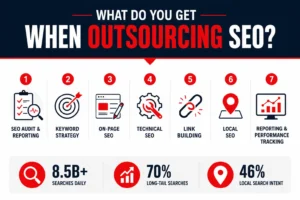
Google now processes over 8.5 billion searches daily, while nearly 60% of searches end without a click.
That is why professional SEO services outsource providers now operate more like integrated growth teams than traditional SEO vendors. Businesses can expect the following:
1. SEO Audits and Reporting
Most SEO outsourcing services begin with a complete website audit because modern SEO problems are often technical before they become content-related.
This usually includes:
- Crawl analysis
- Indexing diagnostics
- Site architecture evaluation
- Core Web Vitals assessment
- Schema validation
- Internal linking audits
- Mobile usability testing
Professional agencies now use enterprise tools like Screaming Frog, Ahrefs, Semrush, and SERP monitoring systems to identify issues impacting visibility.
Businesses can receive organic traffic segmentation, visibility tracking, conversion attribution reports, entity visibility analysis, technical issue monitoring, and SEO forecasting dashboards.
2. Keyword Strategy & Search Intent Research
Keyword research today is no longer limited to finding high-volume search terms. Instead of targeting isolated keywords, businesses now build entire topic clusters and content ecosystems that align with different stages of the customer journey.
This approach improves visibility not just in traditional search results, but also:
- Topical authority structures
- Content hubs
- Multi-stage search funnels
- Long-tail query ecosystems
This matters because nearly 70% of search queries are now long-tail searches, making intent-focused optimization essential for sustainable traffic growth.
A professional keyword strategy usually includes:
- Competitor gap analysis
- Commercial intent mapping
- Transactional keyword identification
- Localized keyword targeting
- AI Overview targeting opportunities
3. On-Page SEO Optimization
On-page SEO optimization focuses on improving individual webpages to make them more relevant, readable, and search engine-friendly.
On-page SEO services generally include:
- Meta title and meta description optimization
- Heading structure refinement (H1, H2, H3 hierarchy)
- Keyword placement and semantic relevance
- NLP-based readability improvements
- Internal linking optimization
- Entity optimization for AI search visibility
- Image alt text optimization
- Content freshness updates
- Bounce rate and engagement optimization
- Conversion-focused page restructuring
- E-E-A-T signal improvements
- FAQ optimization for AI Overviews and featured snippets
4. Technical SEO Optimization
Technical SEO optimization focuses on improving the backend structure and performance of a website so search engines can crawl, render, index, and understand pages more efficiently.
Technical SEO services generally include:
- Core Web Vitals optimization
- Page speed improvements
- Mobile-first optimization
- XML sitemap optimization
- Robots.txt management
- Canonicalization fixes
- Structured data and schema markup implementation
- JavaScript rendering optimization
- Crawl budget management
- Indexation issue resolution
- HTTPS and website security improvements
- Broken link and redirect management
- Log file analysis
- Site architecture optimization
5. Link Building
Authority building remains one of the strongest ranking signals in SEO. That is why many businesses specifically outsource link building to specialized SEO agencies with outreach systems and publisher networks.
Professional backlink services usually include:
- Digital PR campaigns
- Guest posting
- Niche outreach
- Featured.com / earned media pitching
- Editorial backlinks
- Brand mention monitoring
- Toxic backlink cleanup
Studies show that nearly 94–95% of pages online have zero backlinks, making authority acquisition a major competitive advantage.
High-quality backlink strategies now focus more on relevance, topical authority, brand trust, citation consistency, and natural link acquisition, rather than outdated bulk backlink tactics.
6. Local SEO Optimization
Local seo outsource services help businesses gain visibility on Google Maps and improve their presence in location-based search results. These services usually include Google Business Profile optimization, local citation management, review generation strategies, geo-targeted keyword optimization, and NAP (Name, Address, Phone Number) consistency across directories.
This matters because nearly 46% of Google searches now have local intent, making it a necessary revenue driver for regional businesses.
Also Read – Benefits Of Local SEO Outsourcing
7. Reporting and Performance Tracking
Professional SEO outsourcing includes advanced reporting and performance tracking focused on rankings, crawl health, organic conversions, click-through rates, indexation, and AI visibility trends. Agencies typically use tools like Google Analytics 4, Google Search Console, Ahrefs, Semrush, and Looker Studio.
While you get these services in outsourcing, it is also equally important to map out your budget and the average cost of outsourcing in 2026.
What Does Outsourcing SEO Cost in 2026?
The cost to outsource SEO in 2026 varies based on competition level, technical complexity, content requirements, geographic targeting, etc. Prices usually increase based on business size, longevity, the services included, and more.
According to Ahrefs SEO Pricing Survey, 63% of businesses spend between $500 and $5,000 monthly on SEO, while agency retainers average approximately $3,209 per month.
Given that, here is a general price estimation to outsource SEO based on business size:
1. Small Businesses
Small businesses typically spend from several hundred dollars to over $3,000 monthly, depending on scope and competition. Lower pricing generally applies to low-competition local industries with smaller websites.
2. Mid-Size/Growing Businesses
Mid-size companies generally invest between $3,000 and $10,000 per month for ongoing SEO outsource services. At this stage, SEO usually expands beyond basic optimization. Pricing fluctuates heavily based on the number of landing pages, CMS complexity, content velocity, and integration with development teams. Businesses competing in SaaS, legal, finance, or healthcare sectors typically face higher costs.
3. Enterprise Businesses
Enterprise organizations commonly spend $10,000 to $50,000+ per month on advanced SEO outsource services. Large enterprises also invest heavily in SEO software infrastructure, automation systems, and AI visibility monitoring.
While the cost to outsource SEO can heavily fluctuate depending on different factors, it is still more budget-friendly than building an in-house team.
Given that, here is a clear comparison between the two:
4. Cost of In-House vs Outsourcing
|
Expense Category |
In-House SEO Team |
Outsourced SEO Services |
|
SEO Manager Salary |
$81K+ annually |
Included in retainer |
|
SEO Specialist |
$60,000 – $90,000 |
Included in retainer |
|
SEO Tools (Ahrefs, Semrush, Screaming Frog, etc.) |
$100 to $500/month |
Usually included |
|
Technical SEO Support |
Additional developer costs |
Included or partially covered |
|
Training & Hiring Costs |
High recurring cost |
Minimal |
|
Scalability |
Slow hiring cycles |
Faster scaling |
|
AI SEO / GEO Expertise |
Requires additional specialists |
Often already available |
|
Average Annual Cost |
$250k to $500k+ annually |
Varies |
Source: Yahoo Finance, PayScale
Disclaimer – The costs mentioned are just estimations, and the real price may vary based on factors such as complexity, location of service provider, service requirements, tenure, and more.
How to Choose the Right SEO Partner Without Getting Burned?
To choose a reliable SEO partner, here is what you should evaluate:
What to Look For?
Before you outsource SEO, look for agencies that explain strategy, technical priorities, and business impact clearly instead of only discussing rankings.
Strong SEO outsource services usually provide transparent reporting access, clear execution ownership, and realistic timelines based on competition, website condition, and search demand.
Red Flags to Walk Away From
Avoid agencies that guarantee rankings, promise overnight traffic growth, or refuse to explain their optimization methods. Extremely cheap outsource SEO services often depend on automated backlinks, AI-generated spam content, or outdated link-building tactics that can damage domain trust over time.
Another major red flag is reporting focused only on keyword positions instead of conversions, crawlability, search intent alignment, and business impact.
To evaluate their expertise and reliability, here what you can question them before hiring.
Questions to Ask Before You Sign
- How do you prioritize technical SEO, content, and authority-building tasks?
- What KPIs do you use beyond rankings and traffic?
- Who will actually execute the SEO work internally?
- How do you measure ROI from SEO campaigns?
- Will I retain ownership of analytics, CMS, and backlink data?
- How do you adapt SEO strategies for AI search and Google AI Overviews?
- What happens if rankings or traffic decline during the campaign?
- How often will reporting and strategy reviews happen?
How Do You Know If Your Outsourced SEO Is Working?
Many businesses judge SEO performance only by rankings, but modern SEO performance is measured through business-impact metrics and technical search visibility.
The most important metrics to monitor include:
- Organic conversion growth
- Non-branded organic traffic
- Click-through rate (CTR) from search
- Indexed page growth
- Keyword visibility by intent category
- Assisted conversions and revenue attribution
- Core Web Vitals performance
- Crawl errors and indexation health
- Backlink quality and referring domain authority
- Visibility in Google AI Overviews and featured snippets
If these are clear and you still don’t see results, here are some mistakes that you should avoid!
Mistakes to Avoid When Outsourcing SEO Services
1. Hiring Based on Price Alone
Cheap SEO packages usually depend on automated backlinks, AI-generated low-quality content, or outdated ranking tactics. These methods may show short-term ranking movement, but often lead to traffic drops after Google updates.
2. Assuming a “Hands-Off” Approach
SEO agencies still require business inputs such as target audience, conversion goals, service priorities, and brand positioning. Without this information, keyword targeting, content strategy, and landing page optimization often slip away.
3. No Clear Goals or KPIs
Many businesses outsource SEO without defining measurable goals. Tracking only rankings is outdated in 2026. Businesses should define KPIs such as organic conversions, non-brand traffic growth, AI Overview visibility, lead quality, customer acquisition cost (CAC), and local search performance.
4. Lack of Communication
Poor communication creates execution-level SEO issues. Agencies may optimize incorrect pages, implement technical changes without approval, or target low-conversion keywords. This becomes critical in services such as local seo outsource, where approval workflows and brand consistency directly affect performance.
5. Treating SEO as a One-Time Project
SEO requires continuous optimization because search intent, SERP behavior, and ranking systems change constantly. Stopping SEO after initial improvements often results in traffic decline, outdated content, loss of keyword relevance, and reduced authority over time.
6. Ignoring Technical SEO Capabilities
Hire agencies that provide outsource SEO services with technical expertise. This helps avoid issues like crawl inefficiencies, Core Web Vitals failures, indexing errors, JavaScript rendering problems, and broken internal linking structures.
7. Not Reviewing Backlink Acquisition Methods
When businesses outsource backlink building, they often fail to review how links are actually acquired. Spammy guest posts, PBN links, irrelevant directories, or automated outreach can damage domain authority and create long-term ranking risks.
8. Poor Reporting Transparency
Many SEO outsource services provide reports filled with impressions and ranking screenshots without connecting SEO performance to business outcomes. Reporting should include conversion attribution, organic lead growth, indexed page performance, technical issue tracking, and engagement metrics.
Who Can Outsource SEO Services for Their Businesses in 2026?
Businesses that lack an in-house SEO team, technical expertise, or the bandwidth to manage continuous optimization should outsource SEO services in 2026. It is especially beneficial for:
Small business owners or Startups
Small business owners can greatly benefit from outsourcing SEO services. With limited budgets and a lack of expertise in SEO strategies, it’s often challenging to keep up with constantly changing algorithms.
E-commerce store owners
Outsourcing SEO can significantly boost an e-commerce store’s success. The online marketplace is highly competitive, and driving consistent traffic to your store is essential for sales.
Bloggers and influencers
If you’re a blogger or influencer looking to increase organic traffic to your website, outsourcing SEO can be highly beneficial. Limited understanding of SEO best practices and the challenge of balancing content creation with optimization can hinder your growth. Professional SEO services can help you optimize your content, improve your search rankings, and stand out in your niche.
Scaling and large enterprises
Mid and large enterprises, managing a volume of content and web pages, require complete SEO strategies to maintain a competitive edge. Outsourcing SEO ensures consistent efforts across multiple departments and teams.
Local businesses
Local business providers can significantly benefit from outsourced local SEO services. It is particularly important in highly competitive regional markets where visibility directly impacts foot traffic, calls, and conversions. Since local SEO now depends on factors like Google Business Profile optimization, review management, local citations, geo-targeted content, and proximity-based rankings, many businesses struggle to manage it effectively in-house.
Also Read – Common Local SEO Mistakes Small Businesses
Freelancers and consultants
Outsourcing SEO can be a game-changer for freelancers or consultants aiming to attract more clients through organic search. With limited time to manage SEO efforts alongside client work and a lack of advanced SEO skills, outsourcing provides professional SEO services.
The Final Thoughts
SEO in 2026 is no longer just about rankings or backlinks. It now involves technical optimization, search visibility, structured content strategies, authority building, and continuous performance tracking. Businesses that approach SEO strategically rather than tactically are the ones building sustainable organic growth and long-term brand visibility.
If you are planning to outsource SEO services, choosing the right partner becomes critical. Invedus helps businesses scale with dedicated SEO specialists at highly competitive pricing. You can also build a custom marketing team from their custom plans.
Request an SEO audit or consultation today and get started!
Frequently Asked Questions
Why should businesses outsource SEO services in 2026?
Businesses outsource SEO in 2026 to access technical expertise, AI search optimization, faster execution, and scalable SEO systems without investing heavily in internal hiring, tools, and ongoing training.
How much does it cost to outsource SEO services?
The cost to outsource SEO services in 2026 usually ranges from $500 to $15,000+ monthly, depending on business size, competition, technical complexity, and the scope of SEO outsource services required.
What services are included when you outsource SEO?
Professional SEO outsource services usually include technical audits, keyword strategy, content optimization, reporting, AI search optimization, outsource backlink building, local SEO, Core Web Vitals optimization, and performance tracking.
How do I transition from in-house to outsourced SEO?
For many businesses, it is more cost-effective to outsource SEO because agencies provide access to multiple specialists, advanced SEO tools, and scalable workflows, whereas in-house teams often have limited expertise and higher operational costs.
Can startups and small businesses outsource SEO services?
Yes, startups and small businesses should outsource SEO, especially when they lack internal expertise, technical resources, or the budget to build a complete in-house SEO department.
Can outsourcing SEO hurt my website rankings?
Yes, outsourcing SEO can hurt rankings if you hire agencies using spammy backlinks, keyword stuffing, black-hat SEO, or low-quality AI content. Poor SEO practices may trigger Google penalties, reduce trust signals, and damage organic visibility over time.
Can businesses outsource only specific SEO tasks?
Yes, businesses can outsource only specific SEO tasks such as technical SEO, content optimization, keyword research, local SEO, or backlink building. Many companies use task-based SEO outsourcing to access specialized expertise while keeping strategy and brand-focused content managed internally.




Last updated on: May 15, 2026